Your wrists are trying to tell you something. That dull ache after a long session at the keyboard, the tension creeping up your forearms by mid-afternoon — these are signs your setup isn’t working as hard as you are. A good ergonomic keyboard can change that, and it changes it faster than most people expect.
This guide focuses on keyboards that combine ergonomic design with the kind of typing feel that actually helps you go faster and stay sharper. We tested and researched options across different budgets and body types, so whether you type all day for work or grind through long creative sessions, there’s something here for you. You’ll walk away knowing exactly which keyboard fits your needs and why.
The picks below cover split layouts, mechanical switches, adjustable tilt, and posture-friendly builds — everything that makes typing feel like less of a battle and more of a flow.
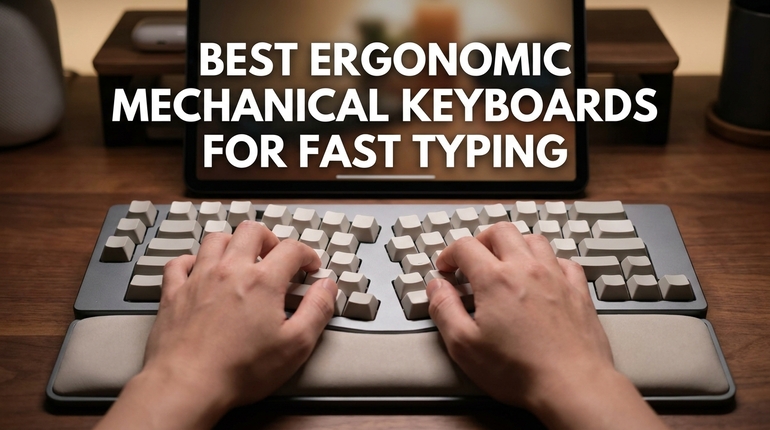
How We Selected the Best Ergonomic Mechanical Keyboards
Our team spent time evaluating keyboards across real-world typing scenarios, comparing how each one performed under the conditions most people actually face: long office hours, data entry, coding sessions, and creative writing sprints. We paid close attention to how each board felt after extended use, not just out of the box.
Here are the factors that shaped our final selections:
- Split or curved key layout: We prioritized keyboards that physically separate or curve the key zones to reduce wrist bending and forearm tension, since that’s the foundation of ergonomic typing.
- Switch type and key travel: The feel underfoot matters. We looked at whether the switches deliver satisfying, accurate feedback without requiring excessive force to actuate.
- Wrist and palm support: Built-in or attachable wrist rests were evaluated for thickness, firmness, and whether they actually hold your hands in a neutral position.
- Adjustable tilt: Keyboards that let you customize the angle of each module or the overall deck give you far more control over your typing posture.
- Build quality and durability: We factored in materials, switch longevity ratings, and long-term performance data from extended use.
- Connectivity and compatibility: Whether wired or wireless, we checked how reliably each keyboard connects across Windows, macOS, and Linux.
- Value for the features offered: We weighed each keyboard’s price against what it actually delivers, rather than letting a high cost stand in for quality.
Every pick on this list earned its place based on genuine performance, not just specs. The reviews ahead reflect what we actually found when we put these keyboards through their paces.
Best Ergonomic Mechanical Keyboards for Fast Typing (2026 Expert Review)
Five keyboards made our final list, and each one stands out in a distinct way. Whether you want a full-featured ergonomic flagship, a budget-friendly workhorse, or a true split for serious posture correction, the options ahead give you a clear path to the right choice.
1. Logitech Ergo K860: The Gold Standard for Comfortable All-Day Typing
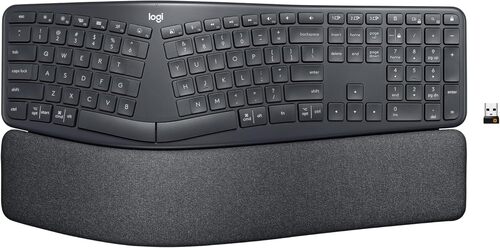
The Logitech Ergo K860 is the keyboard you buy when you’re done compromising. It is certified by United States Ergonomics for improving posture and reducing muscle strain, and that certification reflects a real design commitment. The curved, split keyframe tilts the two key zones apart at an angle that puts your forearms in a far more natural position than a flat keyboard ever could.
The wrist rest here is a genuine standout. Three layers, a stain-resistant fabric exterior, high-density foam for structure, and memory foam underneath for comfort. Logitech claims 54 percent more wrist support compared to a standard keyboard without a palm rest, and we found that figure credible after extended typing sessions. Your palms sit just above the desk level, which keeps tension out of your wrists throughout the day.
What makes the K860 particularly versatile is the adjustable palm lift. Tilt legs at 0, -4, and -7 degrees let you dial in the angle that works best for your desk height and whether you’re seated or standing. The Perfect Stroke keys are gently scooped to match fingertip contours, and they feel precise without being tiring. This keyboard is not mechanical, but the membrane keys deliver a quiet, fluid feel that suits office environments well.
You can connect via Bluetooth to up to three devices or use the USB receiver for a stable wired-style connection. Battery life runs up to two years on a pair of AAA batteries. Plastic components include 71 percent certified post-consumer recycled material, which is a meaningful sustainability step for a product in this category.
Key Specs:
- Layout: Full-size curved split, QWERTY
- Connectivity: Bluetooth, USB receiver (Logi Bolt)
- Tilt adjustment: 0°, -4°, -7° palm lift legs
- Battery life: Up to 24 months (2 AAA)
- Dimensions: 17.95″L x 9.17″W x 1.89″H
- Compatibility: Windows, macOS, Linux, Chrome OS
Pros:
- Three-layer memory foam wrist rest delivers real, sustained comfort
- Adjustable palm lift works equally well for seated and standing desks
- Multi-device Bluetooth plus USB receiver gives flexible connectivity
Cons:
- No backlight, which is a drawback for low-light work environments
- Battery-powered rather than USB rechargeable
2. Redragon K668 RGB: The Budget Mechanical Pick That Punches Well Above Its Price
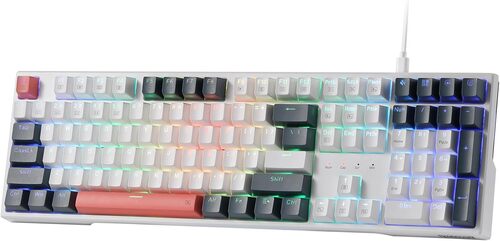
If you want true mechanical switches and vibrant RGB lighting without spending a premium, the Redragon K668 is the keyboard to consider first. It arrives with hot-swappable red linear switches, which means you can pull any switch and replace it without soldering if your preferences change over time. That kind of flexibility is rare at this price point and makes the K668 a long-term investment, not just a starter board.
The full-size 108-key layout includes a number pad plus four additional programmable shortcut keys above it, mapped by default to mute, calculator, screen lock, and desktop. These are genuinely useful additions for productivity. Anti-ghosting across all 104 standard keys means simultaneous keypresses register cleanly, which matters whether you’re typing at speed or using keyboard shortcuts in creative software.
The board ships with two complete sets of keycaps in mixed colors, plus a switch puller and spare switches, giving you immediate customization options right out of the box. Sound-absorbing foam sits beneath the switches and delivers a clear, dampened typing sound that avoids the hollow, echoing clatter common on cheaper boards. The two-stage adjustable feet let you find a comfortable typing angle, and the 3.5mm foam layer noticeably improves acoustics compared to similar boards without it.
RGB customization runs to 19 preset lighting modes controllable directly from the keyboard, with a music sync mode included for desktop ambiance. The Redragon software on their website expands those options further with macro support and full key remapping.
Key Specs:
- Layout: Full-size 108 keys plus 4 hotkeys
- Switches: Hot-swappable red linear (3-pin and 5-pin compatible)
- Connectivity: USB-C wired
- Backlighting: RGB, 19 preset modes
- Weight: 880g
- Dimensions: 17.3″L x 4.7″W
Pros:
- Hot-swappable socket accepts most 3-pin and 5-pin switches on the market
- Ships with two full keycap sets and spare switches for immediate customization
- Sound-absorbing foam improves typing acoustics significantly
Cons:
- No wireless option, wired only
- Some users find the stock keycaps taller than standard profile
3. Perixx PERIBOARD-512B: The Reliable Workhorse for Split Ergonomics on a Budget
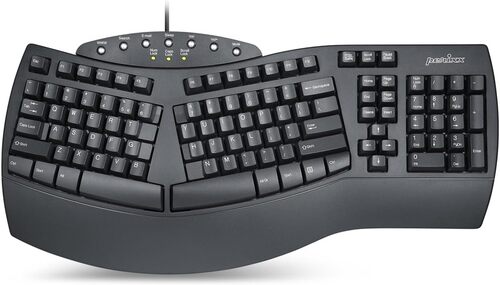
The Perixx PERIBOARD-512B is the keyboard that proves ergonomic design does not have to come with an intimidating price tag. Its one-piece split layout divides the keys into left and right zones, positioning your hands at a natural angle that reduces ulnar deviation, the inward wrist bend that causes long-term strain in flat keyboard users. The stepped, curved key rows add another layer of postural benefit by matching the natural arc your fingers follow when resting.
Build quality impresses for this price tier. The ABS plastic construction feels solid, and the membrane switches are rated to 20 million keystrokes, which is a meaningful durability figure. Key travel sits at 4.2mm with tactile feedback and audible confirmation on each press, giving you a satisfying typing experience that sits somewhere between a standard membrane and a light mechanical switch. Some who have switched from Microsoft’s discontinued ergonomic keyboards have found this to be the closest feel-alike available at a fraction of the cost.
The integrated palm rest is fixed in place, which means the keyboard is one solid piece with no removable components. That keeps the footprint predictable and the setup simple. At just under 2.3 pounds and with a plug-and-play USB connection, there is nothing to configure or install. It works on Windows immediately out of the box.
The full-size layout at 111 keys includes a number pad, and the keycaps use a curved top design with flatter edges that helps fingertips orient to keys naturally. There is a short adjustment period of one to two weeks as your muscle memory adapts to the split layout, but most people find the transition faster than expected. This keyboard is especially well-suited for office professionals, writers, and data entry workers who want ergonomic relief without mechanical complexity.
Key Specs:
- Layout: Full-size split QWERTY, 111 keys
- Connectivity: Wired USB
- Switch type: Membrane, 4.2mm key travel, tactile
- Switch rated lifespan: 20 million keystrokes
- Weight: 2.28 lbs
- Dimensions: 19.09″L x 9.29″W x 1.73″H
Pros:
- Split key layout reduces wrist bending at an accessible price point
- Plug-and-play USB, no drivers or software required
- Curved keycaps with tactile feedback suit long typing sessions well
Cons:
- Wired only, no wireless option
- Can run slightly loud for heavy-handed typists in quiet environments
4. Logitech K845 Mechanical Illuminated: The Precision Typer’s Aluminum Desk Companion
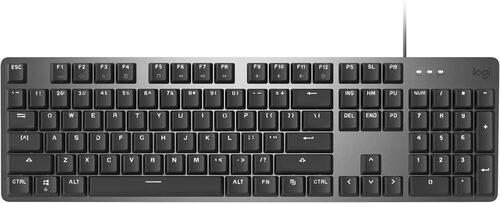
The Logitech K845 takes a different approach from the split ergonomic keyboards on this list. Instead of separating the key zones, it delivers ergonomic comfort through a well-engineered typing angle, mechanical switch precision, and a build quality that makes the keyboard feel like it belongs on a premium desk. The aluminum top case is anodized and noticeably rigid, giving the board a premium feel that plastic keyboards simply cannot match.
Switch selection is the highlight here. You can choose between TTC Red linear, TTC Blue clicky, or TTC Brown tactile variants, and Cherry switch options are also available. Each switch is rated to 50 million clicks, and the molded keycap legends are designed to resist fading over years of heavy use. The curved profile and slim front edge work together with 4-degree and 8-degree tilt legs to position your wrists at an angle that reduces forearm tension during extended sessions. This is ergonomics through geometry rather than layout splitting.
The white backlighting comes in five patterns including reactive, breathing, snake, and random, making it useful for low-light environments without the visual noise of full RGB. The full-size layout retains the number pad, and with 104 keys across a surprisingly compact footprint, it does not sprawl across your desk the way some full-size boards do. Floating keys on an aluminum plate give the board a clean aesthetic that reads as professional rather than gaming-focused.
We found the K845 to be one of the best options for fast typists who want the benefits of mechanical switches and adjustable tilt in a stable, well-built package. It is wired only, which some may see as a limitation, but the USB connection delivers zero-latency input that pure typists tend to prefer.
Key Specs:
- Layout: Full-size, 104 keys, floating key design
- Switches: TTC Red / Blue / Brown or Cherry MX (choice at purchase)
- Switch lifespan: 50 million clicks
- Tilt adjustment: 4° and 8° tilt legs
- Top case material: Anodized aluminum
- Connectivity: Wired USB
Pros:
- Anodized aluminum top case delivers durability and a premium feel
- Wide switch choice lets you match key feedback to your typing style
- Five white backlighting patterns suit low-light productivity work
Cons:
- No wireless connectivity
- Backlight LEDs have a reported lifespan of approximately four years before some begin to dim
5. KINESIS Freestyle2: The True Split Keyboard for Serious Posture Correction
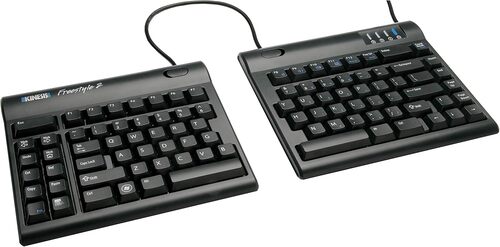
The KINESIS Freestyle2 takes the split keyboard concept further than any other option on this list. Instead of angling two halves within a single housing, it separates them into two completely independent modules connected by a flexible pivot tether. The standard configuration allows up to 9 inches of separation, while the 20-inch variant gives users with broader shoulders the room to position each half closer to shoulder width. That kind of true separation is what allows your arms to hang naturally from your shoulders rather than pressing inward toward the center of your body.
This design principle matters most for people who experience tension in their shoulders, upper back, or forearms. Placing the modules at shoulder width removes the constant inward rotation of the forearms that a centralized keyboard forces on you all day. Many people who have switched to the Freestyle2 report reduced or eliminated wrist, shoulder, and tension headache pain within weeks of consistent use, particularly when pairing it with the optional VIP3 tenting accessory that adds palm rests and multi-angle tilt.
The Freestyle2 uses low-force membrane switches with a tactile bump, producing less noise than most mechanical boards while still giving you a reliable sense of actuation. Key travel is modest, and the force required to register a keypress is low enough to reduce finger fatigue over long sessions. A standard Windows layout comes built in, with hotkeys for Cut, Copy, Paste, Undo, Select All, and media controls accessible without any software installation. It is fully plug-and-play for Windows, Linux, and Chrome OS.
There is no backlight on this model, and the tenting accessory is sold separately, which adds to the total cost if you want the full ergonomic setup. The num lock and function key behavior can feel slightly unusual to new users, though most adapt within a week. For touch typists dealing with real discomfort from conventional keyboards, the Freestyle2 is one of the most clinically deliberate options available in this price range.
Key Specs:
- Layout: Split, full-size QWERTY with embedded 10-key
- Separation: Up to 9″ (20″ version available separately)
- Connectivity: Wired USB
- Switch type: Low-force membrane, tactile
- Compatibility: Windows 7-10, Linux, Chrome OS
- Dimensions: 15.94″L x 9.25″W x 1.26″H
Pros:
- True independent module separation up to 9″ (or 20″) for real shoulder-width positioning
- Built-in shortcut keys for Cut, Copy, Paste, and Undo on the left module
- Plug-and-play setup with no drivers or software needed
Cons:
- No backlighting
- Tenting accessory required for the best ergonomic angle, sold separately at extra cost
Best Ergonomic Mechanical Keyboards for Fast Typing: A Quick Rundown
- Logitech Ergo K860: Best overall for all-day comfort with its certified ergonomic design and memory foam wrist rest
- Redragon K668 RGB: Best value mechanical keyboard with hot-swappable switches, RGB, and two keycap sets
- Perixx PERIBOARD-512B: Best budget split ergonomic keyboard for office and data entry use
- Logitech K845 Mechanical Illuminated: Best for fast typists who want mechanical precision in an aluminum build
- KINESIS Freestyle2: Best true split keyboard for correcting posture and shoulder-width typing
Final Thoughts
The right ergonomic keyboard comes down to understanding your own pain points. If your wrists carry the most tension, a curved split layout with a wrist rest will deliver the biggest improvement. If your shoulders and upper back feel the strain, a true separation design gives you the space to open your posture and type with your arms in a natural position. And if tactile feedback and typing speed are the priority, mechanical switches with an adjustable tilt angle will make every keystroke feel more deliberate and controlled.
Pick based on how you actually type and where your body feels it most. A keyboard you use comfortably for years is worth far more than one that looks impressive but gets swapped out in a month. Trust what your posture needs, not just what the spec sheet says.
Be First to Comment