Large companies rarely succeed for over a century without a clear sense of direction. Mission and vision statements distill that direction into words that guide every product launch, marketing campaign, and strategic choice. When a brand like L’Oréal operates in 150 countries and serves billions of customers, those few sentences carry enormous weight. They tell employees why they come to work. They signal to customers what the brand truly values. And they set a public benchmark against which the company can be measured.
L’Oréal’s official mission is: “To offer each and every person around the world the best of beauty in terms of quality, efficacy, safety, sincerity and responsibility to satisfy all beauty needs and desires in their infinite diversity.” The company does not publish a standalone vision statement. Instead, its corporate purpose, “Create the beauty that moves the world,” serves as the forward-looking aspiration that defines where the group wants to go. Together, these statements reveal a beauty leader that wants to innovate responsibly, include everyone, and shape culture rather than simply sell products.
What follows unpacks each statement in detail. You will see how the mission defines L’Oréal’s everyday commitment, how the purpose statement points toward a bigger future, and how the brand’s six core values connect the two. You will also find real examples of those statements in action and practical lessons you can apply to your own company’s strategy.
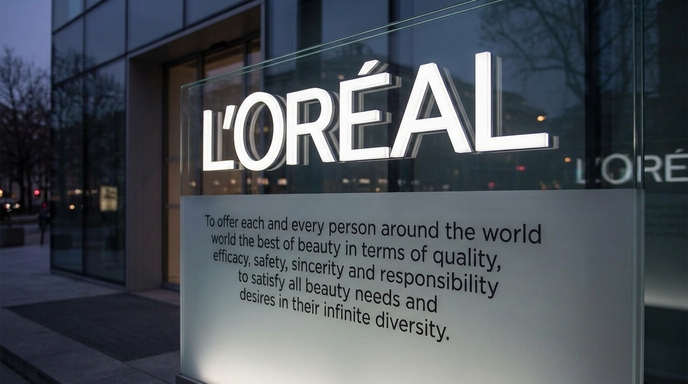
What Is L’Oréal’s Mission Statement?
To offer each and every person around the world the best of beauty in terms of quality, efficacy, safety, sincerity and responsibility to satisfy all beauty needs and desires in their infinite diversity.
This single sentence packs in a lot. It names the audience (every person, everywhere), the standard (the best), the guardrails (quality, efficacy, safety, sincerity, responsibility), and the ultimate goal (satisfy all beauty needs and desires in all their diversity). Notice the scope. L’Oréal does not limit itself to women. It does not limit itself to luxury customers. The phrase “each and every person” is deliberately expansive. The mission covers mass-market drugstore products and high-end luxury creams under the same promise.
The words “sincerity” and “responsibility” are relatively recent additions. They signal a shift from a pure performance promise toward ethical accountability. When the company says it will offer the best beauty with sincerity, it means transparency in product claims. When it says responsibility, it nods to environmental and social obligations. The closing phrase, “infinite diversity,” reflects a strategic commitment to serve all skin tones, hair types, cultural beauty ideals, and gender expressions. That makes the mission both a quality pledge and an inclusivity pledge, rolled into one.
What Is L’Oréal’s Vision Statement?
L’Oréal does not issue a separate vision statement. Instead, the group articulates its long-term ambition through a corporate purpose. That purpose is:
Create the beauty that moves the world.
Short as it is, this statement operates exactly as a vision. It is future-focused. It declares intent to shape global beauty culture, not just respond to it. “Create” puts the company in an active, inventive role. “Moves the world” implies emotional impact, cultural relevance, and broad influence. The purpose does not specify a target market or a product category. It reaches beyond cosmetics to suggest that beauty can drive social change, boost self-esteem, and connect communities. In strategic documents and annual reports, L’Oréal uses this purpose to frame its 2030 sustainability targets, diversity pledges, and digital transformation goals.
For customers, the purpose signals that the brand wants to be part of something larger than a transaction. For employees, it offers a shared direction that can motivate innovation beyond quarterly sales targets. And for the market, it positions L’Oréal as a cultural force rather than a simple manufacturer.
101 Mission Statements is for you if:
- You’re a leader or entrepreneur needing a clear, inspiring statement of intent for your business or nonprofit.
- You want your team and clients aligned with a shared vision of excellence and long-term goals.
- You need a step-by-step guide to craft a customized mission statement that acts as a blueprint for future success.
What Is L’Oréal’s Purpose Statement?
L’Oréal formalized its corporate purpose in 2020, and it now sits at the center of the company’s identity. The purpose statement is:
Create the beauty that moves the world.
This is the same phrase introduced above as the directional statement. It deserves its own section because the company treats it as a distinct element alongside the mission. The purpose answers the question, “Why does L’Oréal exist beyond making money?” The answer is that it exists to use beauty as a positive force. In shareholder communications and on its official website, L’Oréal explains that this purpose rests on three pillars: beauty that is inclusive, beauty that is sustainable, and beauty that is powered by science and technology.
The purpose directly shapes product strategy. For example, it pushes the company to invest in green chemistry and recyclable packaging, because a brand that wants to “move the world” cannot ignore its environmental footprint. It also encourages representation in advertising and product development, because moving the world means moving it for everyone. The purpose influences hiring by attracting talent that wants to work for a company with a clear social role. It influences partnerships, like the long-running L’Oréal-UNESCO For Women in Science programme, which turns the purpose into action by supporting female researchers globally.
Key Differences Between L’Oréal’s Mission and Purpose
Although L’Oréal’s purpose serves as its visionary statement, the company still draws a clear line between its mission and its purpose. The mission describes what the company does and for whom. The purpose declares why that work matters at a societal level. Both are public commitments, but they operate on different time horizons and answer different core questions. The table below maps the distinctions.
| Aspect | Mission Statement | Purpose Statement |
|---|---|---|
| Focus | Product promise and service commitment | Cultural and societal impact |
| Timeframe | Ongoing, day-to-day operations | Long-term, aspirational |
| Primary Audience | Customers and consumers | Society, employees, and stakeholders |
| Core Question Answered | What do we deliver to every person? | Why must our company exist? |
| Purpose | Sets quality and inclusivity standards | Guides strategic direction and inspiration |
These two statements are complementary, not redundant. The mission keeps the company honest about its current commitments. The purpose pulls it forward into new territories. When a product developer wonders whether a new ingredient fits, the mission offers a checklist (is it effective, safe, responsible?). When the executive board debates a long-term investment, the purpose provides the tiebreaker (will this help create beauty that moves the world?). Together they form a decision-making framework that is both practical and ambitious.
Core Values Behind L’Oréal’s Mission and Purpose
L’Oréal’s six core values are the operating system underneath its mission and purpose. Each one directly supports the promises the company makes to the world.
- Passion: This is the emotional fuel. It means L’Oréal hires people who genuinely care about beauty and its power to boost confidence. Passion connects to the mission’s focus on satisfying beauty desires and the purpose’s goal of moving people.
- Innovation: L’Oréal invests heavily in research, filing hundreds of patents each year. Innovation is the engine behind “the best of beauty” in the mission and the creative force implied by “create” in the purpose.
- Entrepreneurial Spirit: Despite its size, the company encourages calculated risk-taking and agility. This value keeps the mission from becoming stale and allows the purpose to adapt to new cultural moments.
- Open-mindedness: This translates into a willingness to listen to diverse consumers worldwide. Open-mindedness makes “infinite diversity” more than a slogan. It demands curiosity about different beauty rituals, skin needs, and cultural norms.
- Quest for Excellence: The mission’s “best” requires a refusal to settle. This value drives product testing, safety protocols, and continuous improvement across all price tiers, not just premium lines.
- Responsibility: This value locks in the ethical dimension of both statements. It covers environmental stewardship, ethical sourcing, and transparent communication. Responsibility ensures that moving the world means moving it in a positive direction.
These six values do not work in isolation. Passion without responsibility can lead to overpromising. Innovation without open-mindedness can miss entire consumer segments. The system works because the values balance and challenge one another, pushing the company to meet both its immediate promises and its long-term vision.
How L’Oréal Lives Its Mission and Purpose
The best way to test any corporate statement is to observe behavior. L’Oréal shows its mission and purpose in several concrete ways.
The iconic tagline “Because you’re worth it” is one of the clearest expressions of the mission in marketing. Introduced in 1973, the line shifted the beauty conversation from product superiority to consumer self-worth. It tells every person that they deserve the best. That aligns tightly with the mission’s promise to serve each and every person and with the purpose’s intent to move the world emotionally.
On the sustainability front, the L’Oréal for the Future program launched in 2020 sets measurable science-based targets. By 2026, the group has already achieved carbon neutrality for all its operated sites, and it is working to transform its full value chain. The mission demands responsibility, and the purpose demands sustainable beauty that can “move the world” without damaging it. These targets prove the statements are not just words.
L’Oréal’s commitment to inclusive beauty appears in product development. The True Match foundation range, for example, grew to offer dozens of shades, and the company uses data from millions of consumers to fill gaps. This directly mirrors the mission’s “infinite diversity” language and the purpose’s call to create beauty that includes everyone. It also shows open-mindedness and entrepreneurial spirit at work, because entering underserved shade segments requires listening and risk-taking.
The L’Oréal-UNESCO For Women in Science initiative, running for over two decades, demonstrates how the purpose can extend beyond cosmetics. By funding and recognizing female researchers, L’Oréal moves the world in a literal sense. It supports scientific breakthroughs and reinforces the idea that beauty and science are connected. This program aligns with responsibility, excellence, and the company’s broader desire to be a positive cultural force.
How L’Oréal’s Mission and Purpose Have Evolved
L’Oréal began in 1909 when a young chemist, Eugène Schueller, formulated a safe hair dye. The company’s early direction was all about product performance and safety. For much of the 20th century, the implicit mission was to be the leader in beauty science. There was no published purpose statement, and the language around serving “all” people did not yet exist.
The shift toward a more inclusive and responsible mission accelerated in the late 20th and early 21st centuries. Acquisitions of diverse brands, a push into emerging markets, and growing public demand for corporate accountability all influenced the wording. The addition of “sincerity” and “responsibility” to the mission and the explicit emphasis on “infinite diversity” reflect lessons learned from sustainability challenges and cultural conversations about representation. L’Oréal recognized that being the biggest beauty company was not enough. It had to set a clear ethical stance.
The formal purpose “Create the beauty that moves the world” arrived in 2020 under CEO Jean-Paul Agon, just as the company deepened its sustainability and digital transformation commitments. This new purpose did not replace the mission. It gave the company a higher-level story. The evolution signals that L’Oréal sees its future not as a portfolio of products, but as a platform for cultural influence. The mission still tells employees what excellence looks like today. The purpose tells everyone where the ship is heading next.
What Your Company Can Learn from L’Oréal’s Statements
L’Oréal’s approach offers useful lessons for any business that wants to sharpen its own guiding statements.
- Separate the “what” from the “why.” L’Oréal keeps its mission concrete (best beauty for everyone) and its purpose aspirational (move the world). Most organizations muddle the two. If your mission statement contains words like “world” and “change” without first defining what you actually do, it loses credibility. Write a mission that describes your daily work with precision. Then write a purpose that explains why that work matters beyond profit.
- Embed values into the language. L’Oréal’s mission is not a generic feel-good sentence. It contains specific quality criteria and ethical commitments that map directly to its core values. When you draft your own statement, make sure every value you claim shows up in the wording. If you say you value sustainability, the mission should mention environmental responsibility. If you say you value inclusivity, the audience language must reflect that.
- Build a bridge between the statement and everyday decisions. L’Oréal connects its purpose to measurable programs like L’Oréal for the Future and to product decisions like foundation shade ranges. A statement that lives only on a website wall is useless. After you write yours, ask: Does this influence hiring criteria? Does it guide supplier choices? If the answer is no, revise until the statement becomes a practical filter for action.
- Let the purpose stretch you without snapping. A purpose like “move the world” is deliberately ambitious. It allows the company to invest in science education and sustainability, areas that go beyond selling shampoo. A good purpose gives your team permission to explore adjacent impact while staying rooted in your core competence. The key is that L’Oréal only ventures into areas where beauty and science genuinely connect. Your purpose should open doors, not lead you into random territory.
Frequently Asked Questions
Q: What is L’Oréal’s current mission statement?
A: L’Oréal’s mission is to offer each and every person around the world the best of beauty in terms of quality, efficacy, safety, sincerity and responsibility, satisfying all beauty needs and desires in their infinite diversity.
Q: What is L’Oréal’s vision for the future?
A: L’Oréal does not publish a separate vision statement. Its corporate purpose, “Create the beauty that moves the world,” functions as the company’s forward-looking aspirational statement, guiding long-term strategy and sustainability goals.
Q: Does L’Oréal have a separate tagline from its mission statement?
A: Yes. The famous tagline “Because you’re worth it” is a consumer-facing expression of the brand’s belief in self-worth. It supports the mission but is not a substitute for the formal mission statement.
Q: How does L’Oréal’s mission statement reflect its brand identity?
A: The mission emphasizes quality, safety, inclusivity, and responsibility. These priorities mirror L’Oréal’s identity as a science-driven, diverse, and ethically aware beauty leader that serves customers across all price points and cultures.
Q: Has L’Oréal’s mission or vision ever changed?
A: The mission has evolved. Early iterations focused on product excellence and innovation alone. Over time, L’Oréal added “sincerity,” “responsibility,” and “infinite diversity” to reflect growing commitments to ethics and inclusion. The purpose statement “Create the beauty that moves the world” was formally adopted in 2020.
Q: What core values guide L’Oréal?
A: L’Oréal operates with six core values: Passion, Innovation, Entrepreneurial Spirit, Open-mindedness, Quest for Excellence, and Responsibility. These values connect the mission’s daily promises to the purpose’s long-term ambition.
Q: How does L’Oréal put its mission into practice?
A: The company puts its mission into practice through inclusive product shade ranges, the “Because you’re worth it” campaign, the L’Oréal for the Future sustainability programme, and initiatives like the L’Oréal-UNESCO For Women in Science partnership that support women researchers worldwide.
Final Thoughts
L’Oréal’s mission and purpose do not simply decorate an annual report. They define a commitment to quality, a promise of inclusivity, and a bold intent to shape the world through beauty. The mission keeps the company accountable to every customer, every day. The purpose pulls it toward a future where beauty is sustainable, diverse, and emotionally powerful. The six core values form the internal culture that makes both possible.
These statements teach that good corporate language is specific enough to guide action and ambitious enough to inspire. They also show that clarity about who you serve and why you exist can differentiate a brand for decades. What do you think of L’Oréal’s purpose-driven approach? Share your perspective in the comments.
101 Mission Statements is for you if:
- You’re a leader or entrepreneur needing a clear, inspiring statement of intent for your business or nonprofit.
- You want your team and clients aligned with a shared vision of excellence and long-term goals.
- You need a step-by-step guide to craft a customized mission statement that acts as a blueprint for future success.
Be First to Comment