A company’s mission and vision statement do more than fill a page on a corporate website. For a business the size of Intel, these few sentences quietly shape how leadership allocates billions of dollars in capital, which markets get pursued, and what kind of culture employees are expected to build.
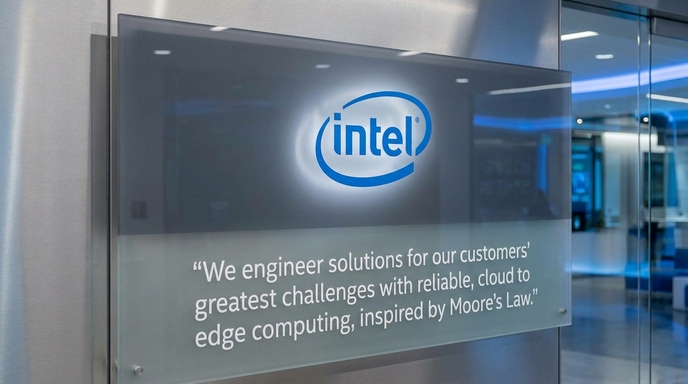
Intel’s official mission statement is “We engineer solutions for our customers’ greatest challenges with reliable, cloud to edge computing, inspired by Moore’s Law.” Its vision statement is “We are on a journey to be the trusted performance leader that unleashes the potential of data.” Together, they describe a company trying to hold onto engineering credibility while chasing a much larger role in the age of artificial intelligence.
Understanding what these statements actually mean, and how they compare to Intel’s separate purpose statement, tells you a lot about where the chipmaker is headed next.
What Is Intel’s Mission Statement?
“We engineer solutions for our customers’ greatest challenges with reliable, cloud to edge computing, inspired by Moore’s Law.”
This mission statement is deliberately broad. There is no mention of processors, laptops, or any specific product line, and that omission is intentional. Intel wants the wording to cover everything from personal computers to data centers to the factories that manufacture chips for other companies.
The phrase “cloud to edge computing” signals who Intel serves: not just consumers buying a new laptop, but enterprises, governments, and developers who need computing power everywhere data is created and used. The reference to Moore’s Law, the observation that transistor density roughly doubles every two years, ties the mission back to Intel’s founding identity as an engineering company built on relentless technical progress.
What Is Intel’s Vision Statement?
“We are on a journey to be the trusted performance leader that unleashes the potential of data.”
Where the mission describes how Intel operates day to day, the vision describes where the company wants to stand in the market. The word “journey” is notable. It frames performance leadership as something Intel is actively working to reclaim rather than something it already holds, an honest admission given the ground Intel has lost to rivals like AMD and Nvidia in recent years.
“Trusted” carries extra weight for a chipmaker that now positions itself as a domestic manufacturing option for governments and corporations concerned about supply chain security. “Unleashes the potential of data” points the company toward artificial intelligence, high performance computing, and the foundry business, areas Intel is betting heavily on for its next chapter.
What Is Intel’s Purpose Statement?
“We create world-changing technology that improves the life of every person on the planet.”
Intel publishes this purpose statement separately from its mission and vision, and it operates at a different altitude. Where the mission explains method and the vision explains market position, the purpose explains why Intel believes it should exist at all.
This is the broadest of the three statements, and it reads more like a philosophy than a strategy. It gives Intel room to justify decisions that do not map neatly to quarterly earnings, such as investments in education, accessibility, and sustainability, by tying them back to a claim about improving life for every person rather than just every customer.
101 Mission Statements is for you if:
- You’re a leader or entrepreneur needing a clear, inspiring statement of intent for your business or nonprofit.
- You want your team and clients aligned with a shared vision of excellence and long-term goals.
- You need a step-by-step guide to craft a customized mission statement that acts as a blueprint for future success.
Key Differences Between Intel’s Mission and Vision
| Category | Mission Statement | Vision Statement |
|---|---|---|
| Focus | How Intel operates and delivers value today | Where Intel intends to stand in the market |
| Timeframe | Present and ongoing | Long term and aspirational |
| Primary Audience | Customers, employees, partners | Investors, industry, employees |
| Core Question Answered | What does Intel do and for whom? | What does Intel want to become? |
| Purpose | Guides daily execution and product strategy | Guides long range strategic bets |
The mission keeps engineers and product teams focused on solving real customer problems right now. The vision gives investors and employees a reason to stay patient through a difficult, multi year turnaround. Neither statement works well without the other.
Core Values Behind Intel’s Mission and Vision
Intel names a specific set of values that it says guide daily decisions and behavior across the company.
Customer First: Every decision is measured against whether it genuinely solves a problem for the people buying Intel’s products, reinforcing the customer language baked into the mission statement.
Fearless Innovation: Employees are expected to take informed risks on new architectures and manufacturing techniques rather than defend the status quo, a value that supports the vision’s push toward reclaimed performance leadership.
Results Driven: Intel emphasizes prioritizing, focusing, and executing with urgency, a direct response to years of missed roadmap targets that damaged trust with customers.
One Intel: The company asks teams across engineering, manufacturing, and sales to act as a single unit rather than compete internally, which matters enormously for a business that both designs and manufactures chips.
Inclusion: Intel states a commitment to building teams where people with different backgrounds can do their best work, connecting to the purpose statement’s claim about improving life for every person.
Integrity: Data driven decisions, intellectual honesty, and accountability to long term stakeholder value round out the list, grounding the more aspirational language elsewhere in something measurable.
These values are not independent slogans. Customer First and Results Driven exist to keep the mission grounded in daily execution, while Fearless Innovation and One Intel exist to make the longer term vision achievable.
How Intel Lives Its Mission and Vision
Intel’s IDM 2.0 strategy, which combines internal chip design with an external foundry business serving other companies, is a direct expression of the vision to become a trusted performance leader. By manufacturing chips for outside customers on advanced nodes like 18A, Intel is betting that trust and reliability can become a competitive advantage on their own.
The company’s multi billion dollar fabrication investments in Ohio, Arizona, and Germany reflect the “reliable” language in the mission statement, framed publicly as a way to strengthen supply chain resilience for customers who do not want manufacturing concentrated in one region.
Intel’s push into AI PCs, including its Core Ultra processor line, shows the mission’s cloud to edge language in practice. Rather than treating AI as something that only happens in data centers, Intel positions personal devices as part of the same computing continuum described in its mission.
The Intel Foundation and the company’s RISE sustainability commitments, including targets for renewable electricity and net zero emissions, connect back to the purpose statement’s claim about improving life beyond the immediate customer base.
How Intel’s Mission and Vision Have Evolved
Intel was founded in 1968 by Robert Noyce and Gordon Moore, initially built around memory chips before pivoting toward microprocessors in the early 1970s. For much of its history, Intel’s identity centered on being the dominant maker of the chip inside personal computers, cemented by the “Intel Inside” branding campaign of the 1990s.
That PC centered identity started to shift meaningfully around the mid 2010s, as smartphones cut into PC demand and cloud computing created new opportunities in data centers. The current mission’s focus on “cloud to edge computing” reflects that pivot away from a single product category.
The most recent shift has been organizational as much as rhetorical. Since Lip-Bu Tan became chief executive in March 2025, Intel has emphasized disciplined execution and rebuilding customer trust alongside the existing mission and vision language, a sign that even well written statements mean little without consistent delivery behind them.
What Your Company Can Learn from Intel’s Statements
Intel’s approach to mission, vision, and purpose offers a few practical lessons for anyone writing or revising their own.
Separate the “how” from the “want to become.” Intel’s mission describes present day operations while its vision describes future ambition. Many companies blur the two into one vague paragraph, which makes both statements less useful for guiding decisions.
Admit where you stand. The word “journey” in Intel’s vision statement is an unusually honest touch for a corporate document. It signals aspiration without pretending the goal has already been reached.
A few more points worth taking from this:
Write for decisions, not marketing. A mission statement should help an employee decide what to prioritize this quarter, not just sound good on a careers page.
Let the purpose statement carry the emotional weight. Intel keeps its purpose broad while keeping the mission and vision closer to business reality, so each statement does its job without one undercutting the other.
Revisit statements when the business changes. Intel’s mission changed meaningfully once its business moved beyond PCs. Statements written for a company’s first decade rarely fit its third or fourth.
Frequently Asked Questions
Q: What is Intel’s current mission statement? A: Intel’s mission statement is “We engineer solutions for our customers’ greatest challenges with reliable, cloud to edge computing, inspired by Moore’s Law.” It emphasizes broad computing solutions rather than any single product category.
Q: What is Intel’s vision for the future? A: Intel’s vision is “We are on a journey to be the trusted performance leader that unleashes the potential of data,” reflecting its ambition to reclaim performance leadership and grow its foundry and AI businesses.
Q: Does Intel have a purpose statement separate from its mission and vision? A: Yes. Intel’s purpose statement is “We create world-changing technology that improves the life of every person on the planet,” and it operates at a broader, more philosophical level than the mission or vision.
Q: What core values guide Intel? A: Intel names Customer First, Fearless Innovation, Results Driven, One Intel, Inclusion, and Integrity among its core values, which it says shape daily decisions and workplace culture.
Q: Has Intel’s mission or vision statement changed over time? A: Yes. Intel’s identity shifted from a PC centered chipmaker toward a broader cloud to edge computing company over the 2010s, and its current statements reflect that pivot along with its newer foundry ambitions.
Q: How does Intel put its mission into practice? A: Intel points to its IDM 2.0 foundry strategy, major fabrication investments in the United States and Europe, and its AI PC product line as direct examples of the mission and vision in action.
Q: Who founded Intel and when? A: Intel was founded in 1968 by Robert Noyce and Gordon Moore, and it has operated under several strategic identities since, most recently under chief executive Lip-Bu Tan since March 2025.
Final Thoughts
Intel’s mission, vision, and purpose statements work together more cleanly than most corporate trios of this kind. The mission stays grounded in present day engineering work, the vision names an honest and specific market ambition, and the purpose gives the company room to justify decisions that reach beyond quarterly results. Read together, they describe a company trying to rebuild credibility through consistent execution rather than bold claims alone.
What do you think of Intel’s mission and vision? Share your take in the comments below.
101 Mission Statements is for you if:
- You’re a leader or entrepreneur needing a clear, inspiring statement of intent for your business or nonprofit.
- You want your team and clients aligned with a shared vision of excellence and long-term goals.
- You need a step-by-step guide to craft a customized mission statement that acts as a blueprint for future success.
Be First to Comment