Mission and vision statements do more than decorate a company’s website. They tell you how a business sees itself today and where it plans to go. A sharp set of statements can explain a brand’s priorities in seconds. A vague one leaves customers, investors, and employees guessing. For a company as large as Shell, with operations in more than 70 countries and a direct hand in the global energy transition, these guiding words carry real weight.
Shell’s official mission is “to safely market and distribute energy and petrochemical products while offering innovative value-added services.” The company does not publish a standalone vision statement. Instead, its forward direction is captured in the bold target at the heart of its Powering Progress strategy: to become a net-zero emissions energy business by 2050. Alongside both sits a distinct purpose: “to power progress together by providing more and cleaner energy solutions.”
Getting these three elements right matters because they shape decisions from the boardroom to the fuel station forecourt. They tell you why Shell exists, what it does every day, and where it is steering the whole enterprise. The following analysis unpacks each statement, the values behind them, and the real-world actions that bring them to life.
What Is Shell’s Mission Statement?
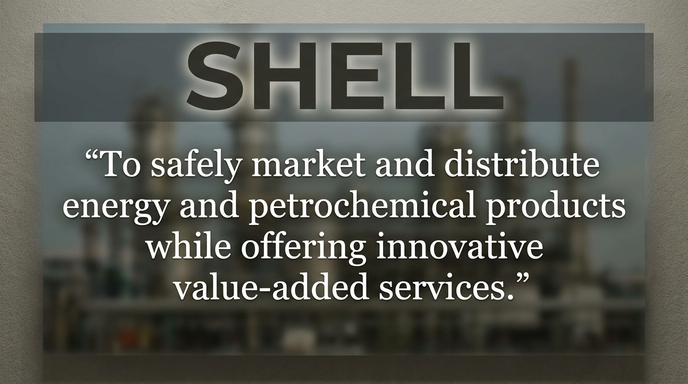
To safely market and distribute energy and petrochemical products while offering innovative value-added services.
This mission statement is tightly focused on operations. It answers the question, “What does Shell do, and how does it do it?” The first word, “safely,” is not accidental. Shell operates in an industry where a single safety failure can have catastrophic consequences. Placing safety at the front signals that operational discipline is the foundation of every business activity.
The core verbs are “market and distribute.” Shell does not frame itself here as an oil company. It defines itself by the service it provides: moving energy and petrochemical products to the people and businesses that need them. The phrase “value-added services” broadens the mission beyond simply selling fuel. It opens the door to everything from loyalty programs and fleet management to renewable power solutions and electric vehicle charging. The mission, in plain language, is about delivering energy reliably, safely, and in smarter ways that add value for customers. It is a practical, ground-level statement that keeps the company focused on execution.
What Is Shell’s Vision Statement?
Shell does not publish a formal, standalone vision statement on its corporate website. Many companies separate a mission (what they do) from a vision (where they are going). Shell chooses instead to embed its long-term ambition directly into its business strategy. The company’s directional statement is its commitment to become a net-zero emissions energy business by 2050, as announced through its Powering Progress strategy.
This target is the clearest signal of Shell’s forward-looking intent. It tells customers, employees, and the market that Shell plans to exist in a fundamentally different energy landscape three decades from now. The vision, even without a labeled “Vision Statement” section, is plain: Shell will transition from a traditional oil and gas producer to an energy company that serves a low-carbon world. For customers, that means a growing range of cleaner products. For employees, it means the skills and technologies of tomorrow will define the company’s future. For the market, it means Shell is betting its long-term relevance on the success of the energy transition. That is a powerful, if not formally packaged, vision.
What Is Shell’s Purpose Statement?
To power progress together by providing more and cleaner energy solutions.
A purpose statement explains why a company exists, beyond making money. Shell’s purpose is about enabling societal progress through energy. The phrase “power progress” is deliberate and double-edged. It ties back to Shell’s history of fueling economic development, while “together” signals partnership with governments, communities, and customers. The company is not claiming it can solve the energy challenge alone.
The real strategic work happens in the words “more and cleaner.” Shell acknowledges that the world needs both abundant energy and a rapid reduction in emissions. The purpose commits the company to growing its energy supply while steadily improving the cleanliness of that supply. This influences product decisions such as expanding liquefied natural gas capacity, investing in solar and wind generation, and building electric vehicle charging networks. The purpose also shapes internal culture. Employees are asked to evaluate every project through the lens of generating more energy with fewer emissions. It is a unifying idea that connects the company’s past as an oil pioneer to its future as a broader energy provider.
101 Mission Statements is for you if:
- You’re a leader or entrepreneur needing a clear, inspiring statement of intent for your business or nonprofit.
- You want your team and clients aligned with a shared vision of excellence and long-term goals.
- You need a step-by-step guide to craft a customized mission statement that acts as a blueprint for future success.
Key Differences Between Shell’s Mission and Vision
The following table compares Shell’s mission with its long-term strategic ambition, which acts as its de facto vision.
| Aspect | Mission | Vision (Strategic Ambition) |
|---|---|---|
| Focus | What Shell does operationally every day | Where Shell is heading long term |
| Timeframe | Present and near term | By 2050 and beyond |
| Primary Audience | Customers, frontline employees, partners | Investors, policymakers, society |
| Core Question Answered | How does Shell deliver value safely? | How will Shell stay relevant in a decarbonizing world? |
| Purpose | Drive daily execution and service quality | Set the course for business transformation |
The mission and vision are distinct but complementary. The mission keeps the company grounded in safe, reliable delivery today. The strategic vision pulls the entire organization toward a destination that will look nothing like its starting point. A company that only focused on the mission would risk becoming obsolete as energy systems change. A company that only chased the long-term vision without operational discipline would lose the cash flow needed to fund the transition. Shell needs both to function.
Core Values Behind Shell’s Mission and Vision
Shell’s core values form the ethical and behavioral foundation for everything the mission and vision demand. The company publishes these values as part of its General Business Principles and Code of Conduct.
Safety: Personal and process safety come first, always. This value directly supports the mission’s opening commitment to operate safely and ensures that the push toward net zero does not create new operational risks.
Honesty: Transparency with stakeholders builds trust. Honest communication about progress, setbacks, and the realistic pace of the energy transition is essential when your purpose involves reshaping a century-old business model.
Integrity: Acting with integrity means making decisions that are ethical and lawful, even when nobody is watching. It connects to the vision by demanding that Shell’s transition efforts are genuine, not just marketing.
Respect for People: Respect covers Shell’s employees, communities, and the broader public. The purpose statement’s emphasis on “together” collapses without this value. Progress must include the well-being of the people affected by Shell’s operations.
These values operate as a system. Safety and integrity prevent corner cutting. Honesty and respect keep the company accountable to the outside world. When the mission pushes for daily results and the vision demands transformative change, the values ensure neither goal is pursued at the expense of people or principles.
How Shell Lives Its Mission and Vision
Real-world behavior is the test of any corporate statement. Shell’s actions offer several examples of the mission and vision in practice.
The expansion of Shell Recharge, the company’s electric vehicle charging network, directly reflects the mission’s call for innovative, value-added services and the vision’s net-zero ambition. By installing fast chargers at retail stations and destinations across Europe, Asia, and North America, Shell is distributing energy in a new way that reduces tailpipe emissions. It is a tangible shift from selling liquid fuel to providing low-carbon mobility.
Shell’s investments in offshore wind, solar parks, and nature-based carbon offset projects are another signal. The company has committed billions of dollars to building a renewable energy portfolio. These projects move the vision from a distant goal to a concrete, capital-intensive reality. They also reshape what “market and distribute” means in the mission. The product mix is evolving from hydrocarbons to electrons and environmental credits.
The Powering Progress strategy itself, launched in 2020, illustrates how the purpose statement drives decision making. Shell set short-term targets to reduce the carbon intensity of its energy products by 6-8% by 2023, 20% by 2030, and 45% by 2035, relative to a 2016 baseline. Publishing measurable, interim milestones makes the purpose “more and cleaner energy solutions” a matter of public accountability rather than vague aspiration. Employees, investors, and campaigners can track whether the company is delivering.
Shell’s approach to partnerships also shows the values in action. The company frequently collaborates with local governments, universities, and technology startups to pilot carbon capture and storage projects or develop sustainable aviation fuel. The “together” in the purpose statement is not decorative. It describes how Shell operates, building coalitions to solve problems no single organization can tackle alone. These partnerships translate the core value of respect for people into cooperative action on the ground.
How Shell’s Mission and Vision Have Evolved
Shell was formed in 1907 through the merger of Royal Dutch Petroleum and Shell Transport and Trading. For most of its history, the company’s identity was inseparable from oil exploration, production, and trading. Its mission, whether stated formally or not, was to find, extract, and sell hydrocarbons at scale. The phrase “safely market and distribute” emerged as a more precise articulation when the downstream business became a major customer-facing force. That operational mission has remained remarkably stable because the core function of delivering energy products safely has not changed.
What has shifted dramatically is the strategic direction. As recently as the early 2010s, Shell’s forward-looking language centered on meeting rising global energy demand primarily through oil and gas. The Paris Agreement in 2015, investor pressure, and changing public expectations accelerated a rethink. Shell’s announcement of a net-zero target in 2020 marked a genuine evolution. The company began to use the language of purpose, supplementing its operational mission with an explicit commitment to cleaner energy. The introduction of the Powering Progress strategy tied executive compensation to carbon reduction targets, embedding the new direction into corporate governance.
This evolution signals that Shell’s priorities have expanded from volume and reliability to include carbon competitiveness. The old mission still holds for the day-to-day business. The new purpose and strategic ambition layer a transformative goal on top of it. The company is navigating a period where both statements must coexist, and that tension defines Shell’s brand in the 2026 energy landscape.
What Your Company Can Learn from Shell’s Statements
Shell’s approach to mission, vision, and purpose offers several practical lessons for any business thinking about its own directional statements.
First, separate daily work from long-term direction if they require different mindsets. Shell’s mission keeps the current business running safely and profitably. Its strategic ambition and purpose reach for a different future. If your company is in a mature industry while trying to pivot, use a tight mission to anchor today’s operations and a bold, measurable target to define tomorrow. Do not mash both into one confusing sentence.
Second, make the purpose specific enough to measure. “Provide more and cleaner energy solutions” is not fluff. Shell tracks the carbon intensity of its energy mix and reports progress publicly. A purpose statement becomes powerful only when you attach metrics to it. If your purpose cannot be measured, it is a slogan, not a strategy.
Third, let values act as guardrails for the transition. Shell’s values of safety, honesty, integrity, and respect are not optional ideals. They are designed to prevent the company from cutting corners in pursuit of either today’s profits or tomorrow’s green credentials. When your business faces conflicting pressures between mission delivery and vision pursuit, your values should make the right path clear.
Frequently Asked Questions
Q: What is Shell’s current mission statement?
A: Shell’s official mission is “to safely market and distribute energy and petrochemical products while offering innovative value-added services.” It focuses on the company’s operational role in delivering energy reliably and safely.
Q: What is Shell’s vision for the future?
A: Shell does not publish a separate vision statement. Its long-term direction is defined by the goal to become a net-zero emissions energy business by 2050, as outlined in the Powering Progress strategy.
Q: Does Shell have a separate tagline from its mission statement?
A: Yes. Shell’s brand tagline, “Powering Progress,” is distinct from its mission. The tagline encapsulates the company’s commitment to advancing life through cleaner energy, while the mission describes its daily operational focus.
Q: How does Shell’s mission statement reflect its brand identity?
A: The mission reflects Shell’s identity as a responsible, customer-facing energy distributor. Emphasizing safety and value-added services positions the brand as reliable and innovative rather than a simple commodity supplier.
Q: Has Shell’s mission or vision ever changed?
A: The operational mission has remained fairly consistent, but the company’s forward direction changed significantly in 2020. Shell moved from a hydrocarbon growth mindset to a net-zero ambition, formalizing its purpose around cleaner energy solutions.
Q: What core values guide Shell?
A: Shell’s core values are Safety, Honesty, Integrity, and Respect for People. These values are embedded in the company’s General Business Principles and influence every aspect of its operations and strategic decisions.
Q: How does Shell put its mission into practice?
A: Shell puts its mission into practice through safe operations, a global fuel and product distribution network, and the rollout of value-added services such as Shell Recharge electric vehicle charging and digital fleet management tools.
Final Thoughts
Shell’s statements reveal a company caught between two worlds. Its mission is the language of an industrial giant, built on safe, efficient distribution of energy products. Its purpose and net-zero ambition are the language of a business trying to reshape itself for a low-carbon era. The core values hold these two forces in productive tension. Safety and integrity keep operations grounded. The purpose and the vision pull the organization forward.
What emerges is a practical model for legacy companies facing disruption. You do not abandon what you do well. You layer a clear, measurable long-term goal on top of it and bind everything together with values that do not bend under pressure. What do you think of Shell’s approach to its mission and vision? Share your perspective in the comments.
101 Mission Statements is for you if:
- You’re a leader or entrepreneur needing a clear, inspiring statement of intent for your business or nonprofit.
- You want your team and clients aligned with a shared vision of excellence and long-term goals.
- You need a step-by-step guide to craft a customized mission statement that acts as a blueprint for future success.
Be First to Comment