A company’s mission and vision do far more than fill space on an investor relations page. They signal what the organization believes it owes the world today and where it intends to be tomorrow. For a global automaker like Volkswagen, whose choices touch millions of drivers, thousands of suppliers, and the environment itself, those signals carry real weight. Getting them right means the difference between a promise kept and a promise broken.
Volkswagen’s official mission is “Shaping mobility for generations to come.” Its vision is to become “the world’s leading provider of sustainable mobility.” Sitting alongside both is a separate purpose statement: “We make the future real.” Taken together, these three pillars capture a company navigating a deliberate shift from volume carmaker to mobility architect.
That shift did not happen by accident. It grew out of one of the most public corporate reckonings in modern business history. Understanding what these statements mean, and how Volkswagen uses them, offers a clear window into the brand’s priorities, its self-image, and the yardstick it now asks the public to measure it by.
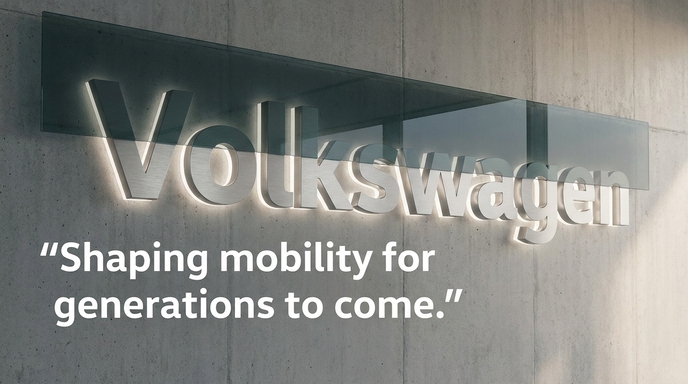
What Is Volkswagen’s Mission Statement?
“Shaping mobility for generations to come.”
The mission statement is disarmingly short. In seven words, Volkswagen declares that its everyday job is not just to sell cars but to actively shape how people and goods will move far into the future. The word “shaping” is the engine here. It implies intention, design work, and a hand on the steering wheel of change rather than a passive reaction to market trends.
The phrase “mobility” is broader than “automobiles.” It opens the door to electric vehicles, software platforms, battery technology, autonomous driving, and mobility services. And “for generations to come” adds a moral weight. It tells employees, suppliers, and customers that Volkswagen’s work must be judged against a long timeline, one that includes people who have not yet been born. This is not a mission about quarterly sales numbers. It is a mission about legacy.
What Is Volkswagen’s Vision Statement?
“We want to become the world’s leading provider of sustainable mobility.”
If the mission describes the work, the vision paints the destination. Volkswagen’s vision is openly ambitious. It wants the top spot, and not in the old metric of units sold, but in something harder to earn: leadership in sustainable mobility. The word “sustainable” does double duty here. It nods to environmental responsibility, but it also suggests a business model that can endure.
This vision makes a promise to three audiences at once. For customers, it means vehicles and services built to last in a carbon-constrained world. For investors, it signals a long-term growth thesis tied to the energy transition. For regulators and communities, it pledges that the company intends to be part of the climate solution rather than a holdout problem. Volkswagen does not publish a separate vision as a standalone corporate slogan. This directional statement, embedded in the Group’s strategy, serves as the north star.
What Is Volkswagen’s Purpose Statement?
“We make the future real.”
Volkswagen’s purpose statement sits a layer deeper than mission or vision. It answers the most basic question any organization can ask: why do we exist? The answer the company landed on is “We make the future real.” That is a striking phrase for a manufacturer. It suggests that the future is not a distant, abstract idea but something that gets built in factories, coded in software labs, and charged at roadside stations.
This purpose gives permission to act. It frames the company’s daily output, from a single stamped body panel to a fleet of battery electric vehicles, as acts of creation that pull tomorrow closer to today. It also serves as an internal cultural anchor. After a period of deep reputational damage, Volkswagen needed a purpose that felt honest, tangible, and forward-looking. “We make the future real” is as much a commitment to rebuilding trust as it is a statement of industrial ambition.
101 Mission Statements is for you if:
- You’re a leader or entrepreneur needing a clear, inspiring statement of intent for your business or nonprofit.
- You want your team and clients aligned with a shared vision of excellence and long-term goals.
- You need a step-by-step guide to craft a customized mission statement that acts as a blueprint for future success.
Key Differences Between Volkswagen’s Mission and Vision
Mission and vision often blur together in corporate writing. Volkswagen keeps them distinct, and the difference matters. The table below breaks down how each statement operates.
| Aspect | Mission | Vision |
|---|---|---|
| Focus | The work Volkswagen does every day. | The future position Volkswagen wants to occupy. |
| Timeframe | Present and ongoing, with a multigenerational horizon. | Long-term destination, still aspirational. |
| Primary Audience | Employees, partners, and customers who interact with the brand now. | Investors, society, and future talent who need to know the end goal. |
| Core Question Answered | What do we do, and for whom? | Where do we want to be? |
| Purpose of the Statement | Guides decisions, product development, and daily behavior. | Inspires, aligns strategy, and signals ambition to the outside world. |
The mission is the engine. The vision is the map. One without the other would leave the company either rudderless or stuck in a day-to-day grind without a clear finish line. Volkswagen designed them to work as a pair.
Core Values Behind Volkswagen’s Mission and Vision
Volkswagen’s corporate values are the behavioral guardrails that turn its mission and vision into action. The Group publicly anchors its culture in a set of principles that connect directly to the promise of shaping sustainable mobility.
Customer Focus: Placing the people who buy and use Volkswagen’s products at the center of every decision, from cabin ergonomics to charging network design. This value ensures the mission serves real lives rather than engineering vanity.
Sustainability: Treating environmental, social, and economic responsibility as non-negotiable design constraints. It is the value that gives the vision’s “sustainable mobility” claim its teeth.
Responsibility: Owning the consequences of the company’s actions, a principle that gained visceral meaning after the 2015 emissions crisis. Responsibility now runs through compliance, product integrity, and community relationships.
Excellence: Committing to high performance in vehicle quality, safety, and manufacturing precision. Without excellence, the ambition to be the leading mobility provider collapses into empty marketing.
Integrity: Acting with honesty and transparency. This value was explicitly strengthened during the cultural rebuild that followed the diesel scandal, and it now underpins the trust required for the vision to be credible.
Innovation: Investing in new technology, battery systems, software defined vehicles, and digital services. Innovation turns the mission’s “shaping” verb into a practical R&D roadmap.
These values do not float in isolation. Customer focus pulls the innovation forward, integrity tempers the pursuit of excellence, and sustainability frames the responsibility. They operate as a system, and Volkswagen’s leadership regularly references them in strategy updates.
How Volkswagen Lives Its Mission and Vision
Statements gain weight only when they show up in real world choices. Volkswagen has tied several visible actions to its mission and vision over the past decade.
The rollout of the ID. family of electric vehicles is the most tangible proof point. Cars like the ID.3 and ID.4 were not niche compliance projects. They were built on a dedicated modular electric platform, signaling a structural bet that the company’s future depends on mainstream zero emission mobility. That move directly translates the vision of sustainable mobility leadership into metal, software, and assembly lines.
Volkswagen’s “Way to Zero” decarbonization program extends the commitment beyond the tailpipe. The company has pledged to become net carbon neutral across its entire fleet lifecycle by 2050, with interim targets set for 2030. This includes transforming factories, greening the supply chain, and supporting battery recycling. It turns the mission’s generational language into a quantifiable, timebound plan.
Massive investment in battery cell production shows the vision in action at the supply level. The Group’s decision to build multiple gigafactories in Europe, including the Salzgitter site, addresses a bottleneck that often stalls electric mobility promises. By controlling more of the battery value chain, Volkswagen aligns its capital allocation with its stated ambition rather than relying solely on external suppliers.
The internal cultural reset known as “Together 2025” and its successor strategies also belong on this list. After the emissions scandal, Volkswagen did not simply update its marketing. It rewired its compliance, audit, and whistleblower systems and placed integrity and responsibility at the center of leadership incentives. The purpose statement “We make the future real” emerged from this period not as a rebranding exercise but as a visible break with a past that had prioritized volume over honesty.
How Volkswagen’s Mission and Vision Have Evolved
Volkswagen’s founding story is inseparable from a single product idea: build a car ordinary people can afford. When the company was established in 1937, its entire purpose was the production of the KdF Wagen, the vehicle that later became the Beetle. The early mission was literal and narrow. It was about democratizing car ownership, nothing more and nothing less.
For decades, Volkswagen operated under a mission statement that reflected its product focused identity: “To offer attractive, safe and environmentally sound vehicles which can compete in an increasingly tough market and set world standards in their respective classes.” That wording survived well into the 2010s. It was a quality and competitiveness pledge, and it said nothing about the company’s larger role in society or the planet.
The diesel emissions crisis of 2015 forced a complete reexamination. Trust collapsed. Regulators fined the company billions. The old mission felt hollow against the scale of the deception. In response, Volkswagen launched its “Together 2025” strategy, which introduced the redefined mission, the new vision, and the purpose statement. The shift from building excellent vehicles to shaping mobility for generations marked a philosophical pivot. The company stopped talking only about the car and started talking about the system the car moves in. That evolution signals a broader reckoning inside the organization. The mission is no longer just about product, and the vision is no longer just about market share. Both are now tied to a promise of accountability that the company knows the public will test at every step.
What Your Company Can Learn from Volkswagen’s Statements
Volkswagen’s layered approach to mission, vision, and purpose offers several practical lessons for leaders building their own strategic statements.
One statement is rarely enough. The company uses three distinct but connected statements because each does a different job. The mission tells the team what to work on today. The vision gives them a destination. The purpose reminds them why any of it matters. Entrepreneurs often try to cram all three jobs into a single sentence, which produces mush. Borrow Volkswagen’s structure and separate the operational, the aspirational, and the existential.
Make the language concrete and testable. “Shaping mobility for generations to come” is open to scrutiny. You can look at Volkswagen’s investment decisions and product lineup and ask whether the company is shaping anything or just reacting. The best mission statements invite that kind of accountability rather than hiding behind vague nouns like “excellence” or “value.” Write your mission so that a stranger could evaluate it against your five year budget.
Align your purpose with your hardest truths. Volkswagen’s purpose “We make the future real” carries meaning precisely because the company had to confront a period when its own actions damaged its future. The purpose did not ignore the crisis. It addressed it by staking a claim on tomorrow. If your organization has a difficult history, a purpose statement that acknowledges forward motion can be more credible than one that pretends the past never happened.
Values must connect to the mission with a specific behavior. It is easy to list “integrity” as a core value. Volkswagen tied integrity directly to the trustworthiness of its sustainability claims and to the compliance architecture it rebuilt after 2015. When you choose your values, explain what each one stops your team from doing or compels them to do, not just what it sounds like.
Frequently Asked Questions
Q: What is Volkswagen’s current mission statement?
A: Volkswagen’s mission statement is “Shaping mobility for generations to come.” It defines the company’s daily work as actively designing the future of transportation, not simply manufacturing vehicles.
Q: What is Volkswagen’s vision for the future?
A: The company’s vision is to become the world’s leading provider of sustainable mobility. This means leading the shift to electric, software driven, and carbon neutral transportation on a global scale.
Q: Does Volkswagen have a separate tagline from its mission statement?
A: Yes. Volkswagen’s long running brand tagline was “Das Auto,” which was retired from widespread use. The current purpose statement “We make the future real” functions as a guiding philosophy but is distinct from the operational mission and the aspirational vision.
Q: How does Volkswagen’s mission statement reflect its brand identity?
A: The mission reflects a brand identity that is moving from pure carmaker to mobility architect. It signals durability, engineering ambition, and a promise to serve not just today’s drivers but future generations as well.
Q: Has Volkswagen’s mission or vision statement ever changed?
A: Yes. Before 2016, the company’s mission centered on offering attractive, safe, and environmentally sound vehicles that set world standards. The emissions scandal triggered a fundamental revision that produced the current mission, vision, and purpose framework.
Q: What core values guide Volkswagen?
A: Volkswagen’s official core values include customer focus, sustainability, responsibility, excellence, integrity, and innovation. These values are designed to translate the mission and vision into concrete employee and leadership behaviors.
Q: How does Volkswagen put its mission into practice?
A: Volkswagen puts its mission into practice through the ID. electric vehicle lineup, the “Way to Zero” decarbonization program, multi billion euro investments in battery gigafactories, and a restructured corporate culture that prioritizes integrity and long term responsibility over short term volume.
Final Thoughts
Volkswagen’s mission, vision, and purpose reveal a company that decided its license to operate had to be re earned. The statements are not merely elegant copy. They are the visible framework of a strategic transformation that touches product, culture, and capital allocation. The mission keeps the organization grounded in the daily work of building mobility solutions. The vision pulls it toward a leadership position defined by sustainability. The purpose anchors both in a reason for existing that tries to turn a difficult past into a more honest future.
For anyone studying how large companies communicate direction, Volkswagen’s three part model is worth close attention. It shows that clarity comes from separation, that ambition must be paired with accountability, and that the right words, backed by the right investments, can help steer a company through a crisis rather than just describe the view after it passes. What do you think of Volkswagen’s redefined mission and purpose? Share your perspective in the comments below.
101 Mission Statements is for you if:
- You’re a leader or entrepreneur needing a clear, inspiring statement of intent for your business or nonprofit.
- You want your team and clients aligned with a shared vision of excellence and long-term goals.
- You need a step-by-step guide to craft a customized mission statement that acts as a blueprint for future success.
Be First to Comment