A clear set of guiding statements can anchor a giant corporation. In the pharmaceutical world, where billions of dollars and millions of lives hang in the balance, those words do real work. The mission and vision statement of Merck distills over a century of science into a promise that reaches patients in more than 140 countries.
Merck’s official mission is “To discover, develop and provide innovative products and services that save and improve lives around the world.” Because the company does not publish a formal vision statement, its corporate purpose fills that forward-looking role. That purpose is “We use the power of leading-edge science to save and improve lives around the world.” Together, these declarations shape strategy, culture, and the daily decisions of over 70,000 employees.
What makes these statements worth studying is how plainly they connect daily work to a global outcome. There is no vague corporate filler. Each sentence declares exactly what Merck does and why. The following breakdown shows how that clarity operates and what any organization can borrow from it.
What Is Merck’s Mission Statement?
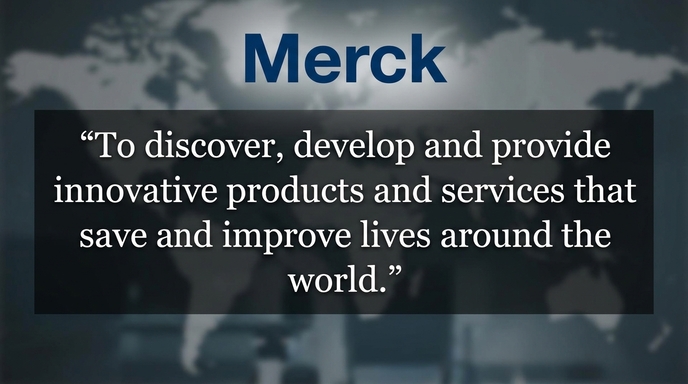
“To discover, develop and provide innovative products and services that save and improve lives around the world.”
This mission is a functional promise. It tells you the three actions Merck performs daily: discover new science, develop it into real treatments, and provide those treatments to people who need them. The phrase “innovative products and services” signals that the company does not deal in me-too solutions. It bets on novel science that changes the standard of care.
The mission’s audience is broad but concrete. It speaks to patients waiting for a vaccine, a physician prescribing a cancer therapy, and a public health official managing an outbreak. Every word connects back to human health. Notice that there is no mention of shareholders, market leadership, or financial returns. The company draws a straight line from its laboratories to a person’s improved life. That single-minded focus is what separates a functional mission from a forgettable one.
What Is Merck’s Vision Statement?
Merck does not publish a separate vision statement on its corporate website. In place of a traditional vision, the company uses its purpose statement to express its long-term ambition and the impact it intends to create.
“We use the power of leading-edge science to save and improve lives around the world.”
This statement answers the question “Where are we headed?” by pointing to an enduring commitment. It is not a distant, dreamy picture. It is a declaration that the engine of progress is science, and the destination is a world where more people live healthier lives. For employees, this frames every project as part of a larger, lasting effort. For patients and partners, it signals that the company’s compass does not reset with quarterly earnings. The intent is permanent.
What Is Merck’s Purpose Statement?
Merck’s purpose is the same statement that guides its forward vision. It is the company’s “why,” and it sits at the center of its identity.
“We use the power of leading-edge science to save and improve lives around the world.”
While the mission describes what Merck does, the purpose explains why the company exists at all. It claims that Merck’s reason for being is not simply to sell medicine, but to unlock the potential of science on a global scale. This language influences product decisions, research priorities, and even the way Merck talks about failure. If an experimental drug does not work, the purpose still stands. The commitment to applying leading-edge science endures beyond any single molecule. It also shapes the company’s approach to access. The phrase “around the world” forces leaders to consider populations that cannot always afford cutting-edge treatments. That tension between commercial reality and global purpose runs through the company’s history and continues to guide its most visible initiatives.
101 Mission Statements is for you if:
- You’re a leader or entrepreneur needing a clear, inspiring statement of intent for your business or nonprofit.
- You want your team and clients aligned with a shared vision of excellence and long-term goals.
- You need a step-by-step guide to craft a customized mission statement that acts as a blueprint for future success.
Key Differences Between Merck’s Mission and Vision
| Aspect | Mission Statement | Vision (Purpose Statement) |
|---|---|---|
| Focus | Daily actions: discover, develop, provide | Enduring reason for being and long-term aspiration |
| Timeframe | Present and near-term | Timeless and forward-looking |
| Primary Audience | Patients, healthcare providers, global communities | Society, humanity, employees, and future generations |
| Core Question Answered | What do we do? | Why do we exist, and where are we going? |
| Purpose | Directs operational behavior and product strategy | Provides a permanent moral and strategic compass |
The mission and purpose do not compete. The mission keeps the organization grounded in execution. The purpose stretches its ambition beyond any single product cycle. One fuels the day. The other fuels the decade.
Core Values Behind Merck’s Mission and Vision
Merck’s stated core values turn the high-level statements into everyday conduct. Each value connects directly to the mission of saving and improving lives.
- Patients First: Every decision, from lab investments to pricing strategies, begins with the question of what serves the patient. This value makes the mission personal, not abstract.
- Ethics & Integrity: The company commits to the highest ethical standards, which protects the trust that the mission requires. Without integrity, the promise of saving lives loses its foundation.
- Innovation: Innovation is the engine that powers the mission’s demand for “innovative products and services.” It rewards rigorous science and the courage to pursue difficult targets.
- Collaboration: Merck works with researchers, governments, and patient groups because no single entity can solve global health challenges alone. Collaboration amplifies the mission’s reach.
- Diversity & Inclusion: A diverse workforce brings the range of thought needed to solve problems that affect all of humanity. This value ensures the mission includes everyone, not just a narrow slice of the world.
These five values form a system. Patients First sets the priority. Ethics & Integrity sets the boundary. Innovation and Collaboration supply the method. Diversity & Inclusion ensures the work remains relevant to a global population.
How Merck Lives Its Mission and Vision
Real-world actions reveal whether a mission statement is a poster or a practice. Merck has several long-running programs that leave little doubt.
The Mectizan Donation Program began in 1987, when the company discovered that its drug ivermectin could prevent river blindness. Merck pledged to donate the medicine to anyone who needed it, for as long as necessary. More than three decades later, the program still delivers treatments in dozens of countries. It is a direct, sustained expression of providing products that save and improve lives without the filter of a profit motive.
Merck for Mothers is a $500 million initiative launched in 2011 to reduce maternal mortality. The program partners with local organizations to improve care during pregnancy and childbirth. It reflects the purpose statement’s global ambition by targeting a cause of death that is both devastating and highly preventable.
During the COVID-19 pandemic, Merck developed molnupiravir and signed voluntary licensing agreements with generic manufacturers to supply the drug in low-income countries. That decision echoed the mission’s “around the world” scope. It also showed how the value of Collaboration operates under pressure.
The company’s internal patient assistance programs help uninsured patients in the United States access Merck medicines for free or at a reduced cost. These efforts make the promise of providing innovative products real for people who might otherwise be left out.
How Merck’s Mission and Vision Have Evolved
Merck’s current mission has not always looked this lean. For decades, the company’s official statement included commitments to shareholders, employees, and superior returns. The older wording spoke of “providing society with superior products and services” and “providing employees with meaningful work” while also aiming for “a superior rate of return” for investors. In the late 2000s, leadership stripped the mission down to its essential patient promise. That shift signaled a strategic choice. Merck decided that a mission crowded with stakeholders would dilute focus. The new statement, introduced around 2009, bet everything on the patient.
The purpose statement entered the picture later as a complement, not a replacement. It gave the company a clearer answer to the “why” question that the mission, which is mostly about “what,” could not fully carry. George W. Merck, the founder’s son, famously said in 1950, “Medicine is for the people. It is not for the profits.” That philosophy had always lived inside the culture. The formal purpose statement gave that philosophy a permanent home in the company’s public language. The arc from a multi-stakeholder mission to a patient-only mission and a science-driven purpose shows a brand learning to say less so that it means more.
What Your Company Can Learn from Merck’s Statements
Merck’s approach offers practical lessons for any business that wants its guiding statements to feel genuine and useful.
- Cut the stakeholder list. The older mission tried to honor everyone. The current one honors the end user. That clarity forces every department to align around a single priority. If your mission statement reads like a compromise between departments, start trimming.
- Let your purpose do the dreaming. Merck does not publish a vision statement because its purpose already stretches far enough. A strong purpose statement can serve as both your “why” and your “where.” Do not add a vision just because a template tells you to.
- Match the language to the action. Merck uses plain, active verbs: discover, develop, provide, use. The words leave no room for confusion about what happens next. Weak statements lean on words like “foster” or “drive.” Strong ones describe observable behavior.
- Prove it with one flagship program. The Mectizan Donation Program is over 35 years old. It is a single, undeniable piece of evidence that the mission is real. You do not need a dozen initiatives. You need one that lasts long enough to become part of your identity.
Frequently Asked Questions
Q: What is Merck’s current mission statement?
A: Merck’s mission is “To discover, develop and provide innovative products and services that save and improve lives around the world.” This statement has guided the company since it was simplified in the late 2000s.
Q: What is Merck’s vision for the future?
A: Merck does not publish a separate vision statement. Its corporate purpose, “We use the power of leading-edge science to save and improve lives around the world,” serves as its long-term directional statement.
Q: Does Merck have a separate tagline from its mission statement?
A: Yes. Merck’s brand tagline is “Inventing for Life.” This tagline captures the company’s inventive spirit and complements the mission and purpose statements without replacing them.
Q: How does Merck’s mission statement reflect its brand identity?
A: The mission focuses entirely on discovering and providing solutions that directly impact patient health. This reinforces Merck’s identity as a science-led company that measures success in lives saved and improved, not just in revenue.
Q: Has Merck’s mission or vision statement ever changed?
A: The mission statement was revised around 2009. The previous version included commitments to shareholders and employees. The current version focuses solely on patient outcomes, which signaled a major strategic and cultural shift.
Q: What core values guide Merck?
A: Merck lists five core values: Patients First, Ethics & Integrity, Innovation, Collaboration, and Diversity & Inclusion. Each value connects directly to the mission of discovering and providing treatments that save and improve lives.
Q: How does Merck put its mission into practice?
A: Merck puts its mission into practice through long-running programs such as the Mectizan Donation Program for river blindness, the Merck for Mothers initiative, and voluntary licensing agreements that expand access to its medicines in low-income countries.
Final Thoughts
Merck’s statements work because they strip away everything except a single, measurable outcome. The mission tells you exactly what the company does each day. The purpose tells you why it will still do it decades from now. Values like Patients First and Ethics & Integrity translate those words into daily decisions that the public can observe and judge.
If your own mission or vision feels cluttered, Merck’s example suggests a simple test. Ask whether every line points to a real action and a real person. When it does, the statement earns its place on the wall and in the strategy.
What do you think of Merck’s mission and purpose? Share your thoughts in the comments below.
101 Mission Statements is for you if:
- You’re a leader or entrepreneur needing a clear, inspiring statement of intent for your business or nonprofit.
- You want your team and clients aligned with a shared vision of excellence and long-term goals.
- You need a step-by-step guide to craft a customized mission statement that acts as a blueprint for future success.
Be First to Comment