A strong mission and vision statement can anchor a global brand. These public commitments tell employees, customers, and investors what the company stands for and where it is headed. For a business as large as McDonald’s, the statements need to be simple enough for a crew member to remember and sharp enough to guide billion-dollar decisions.
McDonald’s serves over 65 million customers every day across more than 100 countries. That kind of scale demands clarity. The company’s current mission is “to be our customers’ favorite place and way to eat and drink.” Its vision, which works as a directional statement for growth, is “to move with velocity to drive profitable growth and become an even better McDonald’s, serving more customers delicious food each day around the world.”
These two sentences do a lot of work. One captures the emotional goal of winning customer loyalty. The other describes a fast, profit-focused path forward. To understand what they really mean, you need to look closely at the words, the values behind them, and the history that shaped them.
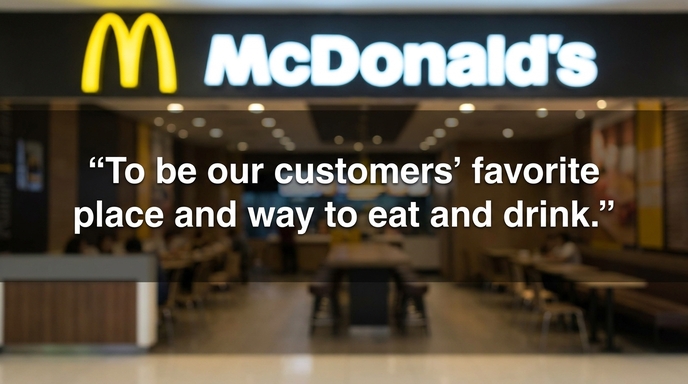
What Is McDonald’s Mission Statement?
To be our customers’ favorite place and way to eat and drink.
This mission statement has been in place since 2018. It is deceptively short, but it reveals several strategic priorities. First, it focuses on being a “favorite,” not necessarily the cheapest or the most upscale. Favorite means top of mind, emotionally chosen, and repeatedly visited. The word “place” points to physical restaurants, the drive-thru, and the dine-in experience. The phrase “way to eat and drink” broadens the lens to all the methods McDonald’s uses to reach customers. It includes takeout, delivery, mobile ordering, and even the drive-thru as a distinct “way.”
The addition of “and drink” in 2018 was a deliberate move. It signaled that McCafé beverages and other drink options were now central to the brand’s identity. No longer just a burger and fries stop, McDonald’s wanted to compete with coffee chains and capture afternoon and evening beverage sales. This small word change reflected a major business shift.
The mission does not mention burgers, speed, or value. That might seem strange for a fast-food icon. But the omission is smart. It keeps the mission flexible as menus and technology change. The core idea stays constant: win the customer’s preference for both location and format. That clarity helps store managers, marketers, and product developers align their daily choices with one simple question. Will this make McDonald’s the customer’s favorite place and way to eat and drink?
101 Mission Statements is for you if:
- You’re a leader or entrepreneur needing a clear, inspiring statement of intent for your business or nonprofit.
- You want your team and clients aligned with a shared vision of excellence and long-term goals.
- You need a step-by-step guide to craft a customized mission statement that acts as a blueprint for future success.
What Is McDonald’s Vision Statement?
McDonald’s does publish a separate vision statement. It comes from the “Accelerating the Arches” growth strategy that the company introduced in 2020 and refreshed in 2023.
To move with velocity to drive profitable growth and become an even better McDonald’s, serving more customers delicious food each day around the world.
This vision is far more action-oriented than the mission. It uses the word “velocity,” which implies both speed and direction. McDonald’s leadership wanted to signal a break from slow, cautious decision-making. The vision sets a high bar: profitable growth, not just growth for its own sake. The phrase “even better McDonald’s” acknowledges that the company is already successful but must keep improving to stay relevant.
The vision also sharpens the focus on food quality with the word “delicious.” That was intentional. For years, McDonald’s had battled perceptions of low-quality food. By putting “delicious” into a public vision statement, the company made a promise it knew customers would hold it to. Finally, “each day around the world” reinforces the global scale and the daily operational reality. A vision is not a dream you visit once a year. It is a daily target.
Together, the mission and vision form a practical pair. The mission defines the emotional win, being the favorite. The vision describes the organizational engine that will get the company there.
The Core Values That Support the Mission and Vision
McDonald’s breaks its values into five straightforward words. Each one acts as a behavioral anchor for employees and franchisees. The company lists them this way.
- Serve: Put customers and people first. Every decision starts with the question of who it serves and how well.
- Inclusion: Open the doors to everyone. McDonald’s hires broadly, serves diverse communities, and aims to make every customer feel welcome.
- Integrity: Do the right thing. This covers ethical sourcing, honest marketing, and transparent business practices.
- Community: Be a good neighbor. Local franchisees are often deeply involved in neighborhood events, youth sports, and charity work through Ronald McDonald House Charities.
- Family: Celebrate family connections. The brand has positioned itself as an affordable, comfortable space for families since the beginning.
These values are not original in the sense that no other company uses them. What makes them effective is how directly they translate into daily operations. A crew member who remembers “Serve” and “Inclusion” can make a fast decision about how to treat a customer without reading a thick policy manual. The values act as guardrails. They keep the mission and vision from becoming empty slogans.
A Brief History of McDonald’s Guiding Statements
The first McDonald’s restaurant opened in 1940 in San Bernardino, California, run by Richard and Maurice McDonald. Ray Kroc joined the story in 1954 and founded McDonald’s Corporation in 1955. The early guiding philosophy was not a polished mission statement. It was the operational formula known as QSC&V: Quality, Service, Cleanliness, and Value. Those four words were more than a motto. They were a checklist that every franchisee had to meet.
For decades, QSC&V functioned as the company’s de facto mission. It told employees exactly what to focus on. The food had to be high quality. The service had to be fast and friendly. The restaurants had to be spotless. The prices had to feel fair. This clear, measurable standard helped McDonald’s grow from a single drive-in to a global chain.
As the company matured, it added more formal mission and vision language. For many years, the mission was a variation of “to be our customers’ favorite place and way to eat.” The company tested additions around health, choice, and community impact. The 2018 update added “and drink,” which aligned with the global push to upgrade coffee and smoothie offerings. The vision evolved more recently. Before “Accelerating the Arches,” McDonald’s often used longer, more generic vision statements. The current vision, introduced in 2020, stripped away corporate jargon. It made speed, profit, and food quality the headline messages.
This evolution shows a pattern. As the business got more complex, the language got simpler. That is the mark of a company that understands the difference between internal strategy documents and the public promises that shape a brand.
How the Mission and Vision Come to Life
Words on a website mean nothing unless they show up in real decisions. McDonald’s has made several visible moves that map directly back to its mission and vision.
The drive-thru and delivery push is a direct expression of “way to eat.” During the pandemic, McDonald’s accelerated digital ordering, curbside pickup, and delivery partnerships. The goal was not just survival. It was to become the favorite way to eat even when the dining room was closed. Sales data showed that customers rewarded that speed. Drive-thru times became a competitive obsession, tying directly to the vision’s call for velocity.
Menu simplification and core item improvements reflect the “delicious food” part of the vision. McDonald’s removed artificial preservatives from Chicken McNuggets, switched to fresh beef for Quarter Pounders in many markets, and improved its buns. These changes cost money and required supply chain coordination. The company made them because the vision demanded an “even better McDonald’s,” not just a bigger one.
The “favorite place” element shows up in store remodels and the experience of the physical restaurant. Many locations now feature self-order kiosks, modern seating, and brighter lighting. The goal is to make the restaurant feel like a place you want to be, not just a place you rush through. Even the design of the iconic red and yellow packaging reinforces that sense of a favorite, familiar treat.
The McCafé brand expansion is the most literal reflection of the “and drink” mission addition. By investing in espresso machines, blended ice drinks, and seasonal beverages, McDonald’s competed for morning and afternoon routines that once belonged exclusively to coffeehouse chains. This move broadened the customer base and increased average check size, directly supporting profitable growth.
These examples share a common thread. Each one can be traced back to a specific word or phrase in the mission or vision. That is the test of a good guiding statement. It should make someone inside the company say, “If we do this, we are living our mission. If we skip that, we are not.”
Mission vs. Vision: A Side-by-Side Comparison
It is easy to blur mission and vision together. The table below breaks down the core differences using McDonald’s actual statements.
| Aspect | Mission Statement | Vision Statement |
|---|---|---|
| What it is | The company’s purpose and daily focus | The company’s aspirational destination |
| Core question | Why do we exist? | Where are we going and how fast? |
| Time horizon | Ongoing, always relevant | Typically targets a multiyear transformation |
| Key words | Favorite, place, way, eat, drink | Velocity, profitable growth, even better, delicious |
| Primary audience | Customers and frontline employees | Investors, leadership, and the broader organization |
| McDonald’s example | Being the favorite place and way to eat and drink | Moving with velocity to drive profitable growth and serve more customers delicious food |
This distinction matters because it prevents confusion. A mission keeps you grounded in today’s promise to the customer. A vision pulls you toward a future state that requires change. McDonald’s needs both. If it only had a mission, it might protect the current experience but miss the need to grow. If it only had a vision, it might chase growth at the expense of the everyday customer relationship.
What You Can Learn From McDonald’s Statements
McDonald’s mission and vision offer practical lessons for students, entrepreneurs, and marketers who are writing their own guiding statements.
First, brevity forces clarity. The mission is 11 words. The vision is 28 words. No one needs a paragraph they have to memorize. Short statements spread faster inside an organization. They fit on training cards, store posters, and the back of a manager’s name tag. When you write your own mission, cut it by half and then cut it again.
Second, leave room for operational change. The mission does not mention a specific menu item or technology. That is intentional. Burgers and kiosks can change. Being the favorite place and way to eat can stay true for decades. A vision should push for a transformation, but a mission should outlast individual product cycles.
Third, use specific, tangible words. “Delicious food” is a plain, everyday phrase. Anyone can understand it and hold the company accountable to it. Avoid jargon and filler. If a word does not paint a picture or set a standard, remove it.
Fourth, align your values so they support the mission. McDonald’s value of “Serve” directly feeds the mission of being a favorite. The value of “Integrity” supports the vision’s call for a better company. When values and mission reinforce each other, you get a consistent culture instead of a mixed message.
Finally, let your statements guide spending. McDonald’s could have invested heavily in any number of side projects. Because the vision emphasizes profitable growth and delicious food, it steers resources toward menu quality and digital speed instead of unrelated ventures. Your own mission and vision should help you say no to good ideas that do not fit.
These public statements are not a side note. They are the strategic engine that keeps a giant organization moving in one direction. McDonald’s did not become the world’s largest fast-food chain by accident. A clear mission to win customer preference and a vision to improve with speed gave the company a decision-making advantage that compounds year after year. The language is simple, but the discipline behind it is rare. That combination is worth studying for anyone who wants to build a brand that lasts.
101 Mission Statements is for you if:
- You’re a leader or entrepreneur needing a clear, inspiring statement of intent for your business or nonprofit.
- You want your team and clients aligned with a shared vision of excellence and long-term goals.
- You need a step-by-step guide to craft a customized mission statement that acts as a blueprint for future success.
Be First to Comment