Energy companies do more than fuel cars and power homes. They shape economies, influence geopolitics, and now sit at the center of the climate conversation. For a company the size of BP, a clear mission, vision and purpose statement is not just corporate decoration. It signals to investors, employees, and the public what the business stands for and where it is heading. When a 100-year-old oil major rewrites those statements, the world pays attention.
BP has done exactly that. In early 2020, under a new chief executive, the company set out a fresh identity. It drew a line between what it does today and the future it wants to build. That shift put words like “reimagining” and “reducing emissions” at the front of its brand. Those words now guide everything from drilling operations to electric vehicle charging networks.
BP’s current mission is: To deliver the energy the world needs while reducing emissions. BP does not publish a separate vision statement. Instead, its purpose is reimagining energy for people and our planet. Both statements work together to define a company in transition. The mission captures present-day responsibility. The purpose reveals a long-term aspiration. The sections that follow unpack exactly what these words mean, how they evolved, and what other businesses can learn from them.
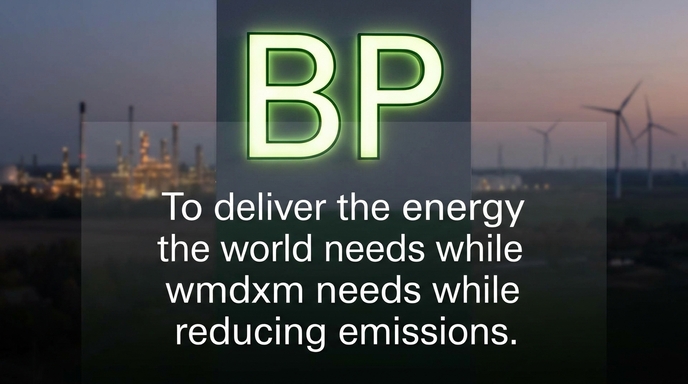
What Is BP’s Mission Statement?
To deliver the energy the world needs while reducing emissions.
This mission statement is refreshingly direct. It does not hide behind jargon. It tells you exactly what BP aims to do right now. The first half, “deliver the energy the world needs,” acknowledges an uncomfortable reality. Society still runs on oil and gas. Homes need heating, planes need fuel, and factories need power. BP accepts its role in keeping that system reliable and affordable today.
The second half, “while reducing emissions,” is the pivot. It injects accountability into the company’s operations. It signals that BP cannot just supply energy. It must supply it with a shrinking carbon footprint. This phrase ties the company’s day-to-day work to the global push for decarbonization. It serves as a constant reminder that business as usual is not the plan. The mission speaks to customers, governments, and partners who are all demanding cleaner energy without sacrificing reliability.
What Is BP’s Vision Statement?
BP does not publish a formal vision statement on its official website. In its place, the company relies on a clear purpose and a set of tangible net zero aims. This absence is not an oversight. It reflects a strategic choice. While many corporations craft a separate vision statement to paint a picture of the distant future, BP embeds that forward-looking ambition directly into its purpose and its 2050 targets.
The company’s public ambition is to become a net zero company by 2050 or sooner, and to help the world get there too. That goal functions as a directional North Star. It tells employees, investors, and the market exactly where BP intends to go. The language in annual reports and strategy updates describes a transition from an international oil company to an integrated energy company. This vision is not locked in a standalone statement. It lives in concrete pledges around renewable energy capacity, methane reduction, and a shrinking oil and gas production base over time. For BP, the vision is measured by milestones, not just words.
What Is BP’s Purpose Statement?
Reimagining energy for people and our planet.
Where the mission focuses on present delivery, the purpose explains why BP exists. “Reimagining” is an active, creative verb. It suggests that the current energy system is not good enough and that BP intends to build something better. The phrase “for people and our planet” broadens the audience. This purpose does not serve shareholders alone. It positions society and the environment as equal beneficiaries.
This purpose statement was introduced in 2020 and marked a sharp break from the company’s earlier identity. It gave employees a reason to come to work that went beyond extracting hydrocarbons. It also became a filter for business decisions. When BP invests in solar farms, hydrogen hubs, or electric vehicle charging, it can point to a purpose that frames those moves as natural extensions of its DNA. The purpose does not describe what BP does. It describes the change BP wants to create.

101 Mission Statements is for you if:
- You’re a leader or entrepreneur needing a clear, inspiring statement of intent for your business or nonprofit.
- You want your team and clients aligned with a shared vision of excellence and long-term goals.
- You need a step-by-step guide to craft a customized mission statement that acts as a blueprint for future success.
Key Differences Between BP’s Mission, Vision, and Purpose
BP separates its mission and purpose clearly, and its net zero ambition fills the role of a vision. Understanding how they differ reveals the logic behind the company’s communication strategy.
| Mission | Vision (Directional Aim) | Purpose | |
|---|---|---|---|
| Focus | Delivering reliable energy and cutting emissions | Becoming a net zero integrated energy company | Transforming the energy system |
| Timeframe | Today and the near future | 2050 and beyond | Ongoing, enduring |
| Primary Audience | Customers, governments, operational partners | Investors, policymakers, society | Employees, communities, all stakeholders |
| Core Question Answered | What do we do? | Where are we going? | Why do we exist? |
| Strategic Role | Guides daily operations and near-term decisions | Sets long-term targets and investment direction | Anchors culture, brand identity, and legacy |
Each element answers a different question. The mission manages the present. The directional aim sets the destination. The purpose provides the motivation. BP has learned that bundling these into a single slogan would confuse audiences. Keeping them distinct but connected allows the company to explain a complex energy transition without losing clarity.
Core Values Behind BP’s Mission and Purpose
BP names five core values that support its mission and purpose. Each one connects directly to the demands of operating safely and responsibly during a major business transformation.
Safety: Operations must protect people and the environment. This value underpins the mission’s promise to deliver energy without harming communities.
Respect: BP commits to listening and responding to the people affected by its work. Respect strengthens the “for people” part of the purpose.
Excellence: The company insists on high standards in every project, from oil platforms to solar installations. Excellence ensures emission reductions are real and measurable.
Courage: Employees are encouraged to speak up and challenge the status quo. Courage makes “reimagining energy” possible, because reinvention requires bold ideas and honest feedback.
One Team: BP prioritizes collaboration across disciplines and geographies. The energy transition demands that engineers, traders, and sustainability experts work as a single unit.
These five values function as a system. Safety and respect guard the company’s license to operate. Excellence and courage fuel innovation. One Team breaks down silos. Together, they create the internal conditions needed to pursue a mission built on contradiction: producing more energy while lowering emissions.
How BP Lives Its Mission and Purpose
BP’s shift into electric vehicle charging is one of the most visible expressions of its mission. Through BP Pulse, the company has installed thousands of charging points across the UK, Europe, and China. This directly delivers energy that customers need while producing zero tailpipe emissions. It also gives BP a foothold in a mobility market that is moving away from gasoline.
The company’s partnership with Lightsource BP shows the purpose in action. Lightsource BP develops utility-scale solar projects around the world. By 2026, it has become one of the largest solar developers outside China. That growth demonstrates a concrete move from an oil-centered portfolio toward reimagined energy infrastructure. BP is not just talking about renewables. It is building them.
On the operational side, BP has set methane intensity targets and installed continuous monitoring at major processing sites. Reducing methane leaks is one of the fastest ways to cut near-term warming. This aligns with the “while reducing emissions” part of the mission and backs the net zero directional aim with hard data. The company also made a headline commitment to cut oil and gas production by 40 percent by 2030 compared to 2019 levels, though that target was later adjusted to a 25 percent reduction to reflect energy security concerns. Even the revised figure signals a structural shift away from its legacy business.
How BP’s Mission and Purpose Have Evolved
BP was founded in 1908 as the Anglo-Persian Oil Company. For most of its first century, the company’s purpose was straightforward: find, extract, and sell oil. That identity began to shift publicly in the year 2000. BP rolled out a new sunburst logo and the tagline “Beyond Petroleum.” It was an early signal that the company wanted to be seen as something broader than an oil producer, even though its business remained heavily weighted toward fossil fuels for the next two decades.
The most significant change came in 2020. Bernard Looney, who took over as chief executive that year, unveiled a new purpose, a new mission, and a net zero ambition. The phrase “reimagining energy” replaced “Beyond Petroleum.” This was not a cosmetic refresh. It was paired with a promise to restructure the company, shrink oil and gas output, and pour billions into low-carbon energy. The move signaled that BP would no longer defend a dual identity. It would actively reshape its business to match its words. The evolution from 1908 to 2026 tells a story of a company slowly, then suddenly, redefining its reason for being.
What Your Company Can Learn from BP’s Statements
BP’s statements offer practical lessons for any organization trying to clarify its own identity.
Separate mission and purpose. BP shows that a mission can describe what you do today, while a purpose explains why you matter. Mixing them often creates a vague, unconvincing paragraph. Keep them distinct, and each one becomes more useful.
Write for the skeptic. BP’s mission works because it admits a hard truth: the world still needs oil and gas. A mission that only sounds sunny will feel fake. Acknowledge reality, then commit to change. That builds credibility faster than inspirational language.
Connect purpose to capital allocation. BP’s purpose would ring hollow if the company did not invest in solar, wind, and EV charging. Every sentence in a purpose statement should point toward a budget line. If your purpose cannot be traced to a spending decision, it is not a strategy.
Let vision live in measurable targets. BP does not have a separate vision statement, but it has a net zero by 2050 goal that everyone can understand. Specific, timebound ambitions often do a better job than poetic vision paragraphs. Consider whether your company needs a vision statement or a clear destination metric.
Frequently Asked Questions
Q: What is BP’s current mission statement?
A: BP’s mission is “to deliver the energy the world needs while reducing emissions.” It balances the company’s role as a reliable energy supplier with its commitment to decarbonization.
Q: Does BP have a separate vision statement?
A: No, BP does not publish a standalone vision statement. Its long-term direction is communicated through its purpose, “reimagining energy for people and our planet,” and its aim to become a net zero company by 2050 or sooner.
Q: What is BP’s purpose statement?
A: BP’s purpose is “reimagining energy for people and our planet.” Introduced in 2020, it frames the company’s existence around transforming the global energy system for the benefit of society and the environment.
Q: How does BP’s mission statement reflect its brand identity?
A: The mission captures BP’s pragmatic, action-oriented brand identity. It acknowledges the continued demand for oil and gas while locking the company into a path of reducing its climate impact.
Q: Has BP’s mission or purpose ever changed?
A: Yes, the most significant change occurred in 2020 when BP replaced the earlier “Beyond Petroleum” tagline with a new purpose and mission. This shift signaled a deeper commitment to the energy transition.
Q: What core values guide BP?
A: BP’s five core values are Safety, Respect, Excellence, Courage, and One Team. These values support safe operations and the cultural change needed to deliver on its mission and purpose.
Q: How does BP put its mission into practice?
A: BP puts its mission into practice by expanding its EV charging network BP Pulse, investing in large-scale solar through Lightsource BP, setting methane reduction targets, and reshaping its portfolio toward lower-carbon energy sources.
Final Thoughts
BP’s mission and purpose tell a clear story of an energy company that has accepted its present reality while betting on a different future. The mission keeps the business honest about what it still is. The purpose points toward what it hopes to become. That tension is not a weakness. It reflects the real challenge every legacy industry faces during a transition.
BP’s statements succeed because they are easy to recall, hard to misinterpret, and tied to measurable action. What do you think of BP’s mission and purpose? Share your perspective on whether the company is moving fast enough to match its words in the comments below.
101 Mission Statements is for you if:
- You’re a leader or entrepreneur needing a clear, inspiring statement of intent for your business or nonprofit.
- You want your team and clients aligned with a shared vision of excellence and long-term goals.
- You need a step-by-step guide to craft a customized mission statement that acts as a blueprint for future success.
Be First to Comment