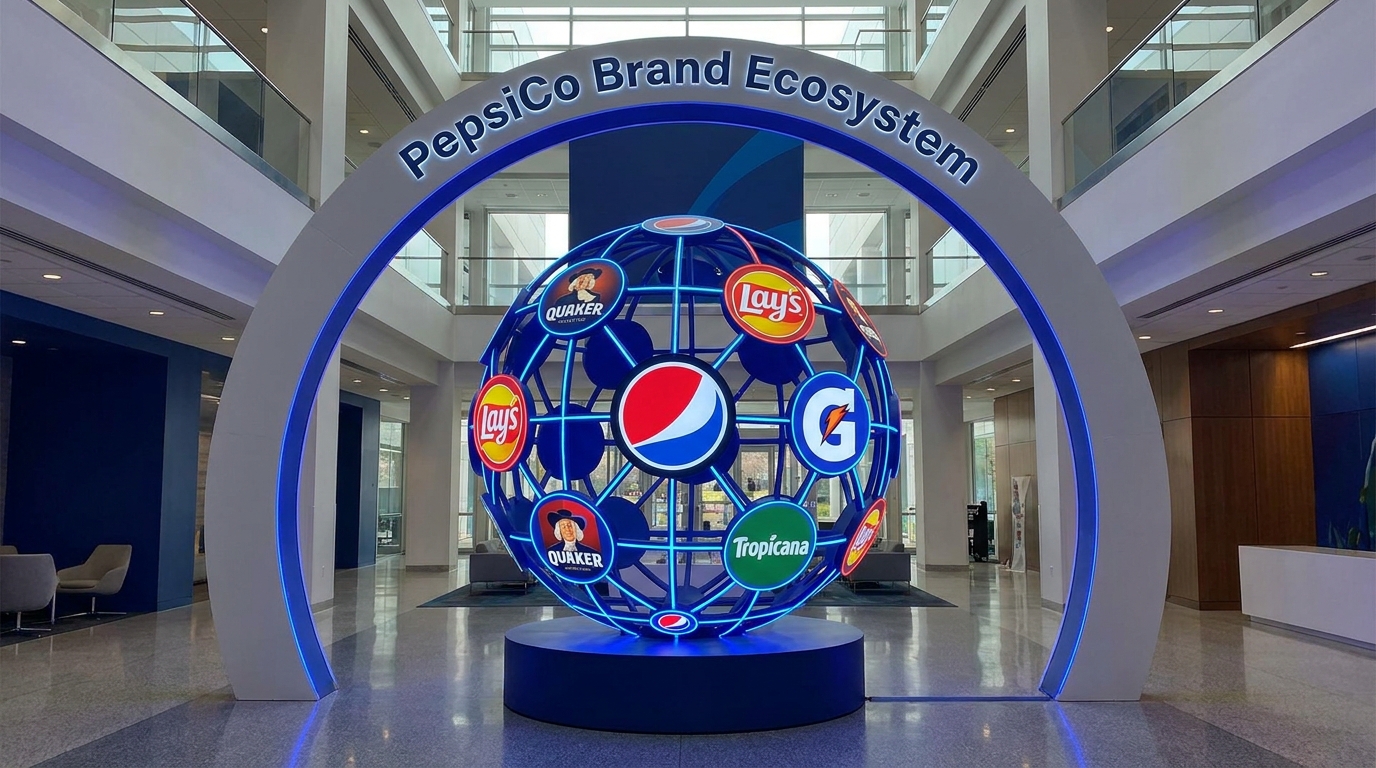
For multinational corporations with hundreds of brands and operations spanning the globe, mission and vision statements do much more than fill a page on a website. They act as the company’s compass, guiding decisions about product development, hiring, sustainability, and community investment. For a brand as large and culturally embedded as PepsiCo, these statements carry an even heavier load. They must balance shareholder expectations with the health and happiness of consumers in over 200 countries.
PepsiCo’s official mission statement is “Create more smiles with every sip and every bite.” Its vision statement is “To Be the Global Leader in Convenient Foods and Beverages by Winning with Purpose.” Understanding these two statements unlocks a clearer picture of how PepsiCo thinks about growth, responsibility, and the everyday moments it wants to own. To see how these guide PepsiCo’s actions, first look at the mission.
What Is PepsiCo’s Mission Statement?
“Create more smiles with every sip and every bite.”
This mission is strikingly short, just nine words. It does not mention beverages or snacks directly, yet every consumer knows exactly what PepsiCo sells. The phrase zeroes in on an emotional outcome rather than a product category. PepsiCo wants to be associated with the positive feelings people get when they enjoy a cold drink on a hot day or share a bag of chips with friends.
“Every sip and every bite” covers the full portfolio, from Pepsi and Mountain Dew to Lay’s and Doritos, without naming a single brand. The verb “create” signals an active role. PepsiCo is not just a manufacturer of food and drinks. It positions itself as a maker of moments and moods.
The mission implicitly promises that PepsiCo will invest in quality, taste, and experiences that spark joy. It serves both customers and the communities where those smiles happen. By centering on the consumer’s emotional payoff, the mission keeps the company focused on what happens after the purchase. That focus shapes product innovation, marketing tone, and even packaging design. At its core, the mission reminds everyone inside and outside the business that PepsiCo exists to make daily life a little more enjoyable.
101 Mission Statements is for you if:
- You’re a leader or entrepreneur needing a clear, inspiring statement of intent for your business or nonprofit.
- You want your team and clients aligned with a shared vision of excellence and long-term goals.
- You need a step-by-step guide to craft a customized mission statement that acts as a blueprint for future success.
What Is PepsiCo’s Vision Statement?
“To Be the Global Leader in Convenient Foods and Beverages by Winning with Purpose.”
PepsiCo does not publish a separate formal purpose statement. Instead, its vision, “Winning with Purpose,” serves as the company’s directional purpose. This vision statement is forward looking and more structurally complex than the mission. It sets two clear goals. First, PepsiCo aims to be the global leader, not just a leader, in its category. That ambition puts it in direct competition with other food and beverage giants.
Second, it introduces the concept of Winning with Purpose, a phrase that has become the company’s strategic mantra. Winning with Purpose means that financial success and social responsibility are not separate tracks. They are interwoven. The vision says that PepsiCo will lead the industry not by cutting corners but by aligning business results with positive outcomes for the planet and society.
The phrase “Convenient Foods and Beverages” also clarifies the company’s operating arena. PepsiCo is not trying to be a full grocery conglomerate. It focuses on ready to eat and ready to drink products that fit modern, fast paced lifestyles. This keeps the vision tightly bound to the company’s identity. The vision is employee facing and investor facing as much as it is consumer facing. It tells the workforce and shareholders that the path to market leadership runs through responsible choices.
Key Differences Between PepsiCo’s Mission and Vision
| Mission | Vision | |
|---|---|---|
| Focus | Emotional outcome (smiles, consumer joy) | Market position and strategic approach (global leadership, purpose) |
| Timeframe | Present, moment-to-moment experiences | Long-term, aspirational future state |
| Primary Audience | Consumers and end users | Employees, investors, and broader stakeholders |
| Core Question Answered | Why does the company exist? | Where is the company heading, and how? |
| Purpose | To define the brand’s daily value to people | To align growth with responsibility and set a competitive ambition |
The mission and vision complement each other neatly. The mission captures the heart, while the vision maps the route. One answers “what do we bring to a person’s life right now,” and the other answers “what kind of company do we intend to be in the long run.” Both are necessary. A mission without a vision can feel aimless. A vision without a mission can feel cold. PepsiCo balances emotional warmth with strategic clarity, making the pair more powerful together than either would be alone.
Core Values Behind PepsiCo’s Mission and Vision
PepsiCo lists six core values that guide its behavior and decision making.
- Act with Integrity: This means being honest, ethical, and transparent in every interaction, from supply chain management to marketing. Integrity builds the trust needed for both the mission’s promise of genuine joy and the vision’s responsible growth.
- Be a Force for Good: PepsiCo commits to using its scale and resources to make a positive difference in communities and the environment. This directly powers the “Purpose” half of the Winning with Purpose vision.
- Empower People: The company aims to create an inclusive workplace where employees can grow and contribute. Empowered people are the ones who turn the mission’s “create more smiles” into real products and campaigns.
- Deliver Results: Results are non-negotiable for a publicly traded company, but the value frames results as a product of doing the right things. It connects to the “Winning” side of the vision, ensuring the company remains competitive.
- Innovate: PepsiCo emphasizes continuous improvement in products, packaging, and processes. Innovation keeps the smiles coming by meeting evolving tastes and expectations while also driving the sustainability breakthroughs the vision demands.
- Care for Customers, Consumers and the World We Live In: This value stretches the company’s concern across all touchpoints. It directly echoes the mission’s consumer smile focus and the vision’s global responsibility.
These values operate as a system. Integrity and caring shape how the company relates to people. Delivering results and innovating keep it competitive. Empowered people and the force for good value turn the mission and vision from words into measurable action.
How PepsiCo Lives Its Mission and Vision
The clearest translation of the vision into action is pep+, PepsiCo Positive, a strategic transformation launched in 2021. pep+ sets concrete targets across three pillars: Positive Agriculture, Positive Value Chain, and Positive Choices. For example, the company aims to spread regenerative farming practices across 7 million acres, roughly equal to its entire agricultural footprint, by 2030. It has also committed to making 100 percent of its packaging recyclable, compostable, or biodegradable and cutting virgin plastic use by 50 percent by 2030. These moves show Winning with Purpose in action. They tie environmental goals to the company’s long term supply chain health.
In 2020, Pepsi, the flagship brand, released a limited edition series of “Smile” cans featuring different smiles to celebrate essential workers. The cans bore no brand name, just a simple smile icon and a message of gratitude. That campaign was a direct expression of the mission “Create more smiles with every sip and every bite.” It turned an everyday product into a small act of recognition, and it generated widespread social sharing. The campaign blurred the line between a consumer good and a gesture of human connection.
PepsiCo’s Food for Good program, run by the PepsiCo Foundation, has delivered more than 200 million meals to children in underserved communities since 2009. The program operates in the United States and expands to other countries during crises. By pairing nutritious meals with the company’s logistics expertise, Food for Good makes the mission tangible for communities that rarely interact with PepsiCo’s commercial brands. It demonstrates that the company’s commitment to smiles extends beyond the checkout aisle.
How PepsiCo’s Mission and Vision Have Evolved
PepsiCo was formed in 1965 through the merger of Pepsi-Cola and Frito-Lay. In its early decades, the company did not promote a short, public facing mission statement the way modern corporations do. For years, a longer corporate mission focused on financial returns, employee growth, and integrity served as the internal compass. That earlier statement described PepsiCo as the world’s premier consumer products company, aiming to produce financial rewards for investors while offering growth opportunities to employees, partners, and communities. It was solid but verbose and centered on the company’s own interests.
A major shift came in 2006 under CEO Indra Nooyi, who introduced Performance with Purpose. This was not a new mission statement but a strategic vision that embedded sustainability, health, and talent development into the business model. Performance with Purpose signaled that PepsiCo would pursue financial results only in ways that also created social value. It guided the acquisition of healthier brands, the reduction of sugar and salt in core products, and ambitious water conservation goals. Then in 2019, under CEO Ramon Laguarta, the company sharpened its language. The mission was simplified to “Create more smiles with every sip and every bite.” The vision became “To Be the Global Leader in Convenient Foods and Beverages by Winning with Purpose.” The change reflected a desire for emotional resonance and a tighter link between purpose and commercial success. The newer statements are shorter, more memorable, and better suited to external communication. They also reframe the company’s role from being a premier company to being a leader by doing good, a subtle but meaningful pivot.
What Your Company Can Learn from PepsiCo’s Statements
PepsiCo’s approach offers several practical lessons for any business crafting its own mission and vision.
Make the mission emotional and concise. PepsiCo’s nine word mission proves that a mission statement does not need to list products or categories. It can capture the outcome you create for customers. A short, emotional mission is easier to remember and more flexible as the company grows. Try distilling your company’s impact into a feeling or a simple benefit, then test whether a 10th grader could repeat it after one reading.
Embed purpose into your vision, not just a separate CSR report. PepsiCo does not treat purpose as a side project. It built “Winning with Purpose” directly into the vision statement. That signals to investors, employees, and customers that responsibility is part of how the company wins, not a trade off. When writing your vision, connect competitive ambition with the broader value you intend to create. A vision that says “we will be number one” feels hollow without a purpose driven method.
Prove your statements with specific, trackable initiatives. The credibility of PepsiCo’s words rests on programs like pep+, the Smile cans campaign, and Food for Good. These are not vague aspirations. They are real, measurable actions that anyone can verify. When you launch or refresh your mission and vision, plan at least three concrete initiatives that will make those words visible within the first year. Then communicate progress openly. Statements without proof quickly become background noise.
Frequently Asked Questions
Q: What is PepsiCo’s current mission statement?
A: PepsiCo’s mission is “Create more smiles with every sip and every bite.” It focuses on the emotional payoff consumers experience when they enjoy the company’s food and beverages.
Q: What is PepsiCo’s vision for the future?
A: PepsiCo’s vision is “To Be the Global Leader in Convenient Foods and Beverages by Winning with Purpose.” It combines the ambition for market leadership with a commitment to responsible and sustainable business practices.
Q: Does PepsiCo have a separate tagline from its mission statement?
A: PepsiCo does not use a single corporate tagline in the way some companies do. The phrase “Winning with Purpose” often functions as a de facto slogan. Individual brands like Pepsi and Lay’s have their own taglines, such as Pepsi’s “That’s What I Like.”
Q: How does PepsiCo’s mission statement reflect its brand identity?
A: The mission captures the essence of PepsiCo’s portfolio as a source of everyday enjoyment. It positions the company as more than a maker of snacks and drinks. It frames the brand identity around the smiles and moments that its products enable.
Q: Has PepsiCo’s mission or vision statement ever changed?
A: Yes. Before 2019, PepsiCo used a longer, more corporate focused mission statement. The vision evolved from “Performance with Purpose” (introduced in 2006) to “Winning with Purpose” in 2019. The current statements are shorter and more consumer facing.
Q: What core values guide PepsiCo?
A: PepsiCo’s six core values are Act with Integrity, Be a Force for Good, Empower People, Deliver Results, Innovate, and Care for Customers, Consumers and the World We Live In. They connect the mission of creating smiles to the vision of winning with purpose.
Wrap-Up
PepsiCo’s mission and vision reveal a company that has learned to pair hard nosed ambition with an emotional core. The mission is disarmingly simple. It does not talk about market share, revenue, or even the products themselves. Instead, it centers on the small, positive human moments the company wants to create. The vision then adds the steel: global leadership, category focus, and a purpose driven path to get there. Together, they show that a company can aim for both profit and joy without contradiction. The six values and real world programs back the words up, turning corporate language into action that customers, employees, and communities can see.
What do you think of PepsiCo’s mission and vision? Share your thoughts in the comments below or explore how other global brands craft their guiding statements.
101 Mission Statements is for you if:
- You’re a leader or entrepreneur needing a clear, inspiring statement of intent for your business or nonprofit.
- You want your team and clients aligned with a shared vision of excellence and long-term goals.
- You need a step-by-step guide to craft a customized mission statement that acts as a blueprint for future success.
Be First to Comment