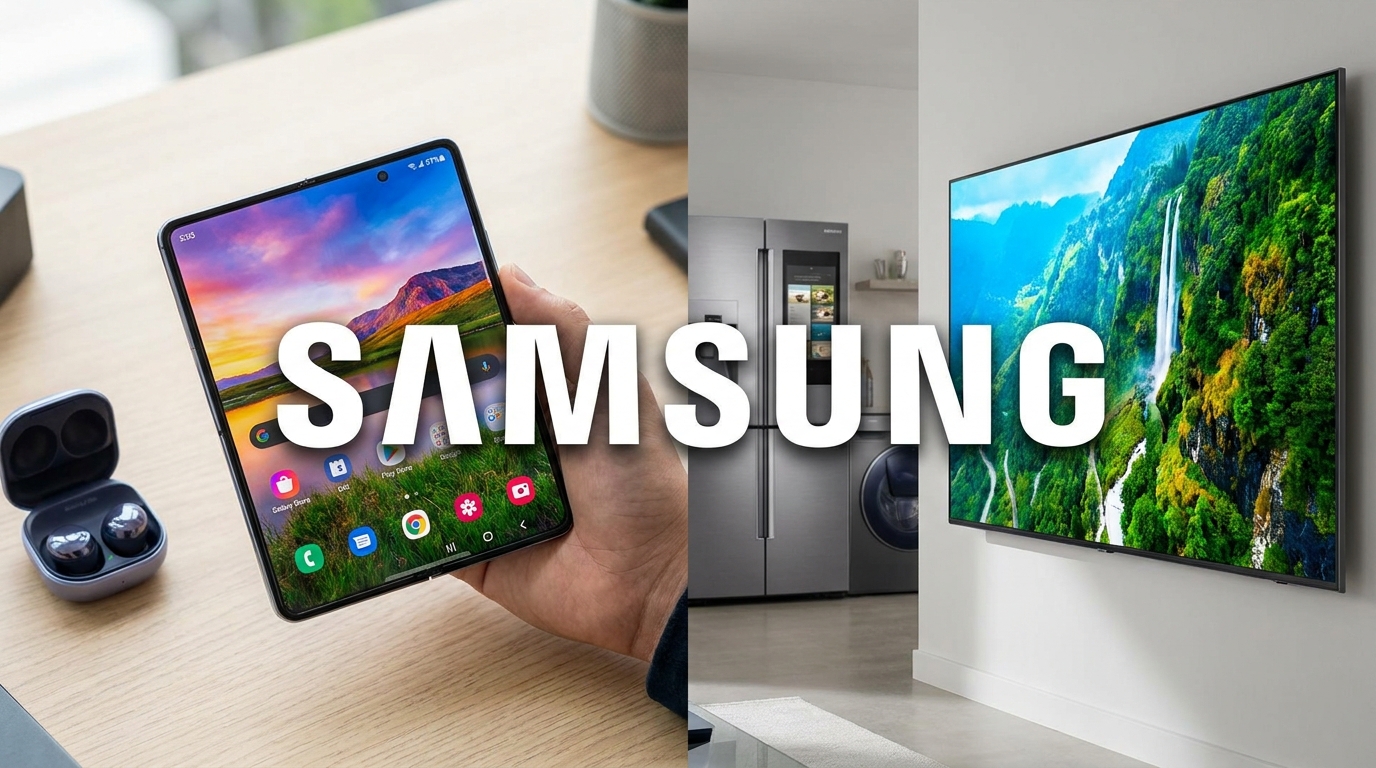
A company that sells over 300 million phones a year, builds skyscrapers, and makes the chips inside your laptop needs a clear sense of direction. Without one, a brand of that size would splinter into a hundred disconnected factories and marketing messages. That is why mission and vision statements matter. They act as a North Star, keeping every division pointed toward the same horizon.
Samsung is not a quiet brand. It competes in consumer electronics, semiconductors, home appliances, and medical devices, all at once. Yet its corporate identity holds together because two statements anchor the entire operation. You can find them on the company’s official philosophy page, and they have remained remarkably consistent even as Samsung’s business transformed.
Samsung’s mission, expressed as a business philosophy, is “to devote our talent and technology to creating superior products and services that contribute to a better global society.” Its vision is “Inspire the World, Create the Future.” These two sentences guide everything from product design to corporate citizenship, and understanding them reveals how Samsung thinks about its place in the world.
What Is Samsung’s Mission Statement?
“We devote our talent and technology to creating superior products and services that contribute to a better global society.”
Samsung calls this its business philosophy, not a mission statement, but the function is identical. It tells employees, partners, and customers why the company gets up in the morning. The wording is deliberate. Talent comes before technology, signaling that people drive innovation. The goal is not just to make good products. It is to make products that improve life at a societal level.
The phrase “better global society” is broad, and that is intentional. Samsung operates in nearly every country on Earth. A narrow mission would exclude entire markets or product categories. Instead, the statement gives the company permission to pursue anything from water purification technology to AI-driven healthcare, as long as the outcome is a measurable improvement for communities. It also sets an ethical expectation. Profit is assumed, but not mentioned. Contribution takes the lead.
This mission also reveals Samsung’s self-image as a responsible industrial citizen. It does not promise to “delight” or “surprise.” It promises devotion and contribution. That is a serious, almost stoic pledge for a company known for flashy Galaxy launches. The language anchors the brand in long-term value creation rather than short-term hype.
101 Mission Statements is for you if:
- You’re a leader or entrepreneur needing a clear, inspiring statement of intent for your business or nonprofit.
- You want your team and clients aligned with a shared vision of excellence and long-term goals.
- You need a step-by-step guide to craft a customized mission statement that acts as a blueprint for future success.
What Is Samsung’s Vision Statement?
“Inspire the World, Create the Future.”
If the mission feels grounded, the vision is deliberately expansive. Samsung introduced this vision in 2010 at the Consumer Electronics Show, and it has not changed since. It is a two-part command. First, inspire the world. That points to products, design, and marketing that spark aspiration. Second, create the future. That speaks to research, technology leadership, and the physical act of inventing what comes next.
The vision does not mention electronics, Korea, or any specific market. It positions Samsung as a global force that shapes how people live decades from now. For employees, the vision is motivational. For customers, it is a promise that Samsung will not just follow trends. It will build them.
A vision this concise carries risk. It could sound like empty corporate poetry. Samsung prevents that by attaching measurable initiatives to the vision, such as sustainability roadmaps, AI investments, and next-generation network leadership. The vision becomes credible only when the company visibly marches toward it, and Samsung has spent billions aligning its R&D pipeline with that future-focused identity.
Key Differences Between Samsung’s Mission and Vision
| Aspect | Mission Statement | Vision Statement |
|---|---|---|
| Focus | Daily operations and product quality | Long-term aspiration and global influence |
| Timeframe | Present and ongoing | Future-oriented, indefinite horizon |
| Primary Audience | Employees, partners, and society | The world at large, future customers |
| Core Question Answered | What do we do and why? | What change do we want to see? |
| Purpose | Guide decision-making and ethical standards | Set direction and stretch ambition |
Both statements support each other. The mission gives the company a practical reason to exist today. The vision gives it a destination. When Samsung debates a new business line, the mission asks whether it contributes to society. The vision asks whether it will inspire and shape the future. Together, they filter out distractions.
Core Values Behind Samsung’s Mission and Vision
Samsung publishes five core values that turn its mission and vision into daily behavior. Each value connects directly to the company’s higher purpose.
-
People: Talent and humanity drive innovation. This mirrors the mission’s opening phrase, “devote our talent,” and puts individuals at the center of corporate success.
-
Excellence: Relentless pursuit of quality and improvement. It directly supports the mission’s goal of “superior products and services.”
-
Change: Willingness to disrupt the status quo. Without change, Samsung cannot “create the future” as its vision demands.
-
Integrity: Operating ethically and transparently. Integrity protects the trust required to contribute to a better global society.
-
Co-prosperity: Shared growth with suppliers, communities, and society. This value embodies the mission’s societal contribution and prevents the vision from becoming self-serving.
These five values operate as a system. People create excellence, change keeps excellence from becoming stale, integrity ensures change does not cut corners, and co-prosperity ensures the benefits of change spread beyond Samsung’s walls. That alignment explains why the company rarely drifts into scandals tied to product quality or labor practices, even at its scale.
How Samsung Lives Its Mission and Vision
Statements mean nothing without action. Samsung proves its mission and vision through several visible commitments that anyone can verify.
The company’s “Solve for Tomorrow” education program, launched in 2010, challenges students to use STEM skills to solve community problems. Samsung has awarded millions of dollars in technology and grants to schools. This directly fulfills the mission’s charge to contribute to a better global society by investing in the next generation of problem solvers.
Product strategy also reflects the vision. The Galaxy Fold series, first released in 2019, was not just a phone. It was a statement about creating the future of mobile computing. Samsung bet heavily on foldable displays years before consumers asked for them, embodying the “create the future” half of its vision even when the initial launch faced challenges.
The “Do What You Can’t” brand campaign translates the vision into an invitation for consumers. It reframes limitations as temporary and aligns with the idea of inspiring the world. The campaign runs across product lines, from wearables to kitchen appliances, unifying disparate categories under one aspirational message.
Sustainability efforts tie directly to the mission. Samsung’s Galaxy for the Planet initiative sets concrete targets for recycled materials, zero-waste packaging, and e-waste reduction. These actions demonstrate what “contribute to a better global society” looks like in practice, moving beyond words into supply chain transformation.
How Samsung’s Mission and Vision Have Evolved
Samsung was founded in 1938 as a trading company in Daegu, Korea. For decades, it had no formal mission statement. The company sold dried fish, noodles, and textiles before entering electronics in the late 1960s. The shift from goods trader to technology manufacturer demanded a new identity.
The clearest articulation of a mission came in 1993, when Chairman Lee Kun-hee launched the “New Management” initiative. Frustrated by quality issues, he famously declared, “Change everything except your wife and children.” Out of that upheaval emerged the business philosophy that still serves as Samsung’s mission: devote talent and technology to superior products that benefit society. That statement has not been rewritten in over three decades.
The vision, however, did change. Before 2010, Samsung’s directional language focused on being a top-tier global company, often measured by market share. The 2010 vision “Inspire the World, Create the Future” represented a strategic pivot. Market share became a result, not the goal. The new vision signaled that Samsung was confident enough in its scale to focus on influence and legacy rather than numerical rankings.
This evolution teaches an important lesson. A mission can stay stable if it captures a timeless organizational purpose. A vision may need to shift when a company outgrows its former ambitions. Samsung’s current vision has lasted over a decade because it set a high bar that technology still has not fully met.
What Your Company Can Learn from Samsung’s Statements
Samsung’s approach to mission and vision offers practical lessons for any brand builder. Here are four takeaways you can apply immediately.
-
Make your mission a filter, not a slogan. Samsung’s philosophy explicitly mentions contribution to society. That wording helps the company decide which projects to greenlight and which to abandon. When you write your mission, test it against a real business decision. If your statement would not influence a hiring choice or a product investment, it is too weak.
-
Write a vision that scares you a little. Samsung’s vision does not say “be a leading electronics brand.” It says inspire the entire world and create the future. That ambition stretches the organization. A safe vision produces safe results. Aim for language that feels slightly uncomfortable given your current size.
-
Tie values directly to your statements. Samsung’s five values are not generic virtues. They explicitly support the mission and vision. Co-prosperity, for example, makes no sense without the mission’s societal contribution. When you list your values, draw a visible line from each one to a phrase in your mission or vision. If you cannot, reconsider whether that value belongs.
-
Prove your statements through visible programs. Samsung does not just claim to contribute to society. It runs educational contests, sets sustainability targets, and publishes progress reports. Your brand should identify two or three signature initiatives that make your mission tangible. Statements without evidence erode trust faster than having no statements at all.
Frequently Asked Questions
Q: What is Samsung’s current mission statement?
A: Samsung’s official mission, published as its business philosophy, is “to devote our talent and technology to creating superior products and services that contribute to a better global society.” It has guided the company since the early 1990s.
Q: What is Samsung’s vision for the future?
A: Samsung’s vision statement is “Inspire the World, Create the Future.” Introduced in 2010, it describes the company’s ambition to lead through innovation and to shape how future generations live and interact with technology.
Q: Does Samsung have a separate tagline from its mission statement?
A: Yes. Samsung uses the tagline “Do What You Can’t” in its consumer marketing. This tagline supports the vision by encouraging people to overcome limitations, but it is not a replacement for the mission or vision.
Q: How does Samsung’s mission statement reflect its brand identity?
A: The mission emphasizes talent, technology, and societal contribution. That identity positions Samsung as more than a gadget maker. It frames the brand as a large-scale problem solver that measures success by impact, not just sales.
Q: Has Samsung’s mission or vision statement ever changed?
A: The mission has remained stable for over 30 years. The vision changed in 2010 from a market-share-focused ambition to the current “Inspire the World, Create the Future.” That shift reflected Samsung’s move from challenger to global leader.
Q: What core values guide Samsung?
A: Samsung’s five core values are People, Excellence, Change, Integrity, and Co-prosperity. They translate the mission and vision into everyday behaviors and decisions.
Q: How does Samsung put its mission into practice?
A: Samsung runs programs like Solve for Tomorrow, invests in sustainable manufacturing through Galaxy for the Planet, and pushes product boundaries with foldable displays. Each initiative connects directly to the mission’s focus on societal contribution and superior products.
Final Thoughts
Samsung’s mission and vision endure because they are simple enough to remember and specific enough to guide choices. The mission grounds the company in an ethical obligation to society. The vision pulls it toward an ambitious, undefined future. Together, they form a leadership framework that has outlasted CEOs, product cycles, and economic downturns.
What you take away from these statements depends on what you are building. If you lead a team, ask yourself whether your mission would survive three decades of change. If you are a marketer, notice how Samsung connects every campaign back to a single idea. And if you are a student of brand strategy, observe the discipline it takes to keep statements alive through action, not repetition. Share your perspective on Samsung’s mission and vision in the comments below.
101 Mission Statements is for you if:
- You’re a leader or entrepreneur needing a clear, inspiring statement of intent for your business or nonprofit.
- You want your team and clients aligned with a shared vision of excellence and long-term goals.
- You need a step-by-step guide to craft a customized mission statement that acts as a blueprint for future success.
Be First to Comment