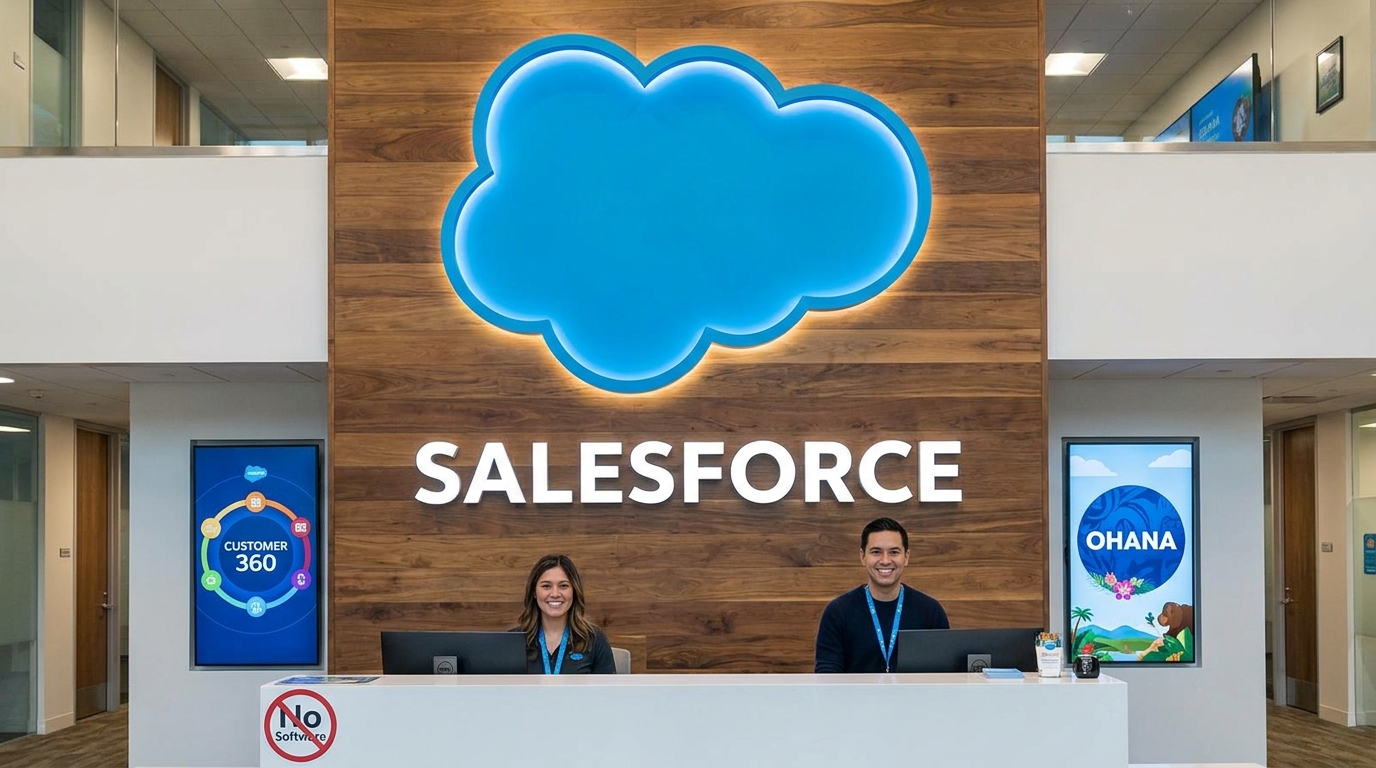
A clear mission acts like a compass for a large corporation. It tells employees, customers, and investors what the company stands for and where it is heading. Salesforce, the cloud software giant founded in 1999, puts its mission front and center: “We bring companies and customers together.” While the company does not publish a standalone vision statement, its guiding purpose is equally direct — “We believe that the business of business is to improve the state of the world.” These two statements capture why Salesforce exists and the change it wants to see.
Salesforce built its entire identity around the idea that technology should make businesses more connected, not more complicated. The mission and purpose statements are not just words on a wall. They drive product decisions, hiring, and the company’s famous philanthropy model. The following sections unpack what those words actually mean and how they fuel one of the world’s most influential enterprise software companies.
What Is Salesforce’s Mission Statement?
We bring companies and customers together.
This mission is remarkably short. It uses just six words. That brevity is intentional. Salesforce has always positioned itself as the platform that breaks down the walls between a business and the people it serves. The mission names two clear parties: companies and customers. The verb “bring together” is active and relational. There is no mention of software, cloud computing, or artificial intelligence. The statement focuses on the outcome, not the tool.
In practice, bringing companies and customers together means giving every department a single, shared view of the customer. Salesforce’s entire product suite (sales, service, marketing, commerce, and analytics) exists to unify data and interactions. The mission works for a small startup using a free trial just as well as it does for a global airline managing millions of loyalty members. It is universal, human, and easy for every employee to remember. That clarity is a strategic asset.
101 Mission Statements is for you if:
- You’re a leader or entrepreneur needing a clear, inspiring statement of intent for your business or nonprofit.
- You want your team and clients aligned with a shared vision of excellence and long-term goals.
- You need a step-by-step guide to craft a customized mission statement that acts as a blueprint for future success.
What Is Salesforce’s Vision Statement?
Salesforce does not publish a separate, one-line vision statement on its corporate website or in its annual filings. The company’s forward-looking direction is instead expressed through its purpose, its product strategy, and the public commitments it makes. This is not an oversight. It reflects a belief that the destination is best shown through action, not a polished sentence.
What serves as the de facto vision is a future where every company, regardless of size or budget, can use intelligent technology to know its customers deeply. Salesforce often calls this the Customer 360 idea. The vision is a world where a business can tap into a single source of truth about each customer and use AI to anticipate needs before they are spoken. The vision is not about selling more software. It is about making the relationship between business and buyer so valuable that trust becomes the competitive advantage. That forward-looking intent threads through product roadmaps, acquisition decisions, and the company’s massive investment in education and training.
What Is Salesforce’s Purpose Statement?
We believe that the business of business is to improve the state of the world.
This statement is the company’s moral and operational backbone. It was popularized by cofounder and CEO Marc Benioff and has become a rallying cry for a new kind of capitalism at Salesforce. The purpose does not reject profit. It redefines what profit is supposed to serve. Companies, in this view, are not just vehicles for shareholder returns. They are platforms for change. That change covers equality, sustainability, education, and community health.
The purpose directly shapes how Salesforce operates. It is why the company built its 1-1-1 philanthropy model into its founding documents. It is why the company sets public goals for workforce diversity and net zero emissions. When a product decision creates tension between short-term revenue and long-term trust, this purpose is the tiebreaker. The statement is bold, and it invites scrutiny. Salesforce uses it publicly as an accountability mechanism, not a decoration.
Key Differences Between Salesforce’s Mission, Vision, and Purpose
| Statement | Focus | Timeframe | Primary Audience | Core Question Answered | Purpose |
|---|---|---|---|---|---|
| Mission (official) | Connecting companies and customers | Present, ongoing | Customers and employees | What do we do? | Defines daily operational focus |
| Directional Vision (implied) | A future of intelligent, connected customer experiences | 5 to 10 years out | The broader market | Where are we heading? | Guides product and strategy roadmap |
| Purpose (official) | Improving society through business | Perpetual, no end date | All stakeholders and society | Why do we exist? | Anchors values and long-term impact |
The mission explains what Salesforce does right now. The implied vision sets a destination. The purpose gives a reason that is bigger than commerce. Each statement does a different job, and each one loses power without the others. Together they form a story that is easy to tell internally and externally.
Core Values Behind Salesforce’s Mission and Vision
Salesforce lists five core values that turn its statements into daily behavior. These values are not generic posters. Each one connects directly to the mission or the purpose.
- Trust: Delivering secure, transparent, and reliable service so customers feel safe sharing their data. Trust is the non-negotiable foundation for bringing companies and customers together.
- Customer Success: Ensuring every customer achieves measurable outcomes with the platform. This value measures the mission’s promise in real results.
- Innovation: Building new technology and embracing shifts like AI to make customer connections smarter over time. Innovation keeps the mission from becoming stale.
- Equality: Creating a workforce and a world where everyone has access to opportunity. This value directly feeds the purpose of improving the state of the world.
- Sustainability: Taking accountability for the company’s environmental impact and helping customers do the same. Sustainability is the long-term expression of caring for the communities where business operates.
These values operate as a system. Trust and customer success ensure the mission stays credible. Equality and sustainability ensure the purpose is more than a slogan. Innovation pushes everything forward.
How Salesforce Lives Its Mission and Vision
Salesforce backs its statements with actions that are public and measurable. The Customer 360 platform is the most direct example of the mission in product form. It unifies sales, service, marketing, and commerce data so a company sees one customer, not scattered fragments. This single view makes personalized, trusted relationships possible at scale.
Trailhead, the company’s free online learning platform, shows the purpose in action. It has helped millions of people learn digital skills and earn credentials at no cost. By opening access to education, Salesforce creates pathways into the tech economy for people who might otherwise be shut out. This is equality and opportunity made tangible.
The 1-1-1 model is another deep proof point. Since day one, Salesforce has donated 1 percent of its equity, 1 percent of its product, and 1 percent of employee time to nonprofits. This model has spread to thousands of other companies. It turns the purpose statement into a structural commitment that outlasts any single leader.
Finally, the company’s sustainability push, including its Net Zero Cloud and science-based climate targets, connects business operations to global impact. When Salesforce helps a customer track and cut carbon emissions using its platform, it is living the idea that business can improve the state of the world. These examples are not one-off campaigns. They are embedded in the company’s rhythm.
How Salesforce’s Mission and Vision Have Evolved
Salesforce was founded in 1999 with a defiant rallying cry: “The End of Software.” Its logo featured the word “software” inside a crossed-out circle. The early vision was about disruption. It wanted to kill the old model of clunky, expensive, on-premise installations and replace it with software delivered via the cloud. That bold stance gave the brand a clear enemy and a strong identity.
As cloud computing became the norm, the message shifted. “The End of Software” felt less urgent. The company settled on the mission “We bring companies and customers together.” This change moved the spotlight from the technology itself to the human outcome. It was a maturation from being a rebel to being a trusted partner. The purpose statement, “The business of business is to improve the state of the world,” rose in prominence during the 2010s as stakeholder capitalism gained traction. It was not a replacement of the mission but a deepening of it. The company’s strategic behavior now carries equal weight on profit, people, and the planet. The official mission wording has stayed stable for years, but the emphasis on purpose and values has grown louder and more operational.
What Your Company Can Learn from Salesforce’s Statements
Salesforce’s approach offers practical lessons for any founder or brand manager who is writing a mission or purpose statement. The principles are simple, but executing them takes discipline.
- Make the mission so short it fits on a sticky note. “We bring companies and customers together” passes the memory test in seconds. If your team cannot repeat the mission from memory, it will not guide decisions. Write a statement that is plain language, active, and under ten words if possible.
- Anchor a purpose beyond profit that you are willing to measure publicly. Salesforce’s purpose is bold, and it backs it with auditable goals on equality and sustainability. A vague purpose does nothing. A purpose tied to metrics becomes a strategy. Pick something you are prepared to report on each year.
- Let a vision live in your roadmap if a single sentence feels forced. Not every company needs a separate, poetic vision statement. Salesforce directs its future state through product releases, acquisitions, and ecosystem investments. If you articulate where you are heading clearly enough in your strategy, customers and employees will feel the vision even without a blockquote.
- Connect every core value back to the mission. Salesforce’s values of trust and customer success are direct enablers of bringing companies and customers together. There is no fluffy filler. Audit your own values list. Delete anything that does not directly fuel your mission or purpose.
Frequently Asked Questions
Q: What is Salesforce’s current mission statement?
Salesforce’s mission is “We bring companies and customers together.” It focuses on the outcome of connection rather than the technology used.
Q: Does Salesforce have a separate vision statement?
Salesforce does not publish a separate one-line vision statement. Its forward-looking direction is expressed through its purpose, its Customer 360 strategy, and its long-term commitments to equality and sustainability.
Q: What is Salesforce’s purpose statement?
Salesforce’s purpose is “We believe that the business of business is to improve the state of the world.” It guides philanthropy, sustainability, and workplace equality efforts across the company.
Q: What are Salesforce’s core values?
Salesforce lists five core values: Trust, Customer Success, Innovation, Equality, and Sustainability. They are used in hiring, performance reviews, and daily decision making.
Q: How does Salesforce’s Ohana culture relate to its mission?
Ohana is the Hawaiian word for family. At Salesforce, it means taking care of employees, customers, partners, and communities as an extended family. This idea deepens the mission of connection and makes the purpose of improving the world personal.
Q: Has Salesforce’s mission ever changed?
Yes. In its early years, Salesforce used the rallying cry “The End of Software” to signal its disruption of traditional enterprise software. As the market matured, the company shifted to the customer-focused mission it uses today.
Q: How does Salesforce put its mission into practice?
Salesforce puts its mission into practice through its Customer 360 platform, which unifies customer data, its free Trailhead education program, and its 1-1-1 philanthropy model. These initiatives turn the words into measurable action.
Final Thoughts
Salesforce demonstrates that a simple mission can power a complex global enterprise. “We bring companies and customers together” is a statement that never stops being relevant to every product decision. Pairing that mission with a purpose as assertive as improving the state of the world gives the brand both a practical anchor and a moral ambition.
The two statements work because they are not siloed in a brand guide. They show up in hiring rubrics, product launches, and sustainability reports. That consistency is what separates a real mission from a decorative one. What do you think of Salesforce’s approach to mission and purpose? Share your perspective in the comments below.
101 Mission Statements is for you if:
- You’re a leader or entrepreneur needing a clear, inspiring statement of intent for your business or nonprofit.
- You want your team and clients aligned with a shared vision of excellence and long-term goals.
- You need a step-by-step guide to craft a customized mission statement that acts as a blueprint for future success.
Be First to Comment