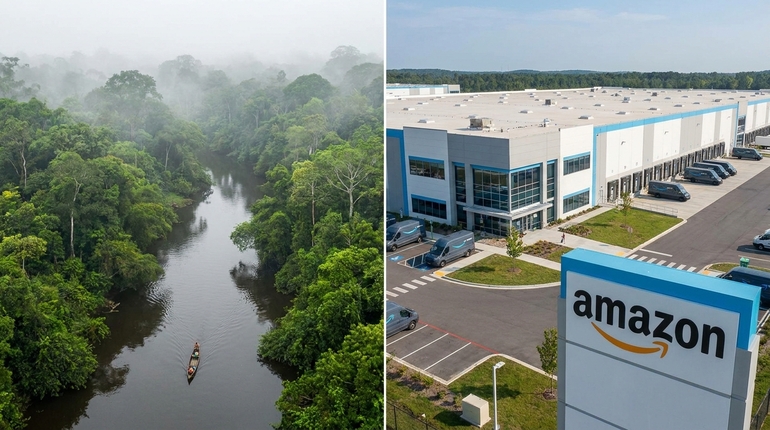
A mission statement is not just a line on an about page. For a company operating at the scale of Amazon, it is a public commitment that shapes everything from hiring decisions to product investments. When a statement is this visible, it either earns trust or exposes gaps.
Amazon’s official mission statement, as published on its About Us page, is: “Our mission is to be Earth’s most customer-centric company, Earth’s best employer, and Earth’s safest place to work.” Amazon does not publish a separate, standalone vision statement in the traditional sense. Its older directional language, “to be Earth’s most customer-centric company; to build a place where people can come to find and discover anything they might want to buy online,” has long served as the company’s forward-looking guide and is still widely cited as its functional vision statement.
Together, these statements tell a clear story about what Amazon values and where it intends to go. Understanding the mission and vision statement of Amazon helps you see how one of the world’s most powerful companies thinks about its customers, its workers, and its future. The sections that follow unpack exactly what those words mean and how they play out in practice.
What Is Amazon’s Mission Statement?
“Our mission is to be Earth’s most customer-centric company, Earth’s best employer, and Earth’s safest place to work.”
— Amazon, About Us (official page)
This statement does three things at once. It names the customer as the first priority, then places employees at the center alongside them. The phrase “customer-centric” is deliberately broad. It does not say “cheapest” or “fastest,” though Amazon pursues both. It says centric, which implies that every decision starts with the customer and works outward.
The addition of “Earth’s best employer” and “Earth’s safest place to work” is relatively new. These two commitments were introduced in 2021 and represent a formal expansion of what Amazon says it owes to the people who do the work. For a company that has faced sustained public criticism about warehouse conditions and worker treatment, these additions carry real weight. Whether you read them as a genuine shift in values or as a defensive response to external pressure, their inclusion in the official mission language signals that Amazon now treats workforce welfare as a core corporate obligation, not a side concern.
101 Mission Statements is for you if:
- You’re a leader or entrepreneur needing a clear, inspiring statement of intent for your business or nonprofit.
- You want your team and clients aligned with a shared vision of excellence and long-term goals.
- You need a step-by-step guide to craft a customized mission statement that acts as a blueprint for future success.
What Is Amazon’s Vision Statement?
“To be Earth’s most customer-centric company; to build a place where people can come to find and discover anything they might want to buy online.”
Amazon does not publish a separate, formally titled vision statement on its current official pages. The language above comes from the company’s original founding-era statement, first articulated when Amazon launched in 1995, and it remains the most widely cited directional statement associated with the brand. On its current About Us page, Amazon also uses the phrase: “Amazon’s mission is to make customers’ lives better and easier every day by relentlessly inventing on their behalf,” which functions as both a mission summary and a forward-looking aspiration.
What this tells you is that Amazon has never cleanly separated its mission from its vision. Both point in the same direction: the customer. The forward-looking intent embedded in its vision language is not about market share or revenue targets. It is about scope, specifically, that customers should be able to find and discover anything. That single word, “anything,” is what has justified Amazon’s expansion from books to groceries to cloud computing to healthcare. The vision is not just about serving customers well today. It is about removing every possible barrier between a customer and whatever they want.
Key Differences Between Amazon’s Mission and Vision
| Mission | Vision | |
|---|---|---|
| Focus | What Amazon does and who it serves today | Where Amazon is heading long-term |
| Timeframe | Present-day operational commitment | Long-term aspiration |
| Primary Audience | Customers, employees, and the public | Customers and the broader market |
| Core Question Answered | Why does Amazon exist? | What does Amazon ultimately want to become? |
| Purpose | Sets daily standards and priorities | Provides directional ambition |
Amazon’s mission and vision are tightly related but not identical. The mission pins the company to specific, daily obligations: be customer-centric, be a good employer, be a safe workplace. The vision sets the ceiling: a world where any customer can find anything they want to buy, conveniently and at the right price. One keeps the company accountable in the present. The other keeps it ambitious about the future.
Core Values Behind Amazon’s Mission and Vision
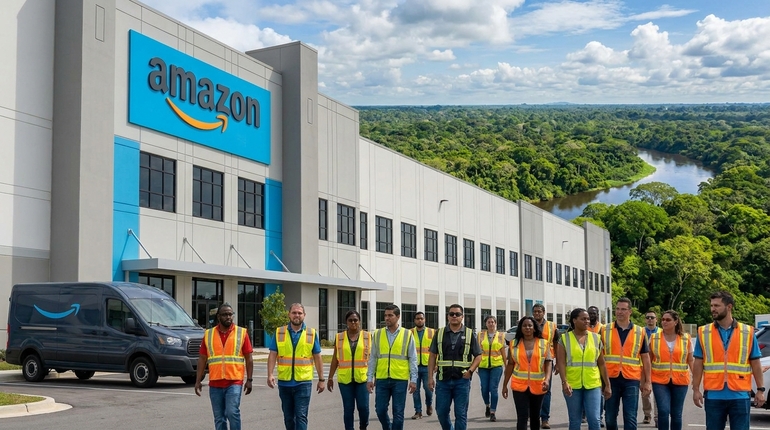
Amazon does not publish a short list of core values in the traditional sense. Instead, it operates through 16 Leadership Principles, which function as its value system. Six of these are particularly central to understanding how the mission and vision work day-to-day.
- Customer Obsession: Leaders start with the customer and work backward. This principle sits first on Amazon’s list deliberately and directly feeds its mission to be Earth’s most customer-centric company.
- Invent and Simplify: Amazon expects its people to seek new solutions and reduce complexity. This connects to the vision of helping customers find and discover anything, which requires constant product and process reinvention.
- Ownership: Employees are expected to think and act like long-term owners of the company, not just task-doers. This reinforces the mission’s commitment to employee excellence and sustained results.
- Bias for Action: Speed matters. Amazon views deliberate, calculated action as a competitive advantage. This principle keeps the company moving fast enough to actually deliver on the broad promises in its mission.
- Frugality: Amazon expects leaders to do more with less and treat cost discipline as a creative challenge. This underpins its long-standing commitment to offering customers the lowest possible prices.
- Strive to be Earth’s Best Employer: Added formally in 2021, this principle reflects the expanded mission language. It asks leaders to create a work environment that is genuinely good for the people in it, not just productive for the company.
These principles do not operate as standalone aspirations. They form an interlocking system where customer focus drives invention, invention requires ownership, ownership demands frugality, and all of it adds up to a company that can credibly claim to be Earth’s most customer-centric. The workforce principles added in 2021 extend that system to include the people doing the work.
How Amazon Lives Its Mission and Vision
Prime and fast delivery. Amazon Prime began as a shipping program in 2005. Today it covers streaming, pharmacy benefits, grocery delivery, and more. Its existence is a direct expression of the mission: make customers’ lives easier and better every day. The program now has over 200 million subscribers globally, and its expansion tracks almost perfectly with the “find and discover anything” logic of Amazon’s vision.
Amazon Web Services (AWS). AWS launched in 2006 as an internal tool and became a public cloud platform that now generates over $100 billion in annual revenue. Its development reflects the “invent and simplify” value applied at scale. It also serves a different customer (businesses, developers) while staying true to the same logic: obsess over what the customer needs and build it before they ask.
The Climate Pledge. In 2019, Amazon co-founded The Climate Pledge, a commitment to reach net-zero carbon across its global operations by 2040, ten years ahead of the Paris Agreement schedule. This is a concrete expression of the Leadership Principle that asks leaders to be responsible stewards because “success and scale bring broad responsibility.” It also reflects the mission’s implicit promise that Amazon cares about the long-term wellbeing of the world its customers live in.
Workplace safety programs. Since adding “Earth’s safest place to work” to its mission in 2021, Amazon has invested heavily in safety technology across its fulfillment centers. The company reported a 30% improvement in recordable incident rates and a 60% reduction in lost-time incident rates over a four-year period through 2024. These numbers remain contested by some labor advocates, but the investment itself shows that the mission language has translated into measurable internal targets.
How Amazon’s Mission and Vision Have Evolved
When Jeff Bezos launched Amazon in 1995, its stated mission was narrow and specific: “to be Earth’s most customer-centric company, where customers can find and discover anything they might want to buy online, and endeavors to offer its customers the lowest possible prices.” The focus was entirely on the shopping experience. The company’s job was to connect a buyer to a product as cheaply and conveniently as possible.
Over the next two decades, Amazon’s actual behavior expanded well beyond that framing. AWS moved Amazon into enterprise cloud infrastructure. Kindle and Fire devices made it a hardware company. Amazon Studios made it an entertainment producer. Each of these moves could be justified by the “find and discover anything” spirit of the original vision, but the original wording did not come close to capturing what Amazon actually was becoming.
The most significant formal update came in 2021, when Jeff Bezos published his final shareholder letter as CEO. He introduced two new ambitions, “Earth’s best employer” and “Earth’s safest place to work,” and explicitly framed them as vision-level goals. This was not a quiet edit. Bezos made the announcement in the context of a union campaign at Amazon’s Bessemer, Alabama facility and widespread public debate about warehouse conditions. The mission language absorbed these new commitments, which moved Amazon from a company that defined itself entirely around the customer to one that formally acknowledges its obligations to its own workforce. That is a meaningful shift in corporate identity, even if it took external pressure to make it official.
What Your Company Can Learn from Amazon’s Statements
Amazon’s mission and vision work because they are specific enough to guide decisions and broad enough to accommodate growth. Here is what that looks like in practice, and what it means for your own statement.
Start with a single, non-negotiable priority. Amazon built its entire identity around one idea: the customer comes first. Every decision, every product, every hire can be evaluated against that standard. If your mission statement contains five equal priorities, it is actually no priority at all. Pick the one thing your company will never compromise on and build from there.
- Use language that scales. The phrase “find and discover anything” was written for an online bookstore but it worked just as well when Amazon entered cloud computing, streaming, and healthcare. Mission and vision language that is anchored to a specific product or category will need rewriting every time you pivot. Language anchored to a customer relationship rarely needs to change.
- Let your values do the operational work. Amazon’s 16 Leadership Principles mean that every employee has a shared vocabulary for making decisions. Your mission statement cannot cover every situation. Your values need to fill in the gaps. Write your values the way Amazon writes its principles: specific, testable, and connected directly to your mission.
- Revise when reality forces it. Amazon waited until 2021 to formally acknowledge its workers in its mission language, and that delay cost the company reputational ground. If your company’s behavior has moved beyond what your mission says, update the statement. Outdated mission language creates a credibility problem that no marketing campaign can fix.
The broader lesson from Amazon is that a mission statement is not a tagline. It is an internal operating document that happens to be public. Write it for the people who need to make decisions every day, not for the website.
Frequently Asked Questions
Q: What is Amazon’s current mission statement? Amazon’s official mission statement is: “Our mission is to be Earth’s most customer-centric company, Earth’s best employer, and Earth’s safest place to work.” This wording has been in place since 2021 and is published on Amazon’s About Us page. Amazon also describes its mission conversationally as making “customers’ lives better and easier every day.”
Q: What is Amazon’s vision for the future? Amazon does not publish a formally titled vision statement on its current pages. The most widely cited directional statement associated with the company is: “to be Earth’s most customer-centric company; to build a place where people can come to find and discover anything they might want to buy online.” This language originated with the company’s founding in 1995 and continues to guide its long-term direction.
Q: Does Amazon have a separate tagline from its mission statement? Amazon does not have a single official corporate tagline. The phrase “Work hard. Have fun. Make history.” has been associated with the company’s culture. Its consumer-facing brand is more commonly associated with the promise of selection, price, and convenience than with any single slogan.
Q: How does Amazon’s mission statement reflect its brand identity? The mission places the customer at the center of every business decision. This is not just a statement of aspiration. It is a design principle. Amazon’s product development method, often called “working backwards,” literally starts with writing a press release for a customer and building the product from there. The mission and the brand operate as one.
Q: Has Amazon’s mission or vision statement ever changed? Yes. Amazon’s original mission, written at launch in 1995, focused exclusively on customers and online shopping. In 2021, Jeff Bezos expanded the official mission language to include “Earth’s best employer” and “Earth’s safest place to work,” making it the most significant formal update in the company’s history. The expansion came at a time of heightened scrutiny over warehouse working conditions.
Q: What core values guide Amazon? Amazon operates through 16 Leadership Principles rather than a traditional values list. The most prominent include Customer Obsession, Ownership, Invent and Simplify, Bias for Action, Frugality, and Strive to be Earth’s Best Employer. These principles are used in hiring, performance reviews, and daily decision-making across the company.
Q: How does Amazon put its mission into practice? Amazon applies its mission through products and programs that improve customer convenience (Prime, same-day delivery, Alexa), worker safety investments across its fulfillment network, AWS services that give businesses access to enterprise-grade technology, and sustainability commitments including The Climate Pledge. The Leadership Principles translate the mission into daily employee behavior.
Final Thoughts
Amazon’s mission and vision statements are not unusually poetic. What makes them effective is their specificity and durability. “Customer-centric” has carried the company from an online bookstore to a global technology infrastructure provider without requiring a rewrite. The 2021 additions show that even Amazon has to update its language when its obligations grow. For any company watching, the lesson is clear: write for what you actually believe, and be willing to revise when the gap between your words and your actions becomes too wide to ignore.
What do you think of Amazon’s mission and vision? Do the statements reflect the company you experience as a customer or employee? Share your thoughts in the comments below.
101 Mission Statements is for you if:
- You’re a leader or entrepreneur needing a clear, inspiring statement of intent for your business or nonprofit.
- You want your team and clients aligned with a shared vision of excellence and long-term goals.
- You need a step-by-step guide to craft a customized mission statement that acts as a blueprint for future success.
Be First to Comment