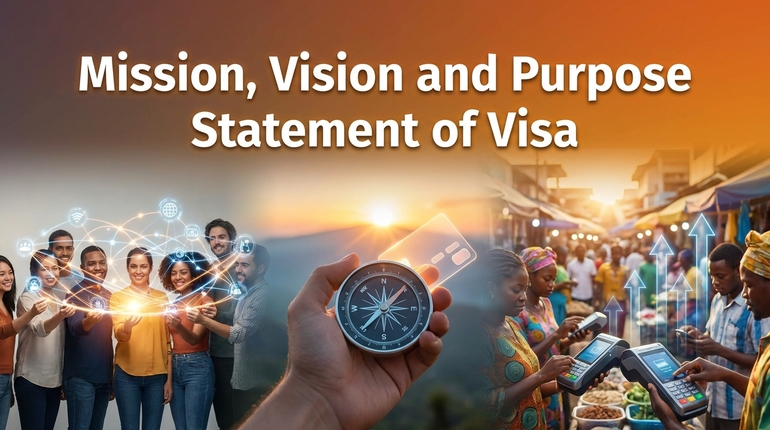
Every large company tells a story about why it exists, and the best companies make sure that story is clear enough to guide thousands of decisions every day. For Visa, a brand that processes hundreds of billions of transactions each year, that story is not about moving money. It is about moving opportunity.
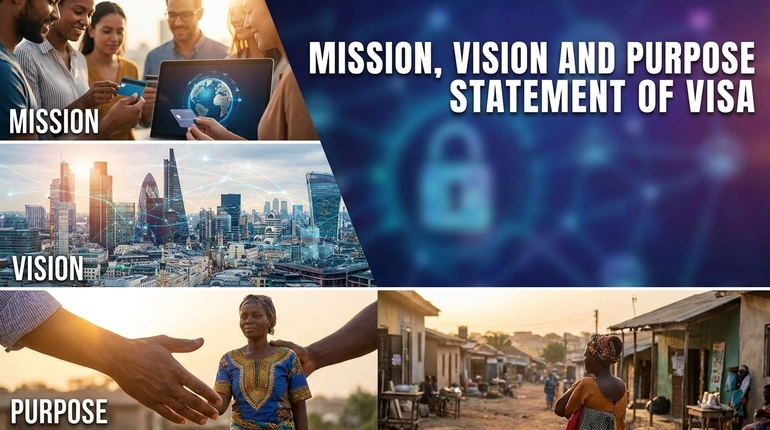
Visa’s official mission statement is “to connect the world through the most innovative, convenient, reliable and secure payments network, enabling individuals, businesses and economies to thrive.” Its vision statement is “to be the best way to pay and be paid for everyone, everywhere.” And its purpose statement, which sits above both, is “to uplift everyone, everywhere by being the best way to pay and be paid.”
These three statements work together like layers of a map. The purpose explains why Visa gets out of bed. The vision paints the destination. The mission describes the vehicle. When you read them side by side, you see a company that has thought carefully about the difference between doing good work and doing work that matters. Let us unpack what each statement really means.
What Is Visa’s Mission Statement?
Our mission is to connect the world through the most innovative, convenient, reliable and secure payments network, enabling individuals, businesses and economies to thrive.
Visa’s mission statement is essentially a promise about performance. It tells you what the company commits to doing today, not someday. The first key word is “connect.” Visa does not issue credit cards or lend money. Banks do that. Visa builds and runs the digital infrastructure that links banks, merchants, governments, and consumers across more than 200 countries and territories. Without that connective tissue, a card from a local credit union in Ohio would not work at a café in Tokyo. That is the “connect the world” piece made real.
The second half of the mission is the payoff: “enabling individuals, businesses and economies to thrive.” This is a deliberate choice of language. Visa does not claim to make anyone thrive directly. It uses the word “enabling,” which positions the company as a platform rather than a hero. An individual thrives because she can receive payments for freelance work from clients on three continents. A small business thrives because it can accept digital payments without installing expensive hardware. An economy thrives because money moves faster and more transparently through a trusted network. Visa’s mission is to be the reliable track that all of that runs on.

101 Mission Statements is for you if:
- You’re a leader or entrepreneur needing a clear, inspiring statement of intent for your business or nonprofit.
- You want your team and clients aligned with a shared vision of excellence and long-term goals.
- You need a step-by-step guide to craft a customized mission statement that acts as a blueprint for future success.
What Is Visa’s Vision Statement?
Our vision is to be the best way to pay and be paid for everyone, everywhere.
If the mission is about what Visa does, the vision is about what Visa wants to become. The word “best” is doing heavy lifting here. It sets a competitive bar that never sits still. Today being the best might mean the lowest fraud rate or the fastest transaction speed. Tomorrow it might mean the most seamless integration with artificial intelligence assistants that shop on a consumer’s behalf. By anchoring the vision to “best” rather than to a specific technology, Visa gives itself room to evolve without losing its north star.
The phrase “for everyone, everywhere” is equally important. It signals universal ambition. Visa’s vision is not to serve only developed markets or only affluent consumers. It is to serve the farmer in rural Kenya and the fashion buyer in Paris on equal terms. That inclusion lens is what separates a vision statement from a market-share goal. A market-share goal asks how much of the pie you can grab. A vision statement like this one asks whether the pie can be made big enough for everybody.
What Is Visa’s Purpose Statement?
Our purpose is to uplift everyone, everywhere by being the best way to pay and be paid.
Visa’s purpose statement is the deepest layer of the three. Where the mission describes function and the vision describes ambition, the purpose describes motivation. “Uplift” is not a typical corporate word. It suggests something almost moral, a belief that access to the financial system is a lever for human dignity. Visa operates on the conviction that when people can participate in the formal economy, when they can send money to family members, pay for an education, or receive insurance payouts digitally, their lives improve in measurable ways.
This purpose influences product design in concrete ways. Visa builds solutions like Visa Direct for real-time push payments, and it partners with rural banks in countries like the Philippines to extend debit card access to communities that cash barely reaches. It also shows up in the company’s public commitments, including the goal it met in 2020 of providing 500 million unbanked and underserved people access to digital payment accounts. A purpose statement that sits unused in a branding document is worthless. Visa’s purpose statement seems to have genuine operational teeth.
Key Differences Between Visa’s Mission and Vision
Understanding the difference between a mission and a vision is easier when you see them in a structured comparison. Here is how Visa’s two statements stack up.
| Dimension | Mission Statement | Vision Statement |
|---|---|---|
| Focus | What Visa does operationally | What Visa aspires to become |
| Timeframe | Present and near future | Long-term, enduring ambition |
| Primary Audience | Employees, partners, shareholders | Customers, markets, society |
| Core Question Answered | “How do we create value today?” | “What does success look like in the long run?” |
| Purpose | Guide daily decisions and resource allocation | Inspire direction and stretch goals |
Both statements are necessary. A mission without a vision risks becoming a to-do list with no horizon. A vision without a mission risks becoming a daydream with no engine. Visa’s pairing works because the mission delivers the “how” and the vision keeps the “why” ambitious enough to matter.
Core Values Behind Visa’s Mission and Vision
Visa does not publish a simple list of one-word values the way some companies do. Instead, it embeds its values inside a set of documented Visa Leadership Principles that shape hiring, performance reviews, and everyday behavior. These principles are the cultural engine that powers the mission and vision.
Lead courageously: Employees are expected to act like owners, challenge the status quo, and hold themselves accountable. This connects directly to the vision’s demand to be the “best,” because standing still is not an option.
Obsess about customers: Teams must deeply understand client and end-user needs, then design simple, compelling solutions. This supports the mission’s promise of a “convenient, reliable and secure” network.
Collaborate as one Visa: The principle requires championing inclusion and diversity, encouraging honest debate, and enabling colleagues to succeed. A network that spans the globe cannot function if internal teams operate in silos.
Execute with excellence: Visa asks its people to decide quickly, deliver with simplicity, and learn openly from mistakes. The mission’s call for an “innovative” network depends on a culture that rewards speed and continuous improvement.
These four principles do not just sit on a poster. They are baked into performance assessments, where how a leader achieves results matters as much as the results themselves. That accountability loop is what turns values from aspiration into habit.
How Visa Lives Its Mission and Vision
Visa’s statements would mean little if the company did not back them with action. Three specific initiatives show the mission and vision in motion.
The first is Visa’s multi-year effort to bring digital payment access to 500 million unbanked and underserved individuals, a goal the company met in 2020 and continues to build upon. This directly activates the “for everyone, everywhere” language in the vision and purpose. In practical terms, it has meant partnerships with fintech firms and governments to extend low-cost acceptance solutions like Tap to Phone and QR codes into communities that traditional banking infrastructure overlooks.
The second is the She’s Next program, a global initiative that provides funding, mentorship, and training to women-owned small businesses. Grant programs operate in dozens of countries from Ireland to South Africa to Kazakhstan. This program translates the mission’s “enabling individuals and businesses to thrive” into a tangible resource: cash and expertise for entrepreneurs who face structural barriers to capital.
The third is Visa’s sustainability commitment, which includes a goal to reach net-zero greenhouse gas emissions by 2040. The company maintained 100 percent renewable electricity across its offices and data centers and achieved a 24 percent reduction in scope 1 and 2 emissions since fiscal year 2020. Sustainability appears explicitly in the company’s mission language (“help make the world a better place”) and reflects a broader understanding that an economic network cannot thrive if the planet does not.
How Visa’s Mission and Vision Have Evolved
Visa traces its roots to 1958, when Bank of America launched the BankAmericard program, the first consumer credit card with a revolving credit feature. The name “Visa” arrived in 1976, chosen because it sounded the same in every language, a quiet nod to the global ambition that would later anchor the company’s purpose. In those early decades, the company’s directional language was simpler. The focus was on acceptance: making a single card work in as many places as possible.
A significant shift came in 2014, when Visa launched the “Everywhere You Want to Be” corporate platform. In the press release announcing the platform, Visa explicitly expanded its vision to include “for everyone, everywhere,” marking a deliberate move from a geographic promise to an inclusive one. The company’s famous tagline, “It’s everywhere you want to be,” which had been retired in 2006, was revived and shortened to “Everywhere you want to be.” The evolution from “everywhere” as a physical footprint to “everywhere” as universal access reflects a deeper change in how Visa thinks about its role in the world.
In recent years, the company has also sharpened the language around its purpose. The phrase “uplift everyone, everywhere” now appears consistently across corporate materials, sustainability reports, and job descriptions. This signals that Visa sees its reason for existing as something larger than transaction processing. The mission and vision have become more outwardly focused, shifting from what Visa does to what Visa makes possible for others.
What Your Company Can Learn from Visa’s Statements
Visa’s approach to mission, vision, and purpose offers several practical lessons for entrepreneurs and brand leaders who are writing or revising their own statements.
First, separate mission, vision, and purpose into distinct tools. Visa avoids the common mistake of mushing everything into one long, forgettable paragraph. The mission handles the “what,” the vision handles the “where,” and the purpose handles the “why.” This clarity makes each statement usable. A product team can check a new feature against the mission. A strategy team can measure a five-year plan against the vision. Marketing can anchor campaigns to the purpose. If your own statements blur these functions, they probably blur the decisions they are meant to guide.
Second, use language that sets a standard, not a ceiling. Visa’s vision commits to being the “best” way to pay and be paid, which is a standard that constantly moves. There is no finish line where Visa can declare itself permanently the best and stop trying. This is smarter than vision statements that describe a fixed state, like “become the number one payment network,” because market leadership can be achieved and then lost. A standard of excellence is a renewable goal.
Third, make inclusion a strategic concept, not a cosmetic one. Visa embeds “for everyone, everywhere” into its vision and purpose, and that language then drives real resource allocation. The company invests in rural bank partnerships, women’s entrepreneurship grants, and accessibility features not because they look good in a sustainability report but because the vision demands them. When you write “everyone” into a statement, be ready to spend money on it.
Frequently Asked Questions
Q: What is Visa’s current mission statement?
Visa’s mission is “to connect the world through the most innovative, convenient, reliable and secure payments network, enabling individuals, businesses and economies to thrive.” This appears consistently on Visa’s official corporate website and in public job descriptions.
Q: What is Visa’s vision for the future?
Visa’s vision is “to be the best way to pay and be paid for everyone, everywhere.” The company has framed this vision as a long-term aspiration that guides its investments in technology, partnerships, and market expansion.
Q: Does Visa have a separate tagline from its mission statement?
Yes. Visa’s tagline is “Everywhere you want to be,” which serves as an external brand slogan rather than an internal operational guide. It was originally introduced in 1985 as “It’s everywhere you want to be,” retired in 2006, and revived in shortened form in 2014.
Q: How does Visa’s mission statement reflect its brand identity?
The mission emphasizes connectivity, innovation, reliability, and security. These mirror the brand attributes Visa has built over decades: trust, global reach, and technological leadership. The phrase “enabling individuals, businesses and economies to thrive” positions Visa as an enabler rather than a transaction processor.
Q: Has Visa’s mission or vision statement ever changed?
The wording has evolved over time. The vision was explicitly expanded in 2014 to include “for everyone, everywhere,” moving the company from a geographic promise to an inclusive one. The purpose language around “uplift everyone, everywhere” has also become more prominent in corporate communications over the past decade.
Q: What core values guide Visa?
Visa embeds its values in its Leadership Principles: lead courageously, obsess about customers, collaborate as one Visa, and execute with excellence. These principles are integrated into employee performance assessments and hiring decisions across the company.
Q: How does Visa put its mission into practice?
Visa puts its mission into practice through initiatives like expanding digital payment access to underserved populations, running the She’s Next grant program for women entrepreneurs, and committing to net-zero emissions by 2040. The company also invests continuously in network security and reliability to maintain the trust its mission promises.
Final Thoughts
Visa’s mission, vision, and purpose reveal a company that has moved well beyond the language of payment processing. These statements describe a global infrastructure business that sees itself as a participant in economic inclusion, not just a beneficiary of it. The clarity with which Visa separates its “what,” “where,” and “why” is a model worth studying. The consistency with which it backs those words with programs, partnerships, and performance metrics is what gives the model credibility.
What do you think of Visa’s mission and vision? Do these statements reflect how you experience the brand as a consumer or business owner? Share your thoughts in the comments below.
101 Mission Statements is for you if:
- You’re a leader or entrepreneur needing a clear, inspiring statement of intent for your business or nonprofit.
- You want your team and clients aligned with a shared vision of excellence and long-term goals.
- You need a step-by-step guide to craft a customized mission statement that acts as a blueprint for future success.
Be First to Comment