A company’s mission and vision statement tells you what a business decided to protect when it had every incentive to chase something else. For a retailer the size of Costco, that decision shows up in every price tag and every shift on the floor. Small wording choices in these statements end up shaping hiring, pricing, and even how many products sit on a shelf.
Costco’s mission is short and specific: to continually provide members with quality goods and services at the lowest possible prices. Its vision, at least the version most commonly cited by business analysts since Costco does not publish a separate one, centers on operational efficiency delivering unmatched savings. Both ideas point in the same direction, and that alignment is part of why the wording has barely changed in over four decades.
Understanding what these two statements actually say, and where they came from, explains a lot about how Costco operates today.
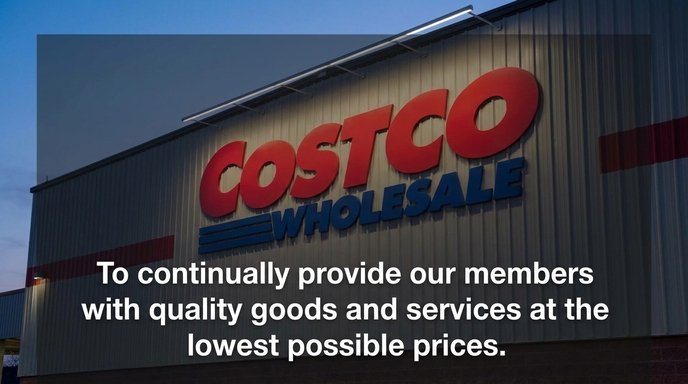
What Is Costco’s Mission Statement?
“To continually provide our members with quality goods and services at the lowest possible prices.”
This sentence has appeared on Costco’s official mission and ethics page largely unchanged since the company opened its first warehouse in 1983. It is deliberately short, and that brevity is the point. Costco is not trying to sound inspiring here. It is telling members exactly what the transaction is.
Three words do most of the work. “Continually” signals that low prices are not a promotional stunt but a permanent operating condition. “Quality” tells shoppers that Costco is not competing purely on cheapness, since low prices without quality control would erode trust fast. “Members” narrows the audience to people who paid for access, which is the foundation of Costco’s entire business model. The statement never mentions selection, convenience, or experience. It stays fixed on price and quality because those are the two levers the company controls most directly.
What Is Costco’s Vision Statement?
Costco does not publish a standalone, official vision statement the way it publishes its mission on costco.com. Business analysts and strategy publications commonly summarize the company’s forward looking intent this way:
“To be a place where efficient buying and operating practices give members access to unmatched savings.”
Even without an official corporate vision page, this description is a reasonably accurate read of Costco’s public strategy. It describes efficiency as the mechanism and savings as the outcome, which lines up with how the company talks about its warehouse model, its limited product selection, and its supply chain in shareholder communications.
Where the mission statement describes the daily transaction, this directional language describes the operating philosophy behind it. Efficient buying means negotiating hard with suppliers and carrying far fewer items than a typical supermarket. Efficient operating means no-frills warehouses with concrete floors and pallet racking instead of polished retail fixtures. For customers, that translates into consistently lower prices. For employees, it means a business model built around volume and speed rather than markup. For the broader market, it forces competitors to match Costco’s efficiency or cede price sensitive shoppers.
101 Mission Statements is for you if:
- You’re a leader or entrepreneur needing a clear, inspiring statement of intent for your business or nonprofit.
- You want your team and clients aligned with a shared vision of excellence and long-term goals.
- You need a step-by-step guide to craft a customized mission statement that acts as a blueprint for future success.
Key Differences Between Costco’s Mission and Vision
| Element | Mission Statement | Vision (Directional Language) |
|---|---|---|
| Focus | What Costco delivers today | How Costco intends to keep delivering it |
| Timeframe | Ongoing, present tense | Forward looking, strategic |
| Primary Audience | Members | Leadership, employees, investors |
| Core Question Answered | What does Costco do for members right now? | How will Costco sustain its advantage over time? |
| Purpose | Anchors daily decisions on price and quality | Guides long term operating strategy and efficiency |
The mission functions as a promise members can check against their receipt. The vision functions as an internal compass for how leadership protects that promise as the company scales into new markets and formats. Neither statement makes sense in isolation. The mission explains the deal, and the vision explains how the company keeps affording to offer it.
Core Values Behind Costco’s Mission and Vision
Costco expresses its core values through a five part Code of Ethics rather than a generic values list, and that structure is worth noting on its own.
- Obey the Law: Full compliance with the laws of every community Costco operates in, treated as a non negotiable baseline rather than a goal.
- Take Care of Our Members: The company frames members as its reason for existing, since without renewals there is no business.
- Take Care of Our Employees: Costco’s pay and benefits are frequently cited by analysts as reasons for its comparatively low staff turnover.
- Respect Our Suppliers: Honoring commitments and protecting supplier property, which matters in a limited SKU model where each vendor relationship carries more weight.
- Reward Our Shareholders: Positioned last on purpose. Costco’s stated logic is that profit follows from doing the first four things well, not the other way around.
The order is not decorative. Costco explicitly states that shareholder reward is the outcome of the other four principles, not a separate priority competing with them. That sequencing is unusual among large public companies and it reinforces the mission statement’s member first framing.
How Costco Lives Its Mission and Vision
Costco’s limited selection model is the clearest operational proof of its stated efficiency focus. Most warehouses stock roughly 3,200 to 4,000 items at a time, compared to tens of thousands at a typical grocery chain, which lets Costco negotiate steeper volume discounts from fewer suppliers.
The Kirkland Signature private label is another visible example. By manufacturing many of its own goods, Costco controls quality standards directly instead of depending entirely on third party brands, which supports the “quality” half of its mission statement.
Employee compensation reflects the Code of Ethics in practice. Costco’s average hourly wage in the United States sits well above federal and state minimums, and its employee turnover rate is far below the retail industry norm, a pattern the company and outside analysts both connect to its “take care of our employees” principle.
Pricing decisions on signature items also reinforce the mission. Costco has held the price of its food court hot dog and soda combo steady for decades even as input costs rose, a decision widely reported as a deliberate signal that the “lowest possible prices” language is not just marketing copy.
How Costco’s Mission and Vision Have Evolved
Costco Wholesale traces its roots to two warehouse retail concepts. Sol Price opened Price Club in 1976, and James Sinegal and Jeffrey Brotman opened the first Costco warehouse in Seattle in 1983. The two companies merged in 1993 before the combined business eventually took the Costco Wholesale name.
Despite that corporate history, the core mission wording has stayed remarkably stable. Reporting on the company consistently traces the current 18 word mission statement back to 1983, with no major public rewrite in the decades since. That stability stands out in an industry where competitors regularly refresh their brand language.
What has evolved is the scale at which the mission gets applied, not the mission itself. The same pricing philosophy that governed a single Seattle warehouse in 1983 now governs online sales, international expansion, gas stations, and pharmacy counters. The company’s strategic behavior has grown more complex even though its guiding sentence has not needed a rewrite to keep up.
What Your Company Can Learn from Costco’s Statements
Costco’s mission statement offers a useful lesson simply because of what it leaves out.
- Say less, mean more. Costco’s mission is one sentence with no adjectives wasted on tone. If your statement needs a paragraph to explain itself, it is probably trying to do too much.
- Name your actual audience. Costco says “members,” not “customers” or “everyone.” Naming the specific group you serve makes a statement easier to act on and easier to measure against.
- Let the mission set operational limits. Costco’s commitment to low prices directly explains its bare bones store design and limited product selection. A mission statement should constrain decisions, not just describe intentions.
- Sequence your values on purpose. Placing “reward shareholders” last, and explicitly tying it to the other four principles, tells employees exactly how trade offs should be resolved. Vague value lists rarely offer that kind of guidance.
The broader takeaway is that clarity beats ambition. Costco’s statements work because employees can recite them and apply them the same day they read them.
Frequently Asked Questions
Q: What is Costco’s current mission statement? Costco’s mission statement is to continually provide members with quality goods and services at the lowest possible prices. It has appeared on the company’s official mission and ethics page in this form since the 1980s.
Q: What is Costco’s vision for the future? Costco has not published a formal, standalone vision statement. Business analysts commonly describe its forward looking direction as building efficient buying and operating practices that give members access to unmatched savings.
Q: Does Costco have a separate tagline from its mission statement? Costco does not widely promote a distinct marketing tagline the way some retailers do. Its mission statement functions as the closest thing the company has to a public facing brand line.
Q: How does Costco’s mission statement reflect its brand identity? The mission’s focus on members, quality, and price mirrors exactly how Costco operates in stores, from its membership requirement to its limited product selection and private label goods.
Q: Has Costco’s mission or vision statement ever changed? The mission statement’s wording has remained essentially consistent since Costco’s founding in 1983. No major public revision has been documented, which is unusual for a company of its size and age.
Q: What core values guide Costco? Costco’s values are organized into a five part Code of Ethics: obey the law, take care of members, take care of employees, respect suppliers, and reward shareholders, in that specific order.
Q: How does Costco put its mission into practice? Costco applies its mission through a limited SKU inventory model, in house Kirkland Signature products, above average employee wages, and pricing decisions like its long held food court combo price.
Final Thoughts
Costco’s mission and vision statements reveal a company that decided early on what it would compete on and has not drifted from that decision since. The mission sets a member first promise around price and quality, the values sequence the trade offs leadership makes, and the strategic direction ties both back to operational efficiency. Few large retailers manage that kind of consistency across four decades of growth.
What do you think of Costco’s approach to its mission statement? Share your thoughts in the comments below.
101 Mission Statements is for you if:
- You’re a leader or entrepreneur needing a clear, inspiring statement of intent for your business or nonprofit.
- You want your team and clients aligned with a shared vision of excellence and long-term goals.
- You need a step-by-step guide to craft a customized mission statement that acts as a blueprint for future success.
Be First to Comment