Mission and vision statements are more than corporate wallpaper. They act as a compass for thousands of employees and signal to customers what a company truly values. For a business like AT&T, which touches the daily lives of millions of people and enterprises, those statements carry particular weight. They tell you whether the company sees itself as a utility, a technology leader, or something else entirely.
AT&T’s guiding statements have sharpened as the company moved from a telephone monopoly to a modern connectivity provider. Today, AT&T’s mission statement is “To connect people with their world, everywhere they live and work, and do it better than anyone else.” Its vision statement is “To be the world’s best at connecting people to their world.” The company also publishes a purpose statement that distills its reason for existence into three words: “We create connection.”
These declarations are short. That is exactly what makes them powerful. They strip away industry jargon and focus on a single idea: connection. But the real value shows up in how those words guide strategy, spending, and culture. To see how AT&T translates language into action, it helps to pull each statement apart and examine it closely.
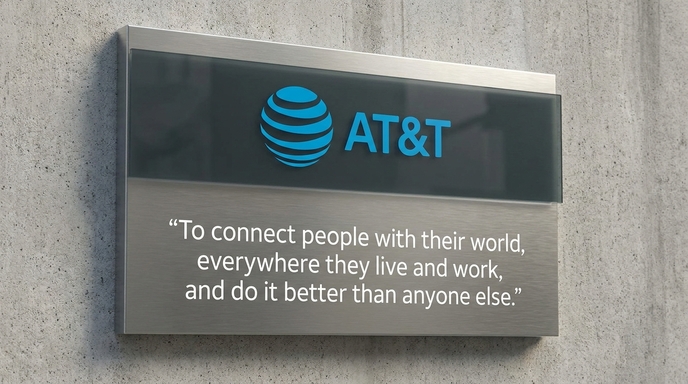
What Is AT&T’s Mission Statement?
“To connect people with their world, everywhere they live and work, and do it better than anyone else.”
This mission statement packs a lot into a single sentence. The phrase “connect people with their world” is deliberately broad. It covers wireless calls and texts, but it also includes broadband internet, business networking, and new services that link people to entertainment, healthcare, and education. AT&T does not define its job as selling phone plans. It defines its job as making those connections reliable and seamless for everyone, regardless of location.
The next part, “everywhere they live and work,” sets a high bar for coverage. It commits the company to serving both dense cities and rural communities, inside office buildings and on highways. That promise directly influences where AT&T spends its capital, pushing it to expand fiber and 5G into harder-to-reach places. The final clause, “do it better than anyone else,” injects a competitive edge. It moves the mission from a feel-good statement to a performance pledge. The embedded values are clear: a relentless focus on the customer, a commitment to reliability, and a refusal to settle for being average. This mission is not about technology for its own sake. It is about using technology to make people’s daily lives work better.
What Is AT&T’s Vision Statement?
“To be the world’s best at connecting people to their world.”
If the mission describes what AT&T does today, the vision describes the summit it wants to reach. The phrase “world’s best” is the star of the show here. It does not say “largest” or “most profitable.” It picks a quality standard that can be measured by customer satisfaction, network uptime, and innovation speed. That word choice tells employees and investors that the company intends to compete on excellence, not just scale.
This forward-looking intent shapes AT&T’s long-term bets. When the company pours billions into expanding its fiber footprint or building a dedicated first-responder network called FirstNet, it points back to this vision. The vision also sets an external benchmark. Being the best globally means matching or beating competitors in Europe, Asia, and beyond, not just winning in the United States. For customers, the vision promises that AT&T will keep pushing for faster, more reliable connections. For employees, it provides a rallying point that goes beyond quarterly earnings. It is an aspirational target that will never be fully checked off, and that is intentional. The best never stop improving.
What Is AT&T’s Purpose Statement?
“We create connection.”
This three-word sentence is the most streamlined message AT&T publishes. Where the mission explains what the company does and the vision explains where it is headed, the purpose explains why AT&T exists at all. “We create connection” is deliberately human. Connection is not just about cables and cell towers. It means linking a small business owner to a new market, letting a grandparent see a grandchild’s first steps over video, and giving first responders a lifeline during a crisis.
This purpose statement became prominent around 2019 when AT&T shifted its portfolio dramatically. After selling off media assets and refocusing on telecommunications, the company needed a clear, emotionally resonant anchor. “We create connection” became that anchor. It now shows up in employee onboarding, advertising campaigns, and community programs. It influences decisions like offering low-cost internet to qualifying households and building climate resilience into network infrastructure. The purpose does not replace the mission or vision. It sits underneath them as the foundation, reminding everyone inside the company that the ultimate product is not data or bandwidth. It is human connection.
101 Mission Statements is for you if:
- You’re a leader or entrepreneur needing a clear, inspiring statement of intent for your business or nonprofit.
- You want your team and clients aligned with a shared vision of excellence and long-term goals.
- You need a step-by-step guide to craft a customized mission statement that acts as a blueprint for future success.
Key Differences Between AT&T’s Mission and Vision
A fast way to grasp how AT&T’s mission and vision work together is to see them side by side. The table below highlights what makes each statement distinct while showing how they complement one another.
| Aspect | Mission Statement | Vision Statement |
|---|---|---|
| Focus | Daily operations and service delivery. | Long-term ambition and market position. |
| Timeframe | Present and ongoing. | Future and aspirational. |
| Primary Audience | Customers and employees. | Stakeholders, investors, and the broader market. |
| Core Question Answered | What do we do and for whom? | Where do we want to be? |
| Purpose | Guide actions and decisions today. | Inspire and set direction for the future. |
Both statements are essential. The mission acts as the engine, pushing AT&T to execute every day. The vision acts as the destination, pulling the company toward a goal it has not yet achieved. When you add the purpose statement, “We create connection,” you get the fuel. It is the reason the engine runs in the first place. Together, they form a self-reinforcing system that keeps the brand on track even as technology and customer habits change.
Core Values Behind AT&T’s Mission and Vision
AT&T’s mission, vision, and purpose sit on a foundation of five stated core values. These values define how the company expects its people to behave while pursuing its goals.
Act with Integrity: Do the right thing even when no one is watching. This value builds the trust that a connectivity provider must have with customers and regulators, directly supporting the “better than anyone else” promise in the mission.
Be Accountable: Take ownership of outcomes and decisions. Accountability turns the bold language of the vision into a day-to-day discipline, ensuring that teams deliver on commitments.
Champion Diversity and Inclusion: Build a workforce that reflects the world AT&T connects. A diverse team fuels the innovation needed to be the world’s best and aligns with a mission that serves everyone, everywhere.
Lead with Innovation: Push technology forward to solve real problems. This value powers the mission’s call to connect people in new and better ways and keeps the vision of global leadership within reach.
Deliver Results: Meet commitments to customers and shareholders. This value grounds the lofty vision in reality. It ensures that great intentions translate into reliable networks, better service, and strong business performance.
These five values do not sit in isolation. They work as a behavioral checklist. Hire against them. Evaluate performance against them. When a difficult decision pits speed against integrity, the values are supposed to win. That is how the company tries to make its mission and vision tangible for every employee.
How AT&T Lives Its Mission and Vision
A mission statement means little if the company’s actions tell a different story. AT&T points to several major initiatives that give weight to its words.
The FirstNet network is a clear example. AT&T built and operates a dedicated, highly secure communications platform for first responders across the United States. That investment puts the mission into practice by connecting people where they live and work in life-or-death situations. It also supports the vision of being the world’s best by setting a high bar for reliability and priority access that few competitors can match.
The company’s “Access from AT&T” program offers low-cost, high-speed internet to qualifying households. This initiative tackles the digital divide head-on. It shows that “create connection” is not just for customers who can pay a premium. By making connectivity affordable, AT&T extends its mission to people who might otherwise be left out, reinforcing the purpose statement in a measurable way.
AT&T’s massive, multi-year investment in fiber optic expansion and 5G deployment also mirrors its stated direction. The company has committed to passing millions of new residential and business locations with fiber, including in underserved rural areas. This spend demonstrates the “everywhere they live and work” part of the mission and the relentless push toward the vision of being the best. You cannot be the best if large parts of your service area lack fast, reliable internet.
Finally, AT&T’s public commitment to carbon neutrality by 2035 illustrates how the purpose of creating connection extends to the planet. The company helps businesses reduce their own emissions through connected solutions like smart energy management. This shows that AT&T sees connection as a tool for solving big societal problems, not just as a consumer product.
How AT&T’s Mission and Vision Have Evolved
AT&T’s origin story reaches back to Alexander Graham Bell and the Bell Telephone Company, which operated with a foundational goal of universal telephone service. For much of the 20th century, that goal was the company’s de facto mission. The breakup of the Bell System in 1984 and the roller coaster of mergers that followed forced the company to rethink its identity repeatedly. When SBC Communications acquired AT&T Corp. in 2005 and took the storied AT&T name, the newly formed company needed a mission that covered wireless, broadband, and business services rather than just landline telephony.
The mission statement that anchors the company today, centered on connecting people with their world, emerged in the late 2000s and has stayed remarkably consistent. The bigger shift occurred around 2019. After years of owning media properties like WarnerMedia, AT&T reversed course, divested those assets, and returned to its core as a connectivity company. The introduction of the purpose statement “We create connection” marked that strategic pivot. It was a public acknowledgment that the company had spread itself too thin and needed to refocus on what it did best. This evolution underscores a larger lesson: when a company strays from its core mission, even a powerful brand can lose its way. The renewed emphasis on connection signals that AT&T now sees simplicity and focus as competitive advantages.
What Your Company Can Learn from AT&T’s Statements
AT&T’s mission, vision, and purpose offer practical lessons for any organization writing or refreshing its own guiding statements.
Be specific about who you serve. AT&T’s mission includes the phrase “everywhere they live and work.” That specificity tells network engineers where to build and guides marketing toward real use cases. A vague promise like “empower everyone” sounds nice but fails to anchor decisions. You want a statement that helps a team say yes to the right project and no to a tempting distraction.
Keep purpose simple and memorable. “We create connection” is three words. Employees can remember it. Customers can understand it. A short purpose statement is more likely to appear in conversation, on internal posters, and in leadership messages without feeling forced. If your purpose needs a paragraph to explain, it probably is not clear enough yet.
Align vision with a measurable standard. AT&T did not choose “to be a leading communications company.” It chose “to be the world’s best.” That word “best” forces the company to define what best looks like and how to track it. When you write a vision, ask whether you could objectively know if you had achieved it. If the answer is no, sharpen the language.
Use values as guardrails, not decoration. AT&T’s values like “Act with Integrity” and “Deliver Results” are designed to collide with real-world trade-offs. Can you deliver results without cutting corners on integrity? That tension is the point. Write values that will be tested under pressure, and they will actually shape culture. Write values that never cause discomfort, and they will be ignored.
Frequently Asked Questions
Q: What is AT&T’s current mission statement?
A: AT&T’s mission statement is “To connect people with their world, everywhere they live and work, and do it better than anyone else.”
Q: What is AT&T’s vision for the future?
A: AT&T’s vision is “To be the world’s best at connecting people to their world.” It sets a long-term aspiration focused on quality and global leadership.
Q: Does AT&T have a separate tagline from its mission statement?
A: Yes. AT&T uses the tagline “Connecting changes everything” in its brand advertising. The tagline is a consumer-facing slogan, while the mission statement is an internal and strategic guide.
Q: How does AT&T’s mission statement reflect its brand identity?
A: The mission positions AT&T as a connector of people and possibilities, not just a network provider. It highlights reliability, ubiquity, and a competitive drive, which are core to the brand’s identity.
Q: Has AT&T’s mission or vision statement ever changed?
A: Over time, the emphasis has shifted from universal telephone service to broadband, mobile, and fiber connectivity. The most significant recent change was the adoption of the purpose statement “We create connection” around 2019 to signal a return to core connectivity.
Q: What core values guide AT&T?
A: AT&T lists five core values: Act with Integrity, Be Accountable, Champion Diversity and Inclusion, Lead with Innovation, and Deliver Results.
Q: How does AT&T put its mission into practice?
A: The company puts its mission into practice through major initiatives. Examples include the FirstNet network for first responders, the Access from AT&T low-cost internet program, ongoing fiber and 5G expansion into rural areas, and a commitment to reach carbon neutrality by 2035.
Wrap-Up
AT&T’s statements paint a coherent picture. The mission acts, the vision pulls forward, and the purpose gives it all meaning. They reveal a company that has learned that focus beats sprawl and that a clear, competitive promise is better than a fuzzy, inspirational one. The emphasis on doing it “better than anyone else” signals that AT&T intends to win on quality, not just familiarity.
What do you think of AT&T’s direction? Do these statements match your experience as a customer or an observer of the brand? Share your perspective in the comments below.
101 Mission Statements is for you if:
- You’re a leader or entrepreneur needing a clear, inspiring statement of intent for your business or nonprofit.
- You want your team and clients aligned with a shared vision of excellence and long-term goals.
- You need a step-by-step guide to craft a customized mission statement that acts as a blueprint for future success.
Be First to Comment