A company that sells 400 brands in over 190 countries does not stay relevant by accident. Unilever’s longevity comes from a deep, and unusually clear, sense of why it exists. Mission and vision statements are not just decoration for a corporate website. They shape product decisions, hiring choices, and multi-billion-dollar investments. When those statements feel honest and specific, they help a massive, complex organization move like a single, focused entity.
Unilever does not publish a traditional, separate mission statement. Instead, its corporate purpose, “to make sustainable living commonplace,” acts as the company’s true north. This single sentence is the filter for nearly every major strategic move the business makes. Unilever’s official vision, meanwhile, looks outward to a defined leadership position: “to be the global leader in sustainable business.” Together, these two statements tell you what Unilever wants to achieve every day and where it intends to stand in the long run.
The story behind them reveals a business that has repeatedly rewired itself around a changing world. From Victorian soap bars to plant-based food innovation, Unilever’s directional language has evolved while staying rooted in one idea: that commerce can and should solve real problems. The sections that follow unpack what these statements mean, how they differ, where they came from, and what any organization can learn from them.
What Is Unilever’s Mission Statement?
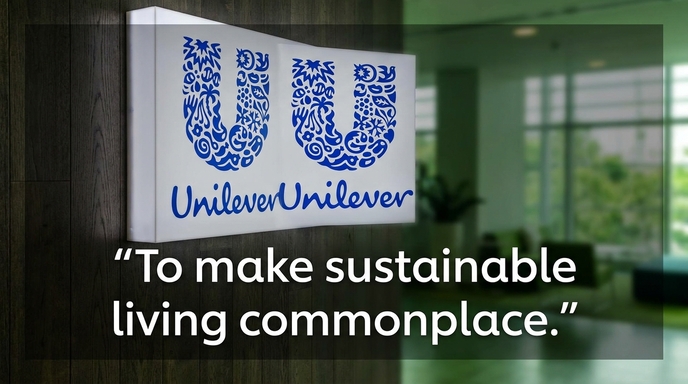
Unilever does not list a separate mission statement on its official site. The company’s purpose, “to make sustainable living commonplace,” serves the same role that a mission statement does for other corporations. It describes the day-to-day work, the reach of its business, and the core belief that motivates the organization. Here is the exact wording that Unilever places at the center of its strategy:
To make sustainable living commonplace.
In plain language, Unilever’s purpose says that products designed for everyday nutrition, hygiene, and personal care should not come at the expense of people or the planet. The word “commonplace” is deliberate. It does not ask consumers to make extraordinary sacrifices or pay a premium for ethical goods. Instead, it commits the business to making better options normal, affordable, and available everywhere. The statement is brief, but it pulls a huge amount of strategic weight. It tells employees that innovation must be tied to environmental and social impact. It tells investors that growth and sustainability are linked. It tells shoppers that the brands in their homes, from Dove to Hellmann’s, are backed by a clear promise.
This purpose is not just a slogan. It resets the relationship between the company and the end user. Unilever’s brands serve an estimated 3.4 billion people each day. That scale makes the idea of “commonplace” a serious operational challenge. It means supply chains, packaging systems, and ingredient sourcing must all bend toward a sustainable model without losing reach or affordability. The purpose, in effect, demands that the company prove sustainability is not a niche luxury but a baseline standard.
101 Mission Statements is for you if:
- You’re a leader or entrepreneur needing a clear, inspiring statement of intent for your business or nonprofit.
- You want your team and clients aligned with a shared vision of excellence and long-term goals.
- You need a step-by-step guide to craft a customized mission statement that acts as a blueprint for future success.
What Is Unilever’s Vision Statement?
A purpose describes what a company does today and why. A vision describes the future position it intends to claim. Unilever’s official vision is public and unambiguous. It appears in the Unilever Compass, the company’s long-term business strategy document:
To be the global leader in sustainable business. We will demonstrate how our purpose-led, future-fit business model drives superior performance.
Unilever’s vision shifts the conversation from intent to leadership. The company is not simply aiming to be a large consumer goods firm that happens to have sustainability programs. It wants to be the reference point, the business other companies measure themselves against when they talk about doing well by doing good. The second sentence is especially revealing. It explicitly ties the company’s purpose to financial performance, a direct response to persistent questions about whether sustainable business models can deliver shareholder value at scale.
This vision has practical meaning for employees and partners. It signals that internal metrics around carbon reduction, plastic circularity, and living wages in the supply chain are just as central as market share and revenue growth. It also communicates a competitive edge: the brand portfolio is positioned not just on taste or cleaning power but on the ability to offer a better version of everyday life. Customers who choose a Unilever product are, in the vision’s framework, opting into a system that aims to prove sustainability wins in the marketplace.
What Is Unilever’s Purpose Statement?
While the previous section already named “to make sustainable living commonplace” as the company’s directional mission, it is worth formally recognizing that Unilever designates this line as its corporate purpose. Unlike firms that publish a mission, a vision, and a separate purpose, Unilever uses this one statement as the foundation. It is the answer to the question “Why does Unilever exist?” Here it is again, explicitly framed as the purpose:
To make sustainable living commonplace.
This statement defines the company’s core reason for existence. Unilever does not exist simply to sell soap, ice cream, or dressings. It exists, by its own declared standard, to integrate sustainability into the normal rhythm of daily consumption. The impact the company aims to create is systemic: a world where buying a deodorant or a jar of mayonnaise does not force a trade-off between personal care and planetary health. This purpose influences product formulation (removing microplastics, shifting to biodegradable ingredients), brand activism (Dove’s Self-Esteem Project, Lifebuoy’s hygiene education), and long-term capital allocation. It also forces internal accountability. Unilever’s leadership regularly reports progress against a public set of sustainability goals, and the purpose requires that those goals feel urgent, not optional. In short, the purpose statement is the gravitational center. Everything else, including the vision, orbits around it.
Key Differences Between Unilever’s Mission and Vision
Unilever’s purpose operates as its mission, anchoring the company in its daily function. Its vision reaches forward to a status the company has not yet fully achieved. The table below isolates how these two statements serve different roles while remaining tightly connected.
| Element | Unilever’s Purpose (Mission) | Unilever’s Vision |
|---|---|---|
| Focus | Making sustainable living normal and accessible today | Becoming the undisputed global leader in sustainable business |
| Timeframe | Present and ongoing activity | Future aspirational state |
| Primary Audience | Consumers, employees, and society | Investors, competitors, and the wider market |
| Core Question Answered | What do we do and why? | Where do we want to stand? |
| Purpose | Drive everyday decisions and product development | Set competitive direction and define long-term success |
These two statements are distinct but complementary. The purpose gives teams a shared test for daily choices, while the vision gives the whole organization a destination that feels ambitious but not abstract. Without the purpose, the vision would sound like a boast. Without the vision, the purpose would lack a tangible measure of market impact.
Core Values Behind Unilever’s Mission and Vision
Unilever’s official code of conduct and culture rests on four core values. Each one translates the abstract idea of “sustainable living” into a specific behavior.
Integrity: Doing the right thing, even when no one is watching, and holding the business to transparent standards. This value protects the purpose from becoming a marketing exercise by demanding honest reporting and ethical sourcing.
Respect: Caring about the people the business touches, from factory workers to consumers, and treating their well-being as non-negotiable. Respect keeps the vision of leadership grounded in human outcomes, not just market share.
Responsibility: Taking ownership of the company’s footprint, from packaging waste to carbon emissions, and refusing to externalize costs onto communities. Responsibility is the engine that turns the purpose into measurable action.
Pioneering: Approaching problems with curiosity and a willingness to experiment. This value matters because “commonplace” sustainability does not yet exist. It has to be invented through better formulations, new materials, and different business models.
These four values operate as a system. Integrity ensures the company reports honestly on its progress. Respect keeps the focus on people. Responsibility demands action. Pioneering supplies the creativity to solve hard problems. Together, they form the behavioral code that makes the purpose and vision believable.
How Unilever Lives Its Mission and Vision
Broad statements are easy to write and easy to ignore. Unilever’s record shows a consistent effort to embed its purpose and vision into real-world operations.
The Dove Self-Esteem Project is one of the longest-running brand purpose programs in the world. Since 2004, it has reached over 94 million young people with body confidence education. This initiative does not sell soap directly. It addresses the mental health link between beauty standards and well-being, a genuine social issue. The campaign reflects the purpose of making sustainable living commonplace by treating emotional resilience as part of personal care. It also supports the vision by building brand equity through sustained social impact rather than short-term advertising.
Lifebuoy’s hand hygiene programs take the purpose into some of the world’s most underserved communities. Through school-based education and behavior change campaigns, the brand has helped millions of children adopt lifesaving handwashing habits. This is not a side project. It is a core part of Lifebuoy’s brand identity, directly linking hygiene products to measurable public health outcomes.
Hellmann’s “Make Taste, Not Waste” campaign tackles household food waste, a major contributor to greenhouse gas emissions. The brand reformulated products, published recipes designed to use leftovers, and partnered with organizations to shift consumer behavior. The initiative aligns with the purpose by normalizing waste reduction in the kitchen and with the vision by positioning Hellmann’s as a market leader in responsible food culture.
Unilever’s operational commitments provide the structural backbone for these campaigns. The company has pledged to achieve zero waste to landfill across its factories, to collect and process more plastic than it sells, and to ensure a living wage for everyone in its direct supply chain by 2026. These targets are public and audited, which forces the organization to treat its purpose and vision as accountable promises, not aspirational mood boards.
How Unilever’s Mission and Vision Have Evolved
Unilever’s sense of purpose has deep roots. The company was formed in 1929 through the merger of a Dutch margarine business and a British soap maker. Even before that merger, William Hesketh Lever, one of the founders, was driven by a clear idea: “to make cleanliness commonplace.” He saw Sunlight soap as a tool to improve public health in Victorian England and later in communities across the British Empire. That early language of “commonplace” improvement planted a seed that would reappear, in updated form, nearly a century later.
For much of the late 20th and early 21st century, Unilever’s public identity orbited around a different mission: “to add vitality to life.” That statement, paired with the tagline “Feel good, look good and get more out of life,” framed the company around personal well-being and everyday energy. It was a consumer-centric promise that matched the mood of the 2000s but said little about the environmental or social cost behind the products.
The shift arrived in a visible way in 2010 with the launch of the Unilever Sustainable Living Plan (USLP). The USLP set ambitious, time-bound targets to decouple growth from environmental impact. Then, in 2020, CEO Alan Jope introduced the Unilever Compass. This strategy retired the old vitality mission entirely and placed “to make sustainable living commonplace” at the center. The vision of becoming the global leader in sustainable business was layered on top. This evolution is not cosmetic. It signals that Unilever now sees its competitive future as inseparable from its ability to solve systemic problems, from climate change to social inequality.
What Your Company Can Learn from Unilever’s Statements
Unilever’s approach to directional language offers practical lessons for founders, brand managers, and marketing leaders. The company’s statements are not perfect, but they are unusually useful. Here is what you can borrow.
Unilever’s purpose does not describe what it sells. It describes a change it wants to make. The takeaway is simple. A mission or purpose should answer the question “Who would miss us if we disappeared?” If your statement sounds like a product category description, strip it back and start again.
The vision ties purpose directly to business performance. Unilever’s statement openly says the purpose-led model will drive superior performance. That is brave and specific. Your vision should make a claim you are willing to be measured against. Vague language like “to be the best” signals nothing. Specific, measurable ambition signals confidence.
The values are written as behaviors, not nouns. “Integrity” is meaningless unless it is paired with a description of what it looks like in practice. Unilever defines each value with an action. When you list your own company values, force yourself to attach a verb to each one. If you cannot, it is probably not a real value.
Consistency between purpose and operations builds trust. Unilever’s brands do not just talk about hygiene or body confidence. They run decade-long programs that become part of the brand’s identity. Your mission will only stick if your product, supply chain, and marketing all point in the same direction.
Frequently Asked Questions
Q: What is Unilever’s current mission statement?
Unilever does not publish a separate, standalone mission statement. Its corporate purpose, “to make sustainable living commonplace,” functions as the company’s de facto mission and shapes its daily operations and strategy.
Q: What is Unilever’s vision for the future?
Unilever’s official vision is “to be the global leader in sustainable business” and to demonstrate how a purpose-led, future-fit model drives superior performance.
Q: Does Unilever have a separate tagline from its mission statement?
Unilever previously used the tagline “Feel good, look good and get more out of life,” which aligned with its old “vitality” mission. The company no longer promotes a single global corporate tagline. Its brand portfolio uses individual taglines tied to specific products.
Q: How does Unilever’s purpose reflect its brand identity?
The purpose “to make sustainable living commonplace” directly reflects an identity built on making ethical choices accessible at scale. It positions Unilever as a business that sees its massive reach as a tool for normalizing sustainability rather than as a reason to cut corners.
Q: Has Unilever’s mission or vision ever changed?
Yes. The company’s guiding language has evolved from William Lever’s 19th-century goal of making “cleanliness commonplace” to the “vitality” mission of the 2000s, and finally to the purpose-led, sustainability-focused statements of the Unilever Compass launched in 2020.
Q: What core values guide Unilever?
Unilever is guided by four core values: Integrity, Respect, Responsibility, and Pioneering. Each value is defined by a specific behavior, such as doing the right thing, caring about people, owning the company’s footprint, and approaching problems with curiosity.
Q: How does Unilever put its mission into practice?
Unilever puts its purpose into practice through brand-level initiatives like the Dove Self-Esteem Project and Lifebuoy’s handwashing programs, operational commitments on plastic and carbon, and a public set of sustainability targets that are tracked and reported annually.
Final Thoughts
Unilever’s decision to replace a cheerful consumer-facing mission with a purpose statement rooted in sustainability is a strategic bet, not a feel-good exercise. The company is wagering that what shoppers, top talent, and long-term investors want from a giant consumer goods firm has permanently changed. Its purpose and vision statements make that bet explicit and put a clear scoreboard in place.
The lesson for any organization is that strong directional language does not try to please everyone. It makes a choice. Unilever chose to pin its future on the idea that business can normalize better living at a planetary scale. What do you think of Unilever’s approach to purpose and vision? Share your perspective in the comments below.
101 Mission Statements is for you if:
- You’re a leader or entrepreneur needing a clear, inspiring statement of intent for your business or nonprofit.
- You want your team and clients aligned with a shared vision of excellence and long-term goals.
- You need a step-by-step guide to craft a customized mission statement that acts as a blueprint for future success.
Be First to Comment