A company’s mission and vision statements are more than just words on a lobby wall. They serve as a compass for thousands of employees and a signal to customers about what truly matters. When a massive multinational gets them right, those few sentences can guide decades of strategy. When it gets them wrong, the drift shows up in confused product lines, brand erosion, and a workforce that loses direction. That is why companies like General Electric offer such a useful case study. GE has spent over a century redefining what it stands for, and its current statements reflect one of the most dramatic corporate restructurings in modern history.
General Electric, a name once synonymous with light bulbs, appliances, and finance, completed its split into three independent companies in 2024. The entity that kept the GE name and stock ticker is now a focused aerospace leader, officially called GE Aerospace. Its mission, which the company often calls its purpose, is stated clearly: “To invent the future of flight, lift people up, and bring them home safely.” GE does not publish a separate vision statement. Instead, this purpose acts as both the daily mission and the long term aspirational north star.
Reading that one sentence tells you exactly what the company does now and what it refuses to compromise on. It also hints at why a 130-year-old conglomerate chose to break itself apart. What follows is a detailed look at that mission, what takes the place of a formal vision, the values that support it, and how the words connect to real world decisions.
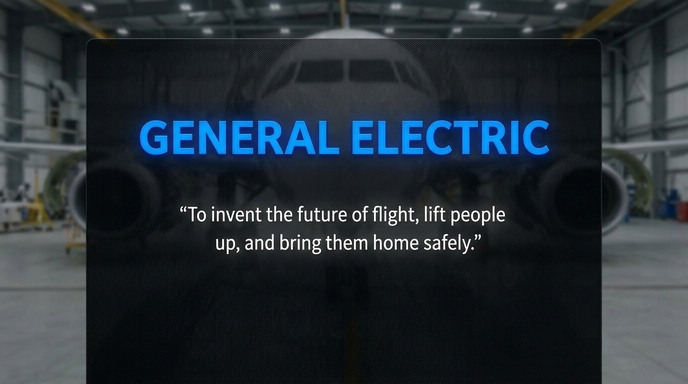
What Is General Electric’s Mission Statement?
To invent the future of flight, lift people up, and bring them home safely.
Each part of this mission carries a specific weight. “Invent the future of flight” is about relentless technical progress. It commits GE Aerospace to pushing propulsion technology beyond incremental gains, aiming for breakthroughs in fuel efficiency, emissions reduction, and aircraft performance. This is not a sleepy promise to maintain market share. It is a statement of leadership intent.
“Lift people up” works on two levels. Literally, it refers to the physics of flight and GE’s role in powering the aircraft that connect cities and economies. Figuratively, it signals that the company sees its work as a force for economic mobility and human connection. A family flying to visit relatives, a cargo jet delivering medical supplies, a military transport carrying aid, all of these scenarios depend on the engines and systems GE builds. “Bring them home safely” places safety above all other performance metrics. It speaks to the weight of responsibility when you design parts that operate at 2,000 degrees and spin at thousands of revolutions per minute. For military pilots, this line is especially literal. For commercial passengers, it is a reminder that an engine failure is not an option. The sentence is short enough to fit on a badge and deep enough to guide billion dollar R&D budgets.
101 Mission Statements is for you if:
- You’re a leader or entrepreneur needing a clear, inspiring statement of intent for your business or nonprofit.
- You want your team and clients aligned with a shared vision of excellence and long-term goals.
- You need a step-by-step guide to craft a customized mission statement that acts as a blueprint for future success.
Does General Electric Have a Separate Vision Statement?
GE Aerospace does not publish a standalone vision statement. In many organizations, the mission describes what the company does today, while the vision paints a picture of the future it wants to build. GE chooses to collapse that distinction into one powerful purpose. This is not unusual. A growing number of firms argue that a split confuses more than it clarifies. When a purpose is future oriented enough, it can do both jobs.
Even without a separate vision, GE Aerospace communicates its long term aspirations clearly through its technology roadmaps and public commitments. The company has pledged to achieve net zero carbon emissions by 2050 for its own operations and to work with the aviation industry on the broader goal of decarbonizing flight. Its engineering teams are actively developing open fan engine architectures, hybrid electric propulsion, and full compatibility with 100 percent sustainable aviation fuel. These are not incremental tweaks. They outline a future where air travel is dramatically cleaner, quieter, and still universally accessible. You could reasonably frame that as the company’s implied vision: a world in which flight is so safe, efficient, and sustainable that it becomes an unquestioned force for good. The lack of a separate vision statement does not mean a lack of direction. It means the direction is baked into the mission itself.
Core Values of General Electric
GE Aerospace anchors its culture on a set of core values that are embedded in hiring, performance reviews, and daily operations. These are the behaviors the company expects from every employee, from assembly technicians to the C-suite. The published values include the following.
- Safety: The absolute priority. Employees are trained and empowered to stop any job if a safety risk appears. Safety is not just about personal injury. It extends to the airworthiness of every component that leaves a GE factory.
- Integrity: Acting with honesty and transparency, even when it is difficult. This value traces back to the company’s long focus on compliance and ethical sourcing in a highly regulated industry.
- Innovation: A commitment to continuous technical improvement. GE’s culture rewards engineers who challenge old assumptions and push for better materials, smarter software, and novel architectures.
- Collaboration: Breaking silos between teams, customers, and suppliers. Modern jet engines are so complex that no single group can optimize them alone. Collaboration speeds learning and reduces errors.
- Inclusion: Building teams with diverse backgrounds and making sure every voice is heard. The company sees inclusion as a practical necessity, because complex problem solving benefits from multiple perspectives.
These values are not decorative. They directly support the mission. You cannot “bring them home safely” without a culture that puts safety first. You cannot “invent the future of flight” without innovation and collaboration. The values form the operational backbone that turns the mission from a slogan into a daily standard.
How the Mission and Vision Evolved Over Time
General Electric was born in 1892 from the merger of Edison General Electric and the Thomson Houston Electric Company. Its early identity revolved around electrifying America, and its mission was practical: make reliable light, power, and machines. By the 1950s, the company distilled its ethos into the tagline “Progress is our most important product.” That phrase, which appeared in ads and annual reports, positioned GE as a broad engine of modernization, not just a manufacturer.
In 1979, GE launched one of the most iconic campaigns in corporate history: “We bring good things to life.” This wasn’t just a jingle. It became the de facto mission statement, linking the company’s sprawling industrial and consumer products to an emotional benefit. It lasted a quarter century. In 2003, under CEO Jeff Immelt, the company replaced it with “Imagination at work.” The shift was deliberate. Immelt wanted to reposition GE as a technology and innovation powerhouse, moving away from the softer “good things” era and toward a future built on digitization, renewable energy, and global infrastructure.
Then came the hard decisions. GE’s conglomerate model, once celebrated, started to show strain after the 2008 financial crisis. Over the next decade, the company sold off major divisions including appliances, plastics, NBC Universal, and most of GE Capital. In 2023, GE HealthCare was spun off as an independent company. In 2024, GE Vernova, the energy business, followed. The remaining aviation focused company emerged as GE Aerospace, and with that focus came a new purpose. The new mission shed all pretense of being a general industrial house. It spoke only to flight. This evolution is a case study in how mission statements must honestly reflect what a business has become, not what it used to be.
The Mission in Action: Strategies, Products, and Campaigns
GE Aerospace’s mission is not abstract. It shows up in specific engine programs, sustainability bets, and the way the company talks about its work.
The GE9X engine, which powers the Boeing 777X, is a direct expression of “invent the future of flight.” It is the largest and most fuel efficient commercial jet engine ever built, using ceramic matrix composites and 3D printed parts that were unthinkable a generation ago. The LEAP engine, produced through the CFM International joint venture with Safran, brings similar advanced materials to single aisle aircraft. It reduces fuel burn and CO2 emissions by about 15 percent compared to previous models. That is a concrete step toward a more sustainable future.
On the military side, engines like the F414 and the experimental XA100 adaptive cycle engine show the “bring them home safely” commitment in high stakes environments. The XA100 can switch between high thrust and high efficiency modes in flight, giving pilots options that directly affect survivability. GE also invests in digital flight deck tools that use predictive analytics to catch maintenance issues before they become safety risks. This data driven approach weaves safety into the daily rhythm of airline operations.
Perhaps the clearest signal of the mission in action is the RISE program, again through CFM International. RISE aims to develop an open fan engine architecture that could reduce fuel consumption and CO2 emissions by another 20 percent compared to the LEAP. Flight tests are planned for the latter half of this decade. Add to that the company’s work on hybrid electric propulsion and 100 percent sustainable aviation fuel compatibility, and you see a consistent thread. Every major program asks the same question: Does this invent the future, connect people, or make flight safer? If the answer is no, it doesn’t fit the mission.
Mission vs. Direction at a Glance
The table below summarizes how GE Aerospace’s published purpose and its implied long term direction compare. Since no separate vision statement exists, the right hand column captures the aspirational goals that emerge from the company’s strategies and public commitments.
| Aspect | Mission (Purpose) | Aspirational Direction |
|---|---|---|
| Statement | To invent the future of flight, lift people up, and bring them home safely. | No formal vision statement; implied ambition of carbon neutral, universally accessible, and inherently safe flight. |
| What It Means | Defines what the company does every day and why it exists. | Describes the long term change the company wants to drive in the aviation industry. |
| Key Focus | Technology leadership, safety culture, customer success, and invention. | Decarbonization, global connectivity, and next generation safety standards. |
| Timeframe | Present tense and continuously applied. | A horizon set by sustainability goals (net zero by 2050) and multi decade technology roadmaps. |
This structure keeps the entire organization aligned behind one clear phrase while still setting a far reaching destination for researchers and strategists.
What You Can Learn from General Electric’s Approach
Businesses of any size can extract useful lessons from how GE’s mission and identity have evolved. Here are a few that apply whether you run a startup or a division inside a larger company.
- Clarity beats complexity every time. GE’s current mission is a single sentence. It replaced decades of sprawling corporate language. A focused mission forces trade offs and makes it easier for employees to know what to prioritize. If your mission could apply to five different industries, it probably needs sharpening.
- Safety can be a strategic differentiator. Most companies treat safety as a compliance issue. By putting it directly in the mission statement, GE Aerospace makes it a brand promise. Customers and governments who buy jet engines are buying assurance. Wording your mission to include a non-negotiable commitment can build trust faster than any advertising campaign.
- A mission can and should change. Some leaders treat a mission as permanent heritage. GE proves otherwise. When the business changed from a conglomerate to a pure play aerospace company, the mission changed with it. That honesty matters. A legacy mission that no longer describes your actual business confuses talent and investors.
- You don’t need a separate vision statement if your purpose is ambitious enough. GE’s purpose already describes a future state, inventing the future of flight is inherently aspirational. Small and medium businesses often waste energy trying to craft two perfect statements when one strong purpose will do the same work. The key is to build concrete long term goals, such as sustainability targets, around that purpose so that the destination is measurable even if it isn’t printed on a separate plaque.
GE’s journey from an electric startup in the 1890s to a focused aerospace giant in the 2020s shows that mission statements live and die by their relevance. The current statement works because it is true. It describes exactly what GE Aerospace does, who it serves, and why failure is not an option. That kind of honesty is worth more than any clever tagline. When you sit down to revise your own organization’s guiding words, focus less on sounding impressive and more on capturing what you actually intend to deliver. If the sentence can’t guide a tough budget decision or a hiring choice, it probably needs another draft.
101 Mission Statements is for you if:
- You’re a leader or entrepreneur needing a clear, inspiring statement of intent for your business or nonprofit.
- You want your team and clients aligned with a shared vision of excellence and long-term goals.
- You need a step-by-step guide to craft a customized mission statement that acts as a blueprint for future success.
Be First to Comment