A company’s mission and vision statements are more than words on a wall. They reveal how a brand sees its role in the world and where it intends to go. When those statements are clear, every decision from store design to supplier partnerships can trace back to them.
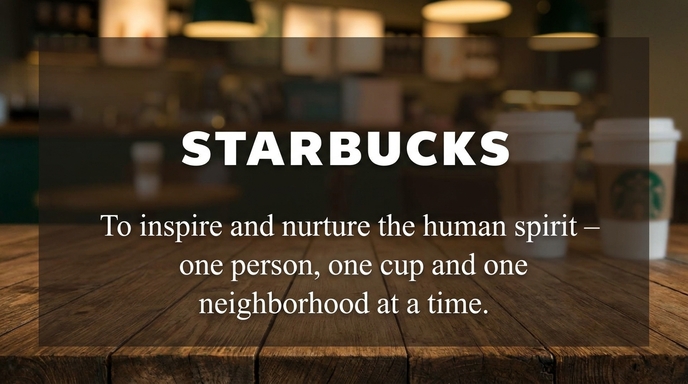
Starbucks, the Seattle-born coffeehouse chain that grew from a single store in Pike Place Market into a global brand, has anchored itself in one of the most recognizable corporate missions. Its current official mission statement is: To inspire and nurture the human spirit – one person, one cup and one neighborhood at a time. Starbucks does not publish a separate, standalone vision statement. Instead, its forward-looking aspirations sit inside that mission and in a set of ambitious long-term goals that act as a directional compass. This article unpacks what those statements mean, where they came from, and how they show up in real business choices.
What Is Starbucks’ Mission Statement?
“To inspire and nurture the human spirit – one person, one cup and one neighborhood at a time.”
This mission puts the human experience at the center of everything Starbucks does. It does not mention coffee explicitly. That is intentional. The statement frames coffee as the vehicle, not the destination. The destination is human connection. “Inspire” signals an emotional lift. “Nurture” speaks to care, warmth, and consistency. “One person, one cup and one neighborhood at a time” scales that ambition down to a manageable, intimate unit. It tells employees (whom Starbucks calls partners) that global impact starts with a single interaction.
The phrasing also hints at the company’s third-place philosophy. Starbucks wants its cafes to function as a comfortable space between home and work. That philosophy lives inside the mission. Every barista greeting, every handcrafted drink, and every store layout is supposed to serve that larger purpose. You see a mission that is not about selling products. It is about designing moments. For a business analyst, that shift is significant. It moves Starbucks from a transactional coffee seller to an experience brand.
What Is Starbucks’ Vision Statement?
Starbucks does not publish an official, separate vision statement on its corporate site. Instead, the company’s long-term direction emerges from its mission, its publicly stated strategic priorities, and its sustainability commitments. Many large organizations separate mission (what we do today) from vision (where we are headed). Starbucks blends the two. Its mission already contains a forward-reaching quality. “Inspire and nurture the human spirit” is an ongoing pursuit, not a completed task.
To understand where Starbucks is heading, you look at the goals it has set publicly. The company has committed to becoming resource-positive by 2030, storing more carbon than it emits and replenishing more freshwater than it uses. It also aims to be the employer of choice for part-time and full-time partners by offering industry-leading benefits and career pathways. These targets function as a de facto vision. They describe a future state in which Starbucks is not only a beloved coffee brand but also a leader in social and environmental performance. So while there is no single vision statement to quote, the destination is clear: scale the mission globally without abandoning the values that made it matter locally.
Key Differences Between Starbucks’ Mission and Vision
A clean comparison helps separate what Starbucks says it does today from the direction it is building toward.
| Aspect | Mission | Vision (Directional Statement) |
|---|---|---|
| Focus | The daily human experience inside and around a Starbucks store | The long-term role Starbucks wants to play in the world |
| Timeframe | Present and ongoing | Future-oriented, with milestones like the 2030 resource-positive goal |
| Primary Audience | Partners, customers, and communities | Shareholders, partners, and society at large |
| Core Question Answered | What do we do and why? | Where are we going and what kind of company do we want to become? |
| Purpose | Guides daily actions and customer interactions | Shapes strategy, investment, and innovation priorities |
Both are distinct but tightly linked. The mission gives everyone a shared why. The vision (even without a single sentence on a plaque) ensures that why has a future. When a company lacks this clarity, short-term decisions can drift away from brand identity. Starbucks avoids that drift by making its long-term ambitions measurable.
Core Values Behind Starbucks’ Mission and Vision
Starbucks lists four core values that directly support its mission and long-term direction. Each one translates a high-minded idea into a behavioral expectation.
Creating a culture of warmth and belonging, where everyone is welcome: This value turns the mission’s “human spirit” language into a concrete standard. Stores are designed to feel inclusive, and partners are trained to treat every customer as a guest, not a transaction.
Acting with courage, challenging the status quo: Starbucks has a history of making controversial decisions when its values demanded it. Closing all U.S. stores for racial-bias training in 2018 was an example. This value connects to the forward-looking vision by pushing the company to rethink its own norms.
Being present, connecting with transparency, dignity and respect: This value grounds the brand’s “one cup at a time” promise. It demands that partners (and the company as a whole) engage with full attention and honesty, whether they are interacting with a customer or a coffee farmer.
Delivering our very best in all we do, holding ourselves accountable for results: This value speaks to operational excellence and accountability. It supports the vision’s ambition of being a leader in sustainability and partner experience, not just a company that makes promises.
Together, these four values form a system. Warmth without courage could become passive. Courage without accountability could become reckless. The structure forces balance, which is essential for a brand that operates in 80-plus markets.
101 Mission Statements is for you if:
- You’re a leader or entrepreneur needing a clear, inspiring statement of intent for your business or nonprofit.
- You want your team and clients aligned with a shared vision of excellence and long-term goals.
- You need a step-by-step guide to craft a customized mission statement that acts as a blueprint for future success.
How Starbucks Lives Its Mission and Vision
Real behavior proves whether a mission is sincere or ornamental. Starbucks offers several verifiable examples where its stated beliefs become observable actions.
The company’s ethical sourcing program, C.A.F.E. Practices, was launched in 2004 and ties directly to the nurturing aspect of the mission. By setting standards for economic transparency, social responsibility, and environmental leadership in its coffee supply chain, Starbucks demonstrates that “nurture” extends past the store and into farming communities. The vision of a resource-positive future builds on this foundation, with investments in climate-resistant coffee varietals and farmer financing.
Another clear signal is the Starbucks College Achievement Plan, introduced in 2014. Through a partnership with Arizona State University, eligible U.S. partners can earn a bachelor’s degree with full tuition coverage. This program embodies the mission’s “inspire and nurture the human spirit” for the people who wear the green apron. It also supports the long-term vision of being an employer of choice. The numbers are public and auditable. Thousands of partners have graduated through the program.
Starbucks also made a deliberate choice to close all its company-operated stores in the United States for an afternoon in May 2018 to conduct racial-bias education for nearly 175,000 partners. The decision followed an incident in a Philadelphia store that contradicted the value of belonging. Financially, the closures cost millions in lost sales. Strategically, the move showed that the mission and values were not subordinate to quarterly earnings. It was a real-world stress test of the company’s stated commitment to human dignity.
Finally, the company’s push toward reusable packaging and greener stores illustrates the long-term vision taking material form. As of 2026, Starbucks operates thousands of LEED-certified or Greener Store framework locations and has set binding targets to cut waste and water use by half by 2030. These are not vague aspirations. They are timeline-driven commitments embedded in the company’s corporate reporting.
How Starbucks’ Mission and Vision Have Evolved
When Starbucks was founded in 1971 by Jerry Baldwin, Zev Siegl, and Gordon Bowker, it sold whole-bean coffee and equipment. There was no cafe experience and no mission statement about the human spirit. The brand’s initial identity centered on coffee quality and education.
The first formal mission came later, under Howard Schultz’s leadership. An early version read: “Establish Starbucks as the premier purveyor of the finest coffee in the world while maintaining our uncompromising principles.” That statement was competitive and product-focused. It served the business well during its aggressive expansion in the 1990s and early 2000s.
By the late 2000s, after a period of rapid growth followed by store closures and a stock decline, Schultz returned as CEO and refocused the company. The mission was rewritten to what it is today: “To inspire and nurture the human spirit – one person, one cup and one neighborhood at a time.” The shift from “premier purveyor” to “human spirit” marked a pivot from selling coffee to facilitating connection. It also broadened the company’s accountability. A purveyor is judged on product. A company that claims to nurture the human spirit is judged on its treatment of people. That evolution continues to shape how Starbucks communicates its priorities to investors, partners, and customers.
What Your Company Can Learn from Starbucks’ Statements
Starbucks’ approach offers practical lessons for any organization writing or revising its own guiding statements. The following takeaways pull directly from what the company does well.
Lead with an emotional outcome, not a product. Starbucks does not say “serve the best coffee.” It says “nurture the human spirit.” This creates room for the brand to grow into new categories while staying recognizable. For your business, ask what feeling or change you create rather than what you sell. A mission that describes an impact is more durable than one that describes a product line.
Make your values behaviorally specific. The four Starbucks values use action words: create, act, be present, deliver. Generic values like “integrity” or “excellence” mean nothing without a verb. When you draft your values, describe what people in your organization actually do. If a value cannot be observed, it is decoration.
Allow your vision to live in goals, not just a sentence. Starbucks proves that you do not need a single artfully crafted vision statement if you commit to measurable long-term targets. Public goals around resource positivity, partner education, and waste reduction serve the same function. They give everyone something concrete to work toward. If your team finds vision-writing uncomfortable, start with a few bold, time-bound commitments and treat them as your directional statement.
Test your mission against hard decisions. Starbucks closed its stores for racial-bias training, a move that cost real money but protected the brand’s integrity. If your own mission cannot make you do something financially inconvenient, it is probably a marketing slogan. A genuine mission makes you choose long-term trust over short-term profit. Review your last three tough business calls through that lens.
Frequently Asked Questions
Q: What is Starbucks’ current mission statement?
A: Starbucks’ official mission statement is “To inspire and nurture the human spirit – one person, one cup and one neighborhood at a time.” It emphasizes human connection rather than coffee itself.
Q: What is Starbucks’ vision for the future?
A: Starbucks does not publish a separate vision statement. Its long-term direction is expressed through its mission and through specific goals like becoming resource-positive by 2030 and being the leading employer for part-time and full-time partners worldwide.
Q: Does Starbucks have a separate tagline from its mission statement?
A: The brand does not maintain a permanent tagline. Elements of the mission, such as “inspiring and nurturing the human spirit,” are often used in marketing, but no standalone tagline replaces the full mission.
Q: How does Starbucks’ mission statement reflect its brand identity?
A: The mission frames Starbucks as a third place between work and home where people feel welcomed and valued. This identity shapes store design, partner training, and the company’s community investments.
Q: Has Starbucks’ mission or vision statement ever changed?
A: Yes. An earlier mission was “Establish Starbucks as the premier purveyor of the finest coffee in the world while maintaining our uncompromising principles.” The current mission, introduced in 2008 under Howard Schultz, shifted the focus from coffee product leadership to human connection.
Q: What core values guide Starbucks?
A: The four publicly stated values are: creating a culture of warmth and belonging, acting with courage, being present with transparency and respect, and delivering the very best while holding themselves accountable for results.
Q: How does Starbucks put its mission into practice?
A: Examples include ethical sourcing through C.A.F.E. Practices, the Starbucks College Achievement Plan that covers partner tuition, temporary store closures for racial-bias training, and sustainability commitments like the Greener Store framework.
Final Thoughts
Starbucks’ mission works because it is specific enough to guide behavior and broad enough to hold for decades. The company’s decision to drop a separate vision statement and instead anchor its future in time-bound goals is a reminder that directional clarity does not always require a poetic sentence. The four values act as guardrails, linking a global supply chain to a single barista’s smile.
What you take away from these statements depends on what your own organization needs. If your mission feels like it belongs on a forgotten wall, use Starbucks’ example to test whether it actually makes your decisions harder or easier. What do you think of Starbucks’ mission? Share your perspective in the comments below.
101 Mission Statements is for you if:
- You’re a leader or entrepreneur needing a clear, inspiring statement of intent for your business or nonprofit.
- You want your team and clients aligned with a shared vision of excellence and long-term goals.
- You need a step-by-step guide to craft a customized mission statement that acts as a blueprint for future success.
Be First to Comment