A company with over 150 years of history does not rise to the top of global finance by accident. For firms like Goldman Sachs, every major decision is shaped by a clear set of guiding ideas. Understanding those ideas helps investors, clients, and curious observers see past the numbers and into what the organization truly values.
Goldman Sachs states its official mission as “To be the world’s most admired financial services firm.” The bank does not publish a separate vision statement. Instead, its long-term direction is defined by a formal purpose statement: “To advance sustainable economic growth and financial opportunity.” Together, these two statements form the strategic backbone of a company that has shaped modern banking since 1869.
What does it mean to be “the most admired,” and how does a bank measure progress toward sustainability and opportunity? The answers reveal a great deal about how Goldman Sachs sees itself and where it intends to go in the years ahead.
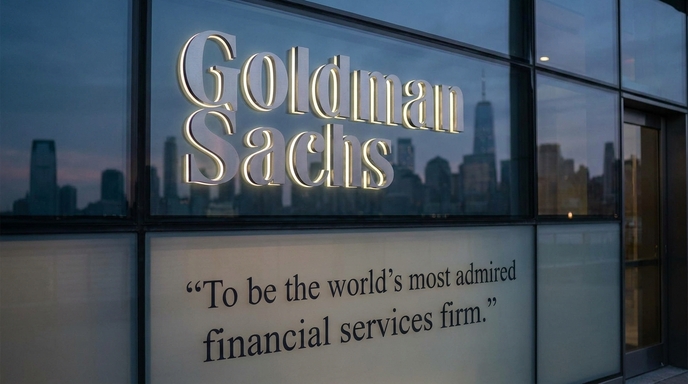
What Is Goldman Sachs’s Mission Statement?
To be the world’s most admired financial services firm.
This mission is ambitious in its simplicity. It does not mention products, market share, or revenue. It focuses entirely on reputation. The bank wants to be admired by clients, shareholders, employees, and the broader public. That admiration must be earned through consistent performance, ethical conduct, and a client-first approach.
The phrase “most admired” is deliberately broad. It includes the quality of advice, the strength of relationships, the caliber of talent, and the firm’s impact on communities. Goldman Sachs serves corporations, governments, financial institutions, and high-net-worth individuals. The mission applies equally to all those relationships. It also signals that the firm is not content with being large or profitable. It wants to set the standard by which every other financial institution is measured.
The mission also serves as an internal compass. Employees across dozens of countries can ask one simple question: does this decision make the firm more admired? That question is meant to guide everything from client interactions to long-term strategy.
What Is Goldman Sachs’s Vision Statement?
Goldman Sachs does not publish a formal vision statement on its official site. Many global banks draw a sharp line between mission (what they do now) and vision (where they want to be later). Goldman Sachs treats that line differently. The forward-looking role that a vision statement would normally play is filled by the firm’s purpose statement and its long-standing business principles.
The company’s 14 business principles, first drafted decades ago, act as a permanent vision for how the firm should operate. The most famous of these is “Our clients’ interests always come first.” Together with the purpose statement, this collection of principles paints a picture of a firm that intends to lead through trust, expertise, and a commitment to responsible growth. The absence of a separate vision statement is not an oversight. It reflects a culture that prefers concrete commitments over aspirational taglines.
101 Mission Statements is for you if:
- You’re a leader or entrepreneur needing a clear, inspiring statement of intent for your business or nonprofit.
- You want your team and clients aligned with a shared vision of excellence and long-term goals.
- You need a step-by-step guide to craft a customized mission statement that acts as a blueprint for future success.
What Is Goldman Sachs’s Purpose Statement?
To advance sustainable economic growth and financial opportunity.
Goldman Sachs introduced this purpose statement in 2020 during a significant update to the firm’s public messaging. It states why the company exists in terms that go far beyond investment banking fees and trading profits. The two concepts, sustainable economic growth and financial opportunity, form a dual promise. Growth must last. Opportunity must be shared.
This purpose connects directly to the firm’s global scale. Goldman Sachs advises corporations on capital raising and mergers. It helps governments issue debt. It invests in communities through initiatives like 10,000 Small Businesses. Each of those activities can either support or undermine sustainable growth. The purpose statement makes clear which side the firm chooses. It also gives employees a filter for evaluating new business. If a product or deal does not advance growth and opportunity, it becomes harder to justify.
The purpose also signals a shift in how the bank talks about itself. Before 2020, the firm’s public identity leaned more heavily on excellence and prestige. Adding a purpose statement acknowledged that a modern financial institution must be judged by its contribution to society, not just its own success.
Key Differences Between Goldman Sachs’s Mission and Purpose
Because Goldman Sachs does not separate mission and vision in the traditional way, the most useful comparison is between the mission and the purpose. The two statements work together but answer very different questions.
| Aspect | Mission Statement | Purpose Statement |
|---|---|---|
| Focus | Reputation and external perception | Real-world economic and social impact |
| Timeframe | Continuous, present-tense aspiration | Long-term, enduring commitment |
| Primary Audience | Clients, investors, talent, and the market | Communities, society, and the global economy |
| Core Question Answered | “What standard must we meet every day?” | “Why does this firm need to exist?” |
| Measurement | Client satisfaction, industry rankings, trust | Tangible growth, access to capital, opportunity gaps closed |
The mission is the bar the firm sets for itself. The purpose is the door it opens for others. One draws the right people in. The other makes sure the work they do matters beyond the balance sheet.
Core Values Behind Goldman Sachs’s Mission and Purpose
Goldman Sachs lists four core values on its official site. Each one directly supports both the mission to be admired and the purpose to advance growth and opportunity.
Client Service: The firm’s first principle is that client interests come first. Lasting admiration from clients is impossible without this value. It also ensures that growth and opportunity are shared with the people and institutions the bank serves.
Excellence: Admiration demands outstanding execution. The firm commits to hiring the best people and holding them to a high standard. Excellence turns the mission from a slogan into a measurable daily target.
Integrity: No financial institution can be admired without trust. Integrity means honest advice, transparent dealings, and accountability. It protects the firm’s purpose from being undermined by short-term thinking.
Partnership: Goldman Sachs operates as a network of global teams, not isolated silos. Partnership extends to clients, communities, and governments. This value turns the purpose statement into a collaborative effort rather than a top-down directive.
These four values interlock. Client service without integrity would be hollow. Excellence without partnership would be selfish. When they operate together, they create the conditions that make the mission achievable and the purpose credible.
How Goldman Sachs Lives Its Mission and Purpose
The firm’s statements would mean little without action. Three programs show how the mission and purpose translate into real-world behavior.
The 10,000 Small Businesses initiative, launched in 2010, provides education, capital, and support to small business owners across the United States and the United Kingdom. It directly advances financial opportunity by helping entrepreneurs who often lack access to traditional resources. By investing in the communities where it operates, Goldman Sachs builds the kind of admiration that cannot be bought with advertising.
The firm’s sustainable finance commitment, announced in 2020 and deepened in subsequent years, targets $750 billion across climate transition and inclusive growth by 2030. This is not charity. It is a strategic decision to align the firm’s core business of deploying capital with the purpose of sustainable economic growth. Major clients, from renewable energy companies to sovereign wealth funds, see a bank that is serious about long-term impact.
The One Million Black Women initiative, launched in 2021, pledges $10 billion in direct investment capital and $100 million in philanthropic support to narrow opportunity gaps for Black women. This program puts the purpose statement to a direct test. It focuses on a specific, measurable outcome rather than a broad promise. The mission of being admired gains ground when a firm proves it will commit resources to an underserved segment of the economy.
Internally, the firm’s hiring and promotion practices reflect the partnership and excellence values. Goldman Sachs consistently ranks among the top employers for MBA graduates and experienced professionals. The bank’s rigorous interview process and its emphasis on team-based performance reviews signal that admiration from peers and clients is earned through demonstrated competence, not connections.
How Goldman Sachs’s Mission and Purpose Have Evolved
For most of its history, Goldman Sachs did not have a formal mission or purpose statement. The firm’s identity was shaped by its business principles, which were first written down in the 1970s under senior partner Gus Levy. Those principles focused heavily on client service, reputation, and profitability.
The explicit mission “to be the world’s most admired financial services firm” emerged later, likely in the early 2000s, as the firm expanded globally and faced new competition. It reflected a desire to codify what had been an unspoken cultural standard. The 2008 financial crisis tested that mission severely. The firm’s reputation suffered along with the rest of Wall Street, and public admiration became a much harder goal to defend.
The introduction of the purpose statement in 2020 marked a clear pivot. By that point, Goldman Sachs had expanded into consumer banking with Marcus, deepened its sustainability work, and begun talking more openly about its role in addressing economic inequality. The purpose statement gave the firm language to describe a broader set of obligations. It did not replace the mission. It added a layer. The mission remained about how the firm wanted to be perceived. The purpose explained why the firm needed to exist at all.
In 2026, these two statements continue to shape public perception and internal strategy. They have moved the firm from a purely reputation-driven identity to one that balances reputation with contribution.
What Your Company Can Learn from Goldman Sachs’s Statements
The way Goldman Sachs structures its mission and purpose offers several practical lessons for anyone writing or refining their own company statements.
Keep the mission centered on a single, clear standard. Goldman Sachs does not list services or sectors in its mission. It picks one concept, admiration, and lets that concept filter every decision. Your company can do the same. Choose the one outcome that matters most and write a mission that relentlessly points toward it.
Let your purpose answer the “so what” question. A mission without a purpose can sound self-serving. Goldman Sachs pairs “be admired” with “advance growth and opportunity.” That combination tells employees, clients, and the public that the firm’s ambition has a social payoff. When you draft a purpose statement, ask what the world loses if your company disappears.
Do not confuse a purpose with a tagline. Goldman Sachs maintains a separate advertising tagline (“Progress is everyone’s business”) that is distinct from its mission and purpose. Taglines are for marketing. Mission and purpose are for strategy and culture. Keep them separate and make sure your employees know which one guides their work.
Make the statements live through specific, named initiatives. Vague language earns skepticism. Goldman Sachs attaches its purpose to measurable programs like 10,000 Small Businesses and the $750 billion sustainable finance target. A purpose statement gains credibility only when the company backs it with a public, time-bound commitment. Name the program, state the dollar figure or the goal, and report progress regularly.
Frequently Asked Questions
Q: What is Goldman Sachs’s current mission statement?
A: The official mission statement is “To be the world’s most admired financial services firm.” It emphasizes reputation and excellence across all client relationships.
Q: What is Goldman Sachs’s vision for the future?
A: Goldman Sachs does not publish a separate vision statement. Its forward-looking direction is defined by its purpose statement and its 14 business principles, which together describe the firm’s long-term commitments.
Q: What is the purpose statement of Goldman Sachs?
A: The purpose is “To advance sustainable economic growth and financial opportunity.” It was introduced in 2020 to explain the firm’s role in society beyond financial performance.
Q: Does Goldman Sachs have a separate tagline from its mission statement?
A: Yes. The firm’s advertising tagline is “Progress is everyone’s business.” It is a marketing message and should not be confused with the mission or purpose statements.
Q: How does Goldman Sachs’s mission statement reflect its brand identity?
A: The mission centers on admiration, which aligns with the firm’s historical focus on prestige, elite talent, and long-term client relationships. It projects an identity built on trust and high standards.
Q: Has Goldman Sachs’s mission or purpose statement ever changed?
A: The mission has remained stable for years, but the purpose statement was formally introduced in 2020. Before that, the firm relied on its business principles without a concise public purpose.
Q: What core values guide Goldman Sachs?
A: The four core values are Client Service, Excellence, Integrity, and Partnership. Each directly supports the mission to be admired and the purpose to advance growth and opportunity.
Final Thoughts
Goldman Sachs runs on two clear statements. The mission pushes the firm toward a world-class reputation. The purpose ties that ambition to a measurable, society-wide outcome. The four values of client service, excellence, integrity, and partnership sit underneath both, providing the daily structure that keeps the company honest. For a 156-year-old institution, this framework is both a defense against complacency and a guide for future decisions.
If you study how Goldman Sachs uses these statements, you will notice they are treated as practical tools, not wall art. That is the real test of any mission or purpose. Does it shape where you invest, whom you hire, and what you say no to? If it can answer those questions, it is worth the effort to write and defend. What do you think of Goldman Sachs’s approach? Share your perspective in the comments below.
101 Mission Statements is for you if:
- You’re a leader or entrepreneur needing a clear, inspiring statement of intent for your business or nonprofit.
- You want your team and clients aligned with a shared vision of excellence and long-term goals.
- You need a step-by-step guide to craft a customized mission statement that acts as a blueprint for future success.
Be First to Comment