A company’s mission and vision statements are not words on a wall. They shape decisions, guide strategy, and signal what a brand truly values. For a giant like General Motors, which employs over 150,000 people and sells vehicles in nearly every country, these statements carry enormous weight. They tell you where the company is going and why it exists beyond making a profit. GM’s mission is to earn customers for life by building brands that inspire passion and loyalty through breakthrough technologies and by serving the communities where it operates.
Its vision is a world with zero crashes, zero emissions, and zero congestion. Its purpose, the deeper reason it exists, is to make the world safer, cleaner, and better through transportation. These three sentences set the direction for every electric vehicle launch, every factory upgrade, and every safety advancement. Breaking them down reveals the thinking behind one of the world’s most historic automakers as it navigates a rapidly shifting industry.
What Is General Motors’ Mission Statement?
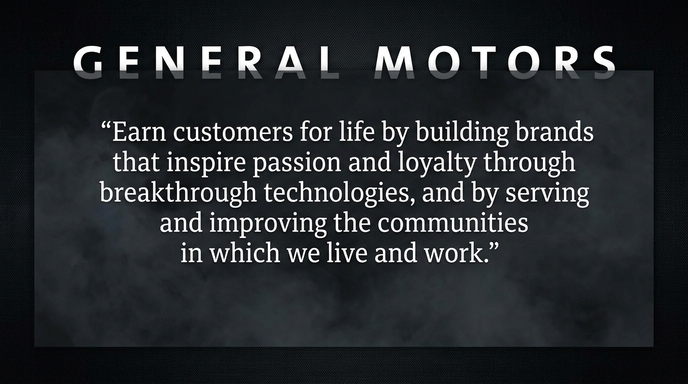
“Earn customers for life by building brands that inspire passion and loyalty through breakthrough technologies, and by serving and improving the communities in which we live and work.”
This mission, published on GM’s official website, focuses squarely on the customer relationship, not just the product. GM promises to build lasting loyalty by creating brands that people feel strongly about. The phrase “earn customers for life” signals that the company sees every sale as the beginning of a long-term bond, not a one-time transaction. It also highlights two paths to that loyalty: advanced technology and community service. The technology piece refers to everything from electric propulsion and self-driving capabilities to safety features and connectivity. The service piece acknowledges that a car company can strengthen its reputation by improving the places where its employees and customers live. The mission is practical, measurable, and deeply tied to the everyday choices GM makes.
What Is General Motors’ Vision Statement?
“Zero crashes, zero emissions, zero congestion.”
This vision is remarkably simple for a company that makes complex machines. It paints a picture of a future free from vehicle-related deaths, tailpipe pollution, and traffic gridlock. The vision is not about selling more cars. It is about eliminating the biggest downsides of transportation. Each “zero” forces GM to think beyond incremental improvements and toward fundamental changes in how vehicles operate. Zero crashes push the company to advance driver-assistance systems and autonomous technology. Zero emissions commit it to an all-electric vehicle lineup. Zero congestion demands smarter mobility services and vehicle-to-infrastructure communication. For employees and investors, this vision sets a clear direction. For the public, it signals that GM wants to be part of the solution to climate change, road safety, and urban livability.
What Is General Motors’ Purpose Statement?
“To make the world safer, cleaner and better through transportation.”
While the vision sets a specific destination, the purpose explains why GM exists at all. It frames transportation as a tool for improving life on a broad scale. “Safer” aligns with the zero crashes vision. “Cleaner” aligns with zero emissions. “Better” captures the broader quality-of-life improvements that mobility can bring, such as access to jobs, education, and healthcare. This purpose statement influences product decisions, such as GM’s commitment to invest $35 billion in electric and autonomous vehicles through 2025. It also guides corporate actions like the goal to achieve carbon neutrality by 2040. The purpose is not about vehicles. It is about the positive outcomes that vehicles can create. That subtle shift changes how the company measures success.
101 Mission Statements is for you if:
- You’re a leader or entrepreneur needing a clear, inspiring statement of intent for your business or nonprofit.
- You want your team and clients aligned with a shared vision of excellence and long-term goals.
- You need a step-by-step guide to craft a customized mission statement that acts as a blueprint for future success.
Key Differences Between General Motors’ Mission and Vision
| Aspect | Mission | Vision |
|---|---|---|
| Focus | Earning customer loyalty through brands, technology, and community service | A future ideal state with no crashes, emissions, or congestion |
| Timeframe | Ongoing, day-to-day guiding principle | Long-term, aspirational target without a fixed date |
| Primary Audience | Current and prospective customers, employees, dealers | Society, policymakers, industry partners, and future generations |
| Core Question Answered | How will we build trust and keep customers coming back? | What world do we want to create through our work? |
| Purpose | Directs operational priorities and brand experience | Inspires big bets and innovation that may take decades to mature |
These two statements work together naturally. The mission keeps GM grounded in today’s market while the vision pulls it toward a radically different tomorrow. One is about execution. The other is about ambition. Both are essential for a company that must sell vehicles now while reinventing what a vehicle can be.
Core Values Behind General Motors’ Mission and Vision
GM calls its core values “GM Behaviors,” a set of six action-oriented principles that shape how employees work. Each one connects directly to the mission or vision.
Be Inclusive: Create an environment where different perspectives are welcomed and respected, which helps build products that serve a diverse range of customers.
Think Customer: Put the customer at the center of every decision, mirroring the mission’s focus on earning lifetime loyalty.
Innovate Now: Move quickly to solve problems with new ideas, supporting the vision’s demand for bold technological leaps.
Look Ahead: Anticipate future trends and plan proactively, directly fueling the long-term thinking behind zero crashes, emissions, and congestion.
One Team: Collaborate across brands, functions, and regions, making it possible to develop complex vehicle platforms like Ultium efficiently.
Win with Integrity: Deliver results honestly and ethically, ensuring that the pursuit of a better world does not compromise the company’s principles.
Together, these behaviors create a culture where the mission and vision are not just slogans. They become daily habits that guide hiring, product development, and how GM people treat each other.
How General Motors Lives Its Mission and Vision
GM’s “Everybody In” marketing campaign, launched in 2021, directly reflects the mission and vision. The campaign positions electric vehicles as a mainstream choice for all, not just early adopters, emphasizing accessibility and mass adoption. It aligns with earning customers for life by making the brand relevant to a new generation.
The Ultium battery platform is a tangible investment in the vision of zero emissions. By creating a flexible, modular battery system that can power everything from compact crossovers to full-size pickup trucks, GM is building the technical foundation for an all-electric future. This platform also supports the mission by enabling a wide range of vehicles that can inspire passion across different customer segments.
Through its majority-owned subsidiary Cruise, GM is working toward zero crashes and zero congestion. Cruise tests autonomous vehicles in dense urban environments, aiming to launch a self-driving ride-hailing service. This directly tackles the vision’s goal of eliminating human error crashes and reducing the number of individually owned vehicles stuck in traffic.
GM’s commitment to source 100 percent renewable energy for its U.S. facilities by 2025 and to become carbon neutral by 2040 shows the purpose statement in action. These operational shifts prove that the “cleaner” part of the purpose extends beyond tailpipes to the company’s own footprint. It also strengthens the mission by showing customers that GM is serious about community well-being.
How General Motors’ Mission and Vision Have Evolved
General Motors was founded in 1908, and for much of its early history, the guiding mission was essentially to provide “a car for every purse and purpose,” as former CEO Alfred Sloan famously described. The focus was on variety, scale, and market dominance. This made GM the largest automaker in the world for decades but eventually led to a culture that prioritized size over customer connection.
The financial crisis of 2009 and GM’s subsequent bankruptcy reset the company’s priorities. After restructuring, the mission shifted to earning customers for life, with a strong emphasis on quality, reliability, and service. The vision of zero crashes, zero emissions, and zero congestion was publicly articulated by CEO Mary Barra in 2017. It marked a strategic turning point, signaling that GM was no longer just a car manufacturer but a mobility company aiming to solve societal problems. The mission wording has been refined slightly over the years but has remained customer-centric since the early 2010s.
The addition of a clear purpose statement, focusing on making the world safer, cleaner, and better, further cemented this shift. It showed that GM viewed its success as inseparable from the health of the planet and the safety of its communities. This evolution reflects a broader auto industry move from mechanical engineering to technology and sustainability.
What Your Company Can Learn from General Motors’ Statements
GM’s statements offer practical lessons for any organization trying to define its own direction.
Make your vision concrete and memorable. “Zero crashes, zero emissions, zero congestion” is easy to recall and impossible to misunderstand. It uses simple numeric targets that unite employees and customers around a clear outcome. Your own vision should be just as vivid and quantifiable.
Separate mission from purpose. GM’s mission explains how it competes (earn loyalty through brands and tech). Its purpose explains why it matters (make the world safer and cleaner). This separation helps the company attract both customers who want great vehicles and talent who want meaningful work. Define what you do to win and why your company exists beyond profit.
Anchor values in observable behaviors. Instead of vague nouns like “integrity” or “teamwork,” GM uses verb-driven Behaviors: “Think Customer,” “Innovate Now,” “Win with Integrity.” This makes it easy to coach, measure, and reward. When you craft values, phrase them as actions people can demonstrate daily.
Align big investments with your statements. GM committed $35 billion to electric and autonomous vehicles, directly supporting its vision and purpose. This alignment builds credibility. If your vision demands a certain capability, your budget should reflect it. Stakeholders notice when words and spending match.
If you found this analysis helpful, you might also explore how Ford and Tesla define their corporate missions.
Frequently Asked Questions
Q: What is General Motors’ current mission statement?
A: GM’s mission is “to earn customers for life by building brands that inspire passion and loyalty through breakthrough technologies, and by serving and improving the communities in which we live and work.”
Q: What is General Motors’ vision for the future?
A: GM’s vision is “zero crashes, zero emissions, zero congestion,” a world without vehicle fatalities, tailpipe pollution, or traffic gridlock.
Q: Does General Motors have a separate tagline from its mission statement?
A: Yes. GM’s global tagline is “Find New Roads,” which expresses a spirit of exploration and improvement. Its recent EV-focused campaign uses “Everybody In.” These are marketing slogans, not the formal mission.
Q: How does General Motors’ mission statement reflect its brand identity?
A: The mission emphasizes building emotional connections and community service, which supports GM’s identity as a brand that stands for reliability, advancement, and responsibility beyond just selling cars.
Q: Has GM’s mission or vision statement ever changed?
A: Yes. The mission evolved from an early focus on variety and scale to a post-bankruptcy focus on customer loyalty. The “zero” vision was introduced in 2017, replacing less publicly stated aspirations with a bold, measurable commitment.
Q: What core values guide General Motors?
A: GM’s values are expressed as six GM Behaviors: Be Inclusive, Think Customer, Innovate Now, Look Ahead, One Team, and Win with Integrity. These guide employee actions and decisions.
Q: How does General Motors put its mission into practice?
A: GM puts its mission into practice by launching customer-focused campaigns like “Everybody In,” investing in flexible EV technology such as the Ultium platform, developing autonomous vehicles through Cruise, and committing to renewable energy and carbon neutrality.
Final Thoughts
General Motors has moved well beyond the simple goal of building and selling cars. Its mission centers on lifelong customer relationships. Its vision draws a bright line toward a future without the harm traditionally associated with driving. And its purpose grounds all of that in a genuine commitment to safety, cleanliness, and social benefit. These statements are not static. They are actively shaping a massive industrial pivot right now.
GM’s approach shows that even a century-old manufacturing giant can reinvent its story with clarity and precision. Whether you agree with the company’s direction or not, the statements are useful models of focus. What do you think of GM’s mission and its ambitious vision? Share your perspective below.
101 Mission Statements is for you if:
- You’re a leader or entrepreneur needing a clear, inspiring statement of intent for your business or nonprofit.
- You want your team and clients aligned with a shared vision of excellence and long-term goals.
- You need a step-by-step guide to craft a customized mission statement that acts as a blueprint for future success.
Be First to Comment