Most large companies have a mission statement. Few have one that doubles as a promise to the entire world. SAP operates at a scale where its software touches 77% of the world’s transaction revenue. That reach means every word in its directional statements carries weight. When a company’s systems help run supply chains, bank transfers, and hospital records, the difference between a slogan and a real guide becomes obvious fast.
SAP does not publish a standalone line called “mission statement.” Instead, its corporate purpose fills that role with uncommon clarity. SAP’s purpose, which serves as its mission, is “Help the world run better and improve people’s lives.” The company’s separate vision statement is “Bring out the best in every business.” Together these two statements separate the day to day from the destination. One explains why SAP exists right now. The other draws the shape of the future it wants to create.
You cannot understand SAP’s strategy, product decisions, or hiring philosophy without grasping this purpose first vision second sequence. What follows unpacks both statements, the values that hold them up, and the real world evidence that SAP means what it says.
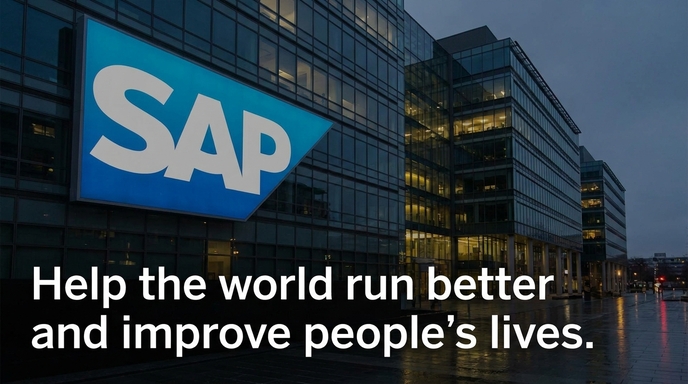
What Is SAP’s Mission Statement?
Help the world run better and improve people’s lives.
SAP calls this its corporate purpose, but it does the work of a mission statement. The sentence is deceptively simple. “Help the world run better” points directly at SAP’s core business: enterprise software that makes processes more efficient, transparent, and connected. The second half “improve people’s lives” pulls the lens outward. It asserts that better business operations create a ripple effect that reaches actual human beings.
The phrasing serves two audiences at once. For business leaders, it signals that SAP software exists to solve real operational problems. For employees and the public, it frames the company’s work as something bigger than profit. The word “help” matters. It positions SAP as an enabler rather than a controller. The world runs on countless independent decisions. SAP’s role, as the statement frames it, is to give those decision makers better tools and data.
Embedded in those eight words are three value signals: humility (help, not dictate), scale (the world, not just large enterprises), and practical idealism (better is achievable, not abstract). That combination is rare in corporate language.
What Is SAP’s Vision Statement?
Bring out the best in every business.
Where the mission anchors on today’s actions, the vision gazes forward. SAP wants every business, regardless of size or industry, to perform at its highest possible level. The phrase “bring out” implies that the potential already exists inside each organization. The software, the partnerships, and the ecosystem SAP builds are meant to unlock what is already there.
The vision is deliberately inclusive. It does not say “the best in Fortune 500 companies” or “the best in our customers.” It says every business. That word choice aligns with SAP’s growing focus on small and midmarket companies through cloud solutions like SAP Business One and SAP S/4HANA Cloud, public edition. It also reflects a belief that global problems get solved when millions of businesses run a little better each day.
For employees, the vision acts as a quality standard. If a new feature or a support process does not help a customer become a better version of itself, it fails the vision test. For the market, it signals that SAP sees its competitive advantage not just in technology but in the depth of its understanding of how businesses actually operate.
101 Mission Statements is for you if:
- You’re a leader or entrepreneur needing a clear, inspiring statement of intent for your business or nonprofit.
- You want your team and clients aligned with a shared vision of excellence and long-term goals.
- You need a step-by-step guide to craft a customized mission statement that acts as a blueprint for future success.
Key Differences Between SAP’s Mission and Vision
A mission explains what a company does and why. A vision describes the world the company wants to build. SAP’s two statements split those jobs cleanly.
| Aspect | Mission (Purpose) | Vision |
|---|---|---|
| Focus | Present-day actions and reason for existing | Long-term destination and aspiration |
| Timeframe | Now and ongoing | Future oriented |
| Primary Audience | Customers, employees, society | Customers, partners, employees |
| Core Question Answered | Why does SAP exist? | What does SAP want to achieve? |
| Purpose | Guide daily decisions and frame the company’s role | Inspire direction and define ultimate success |
Both statements support each other. A business cannot “bring out the best” in its customers unless the world’s underlying systems run better. And systems running better only matters if that efficiency translates into real human and business improvement. Separating mission from vision gives SAP a clear operating system for strategy: purpose sets the baseline, vision sets the bar.
Core Values Behind SAP’s Mission and Vision
SAP’s five published values explain how employees are expected to behave as they pursue the mission and vision. They are specific enough to differentiate SAP from a generic enterprise brand.
Tell it like it is: Honest feedback matters more than comfort. This value pushes employees to speak factually and respectfully, even when the message is hard. It protects the mission by keeping decisions grounded in reality.
Stay curious: The world does not stand still, and neither can SAP’s thinking. Curiosity fuels the innovation needed to keep improving systems and discovering new ways to unlock business potential.
Build bridges, not silos: SAP’s product portfolio is vast. Collaboration across teams and with customers is the only way to deliver integrated solutions. A siloed company cannot help the world run better as a connected whole.
Embrace differences: Improving people’s lives requires understanding people’s lives. A workforce that reflects varied backgrounds, identities, and perspectives is better equipped to design software that serves a diverse planet.
Keep the promise: Trust is SAP’s currency. When customers run mission critical operations on SAP software, reliability and follow through are not optional. This value directly guards the “improve people’s lives” half of the mission because broken promises can cause real world disruption.
Together these five values form a behavioral engine. Curiosity and honesty generate better ideas. Building bridges and embracing differences make sure those ideas work at scale. Keeping the promise converts good intentions into measurable trust.
How SAP Lives Its Mission and Vision
Statements on a wall mean nothing without action. SAP has embedded its mission and vision into programs, product decisions, and hiring practices in ways that are measurable and verifiable.
SAP’s Autism at Work program, launched in 2013, puts the “improve people’s lives” commitment into practice. By actively recruiting people on the autism spectrum and redesigning interview processes to reduce bias, SAP has hired hundreds of colleagues who bring exceptional pattern recognition and attention to detail to roles across the company. The program has since expanded to dozens of countries and inspired other companies to follow. It proves that improving lives is not just an external goal for customers but an internal operational principle.
On the environmental front, SAP introduced the Climate 21 initiative and committed to achieving net zero emissions by 2030. The company built carbon tracking capabilities directly into its ERP systems so that every customer can measure and manage its carbon footprint at the transaction level. This makes the “help the world run better” mission tangible: better data leads to better environmental decisions, and the software itself becomes a lever for sustainability.
SAP’s business AI strategy, branded as SAP Business AI and embedded across its cloud solutions, reflects the vision to “bring out the best in every business.” Rather than offering AI as a separate tool, SAP bakes predictive analytics, automation, and generative AI directly into the workflows that business users already know. The goal is not to show off technology but to quietly make a procurement manager, a financial controller, or a supply chain planner more effective at their job.
The SAP.iO venture studio and accelerator program supports early stage startups building on SAP technology. By giving these young companies mentorship, API access, and go to market support, SAP invests in a future where the best businesses, regardless of their current size, can scale on a foundation of enterprise grade data. This directly channels the vision statement into an ecosystem wide commitment.
How SAP’s Mission and Vision Have Evolved
SAP was founded in 1972 by five former IBM engineers in Mannheim, Germany. Their original vision was to create standard application software for real time data processing. That technical focus served the company for decades. The old tagline “The best run businesses run SAP” communicated a clear product promise but stayed tightly coupled to the brand’s enterprise software identity.
A significant shift came in the mid 2010s as SAP moved aggressively toward cloud computing and began emphasizing purpose beyond profit. In 2020, the company launched a new brand campaign centered on the purpose statement “Help the world run better and improve people’s lives.” This was not a cosmetic update. It reflected a strategic realization that SAP’s technology had become deeply embedded in society’s infrastructure and that the company’s responsibility had grown accordingly.
The vision statement “Bring out the best in every business” emerged around 2021 as part of a broader brand refresh tied to the “We are SAP” narrative. This move separated SAP’s enduring purpose from its aspirational vision for the first time in public language. It signaled that the company now saw its future role as a catalyst for business potential rather than just an operational backbone. What started as a database company had evolved into an organization that measures success by the success of its customers and the wellbeing of the planet.
What Your Company Can Learn from SAP’s Statements
SAP’s approach to mission and vision offers concrete lessons for any organization that wants its words to mean something.
Use purpose as mission when clarity matters more than labels. SAP does not force a separate mission statement when its purpose already does the job. Entrepreneurs should not obsess over finding distinct sentences for mission, vision, and purpose if one clear statement can carry the load. Good language is more important than perfect taxonomy.
Pair a grounded mission with an ambitious vision. SAP’s mission describes work that is possible today. Its vision describes a world that will take decades to build fully. That tension is healthy. A mission that sounds too visionary loses credibility. A vision that sounds too operational fails to inspire. Keep them distinct and complementary.
Make values behavioral, not decorative. SAP’s five values use plain language and describe specific actions: tell it, stay curious, build bridges, embrace, keep. A value like “integrity” says nothing about how to act. A value like “keep the promise” gives employees a clear standard they can measure themselves against every day.
Anchor lofty statements in operational proof. SAP’s sustainability commitment is not a press release. It is a product feature, a supply chain requirement, and an internal hiring mandate. The lesson is straightforward. If your mission says something bold, find the operational lever that makes it true, then pull it publicly.
Frequently Asked Questions
Q: What is SAP’s current mission statement?
A: SAP does not publish a standalone mission statement. Its corporate purpose “Help the world run better and improve people’s lives” serves as the de facto mission, guiding the company’s strategy and daily operations.
Q: What is SAP’s vision for the future?
A: SAP’s official vision is “Bring out the best in every business.” It expresses the company’s long term goal to unlock the full potential of every organization it touches, regardless of size or industry.
Q: Does SAP have a separate tagline from its mission statement?
A: SAP historically used the tagline “The best run businesses run SAP.” Today the company leads with its purpose statement “Help the world run better and improve people’s lives” as its primary brand message.
Q: How does SAP’s mission statement reflect its brand identity?
A: The mission positions SAP as an enabler rather than a controller. By focusing on helping and improving, it frames the brand as a responsible, people centric technology partner rather than just a software vendor.
Q: Has SAP’s mission or vision statement ever changed?
A: Yes. In 2020, SAP introduced its current purpose statement, moving away from product centric messaging toward a broader societal role. The vision statement “Bring out the best in every business” was launched around 2021 as part of a brand refresh.
Q: What core values guide SAP?
A: SAP’s five published values are Tell it like it is, Stay curious, Build bridges not silos, Embrace differences, and Keep the promise. They translate the mission and vision into expected daily behavior.
Q: How does SAP put its mission into practice?
A: SAP puts its mission into practice through measurable programs such as Autism at Work for inclusive hiring, Climate 21 for carbon tracking, embedded AI to enhance business performance, and the SAP.iO startup accelerator to support new businesses.
Final Thoughts
SAP’s mission and vision statements succeed because they say something specific. A company that processes a large share of the world’s business transactions could have chosen generic language about innovation. Instead, it chose language about responsibility. “Help the world run better” admits the world already runs. SAP is just trying to make the machinery smoother and fairer. “Improve people’s lives” moves the conversation from server uptime to human outcomes.
The vision adds a second layer. It shifts the focus from SAP’s own systems to the potential inside every business that uses them. Read together, the statements reveal a company that understands its power and is, by all visible evidence, trying to direct that power toward things that matter. What do you think of SAP’s mission and vision? Share your perspective in the comments below.
101 Mission Statements is for you if:
- You’re a leader or entrepreneur needing a clear, inspiring statement of intent for your business or nonprofit.
- You want your team and clients aligned with a shared vision of excellence and long-term goals.
- You need a step-by-step guide to craft a customized mission statement that acts as a blueprint for future success.
Be First to Comment