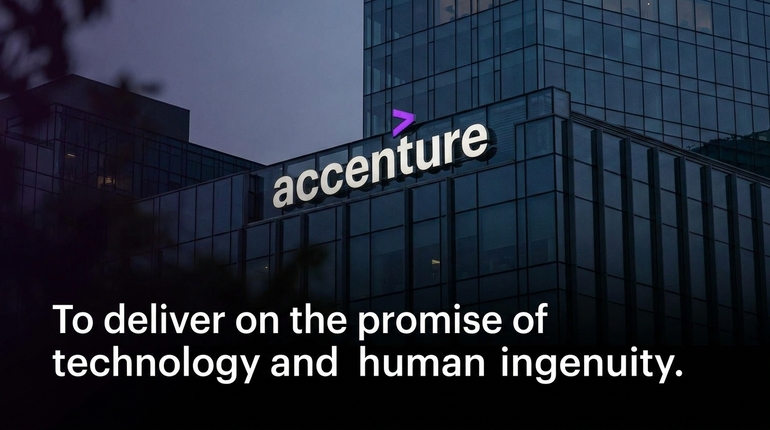
The mission and vision statement of Accenture is not packaged the way most people expect. The company does not publish separate mission and vision statements on its main corporate overview page. Instead, it leads with a purpose statement and a clear forward looking ambition.
Accenture’s official purpose is “To deliver on the promise of technology and human ingenuity.” That sentence does the work a traditional mission statement would do. It says what the company does and the standard it sets for itself.
The official directional language adds a vision like layer: Accenture embraces change to create value and shared success for clients, people, shareholders, partners and communities. This article breaks down what those statements mean, how they connect to Accenture’s core values, and where they show up in real decisions.
What Is Accenture’s Mission Statement?
Accenture does not publish a standalone mission statement under that label. The statement most often cited as the company’s current mission equivalent is its official corporate purpose. That statement appears on the official Accenture company overview page.
To deliver on the promise of technology and human ingenuity.
The wording is short, but it contains three key ideas. “Technology” points to Accenture’s domain: cloud, data, artificial intelligence, security, and enterprise platforms. “Human ingenuity” points to the people who design, build, and run those systems. “Promise” sets an expectation. Accenture is not selling a one time deliverable. It is saying that technology should deliver real value when paired with human judgment.
Accenture serves large enterprises and public sector organizations. The statement describes what Accenture does for them. It combines technical capability with human skill. The values embedded in the wording include practicality and follow through, not just strategic advice. This is a company that positions itself as an implementation partner, not a pure consulting house.
The mission equivalent is anchored in present delivery. The vision equivalent looks at where Accenture wants to go.
What Is Accenture’s Vision Statement?
Accenture does not publish a separate vision statement. The closest forward looking language on its official overview page appears directly beside the purpose statement.
We embrace the power of change to create value and shared success for our clients, people, shareholders, partners and communities.
This sentence is not labeled a vision, but it functions as one. It points toward a future state in which Accenture’s work creates benefits beyond revenue. “Value and shared success” signals a shift from measuring only financial performance to measuring outcomes for several groups at once.
For clients, that means solutions that work in the real world. For employees, it means a workplace where skills grow. For shareholders and partners, it means durable returns and alliances. The phrase “embrace the power of change” also positions Accenture as a company that helps clients manage disruption rather than resist it. This forward looking intent shapes the company’s long term strategy and its brand identity.
Because Accenture treats purpose as a separate idea, it is worth examining that statement on its own terms.
What Is Accenture’s Purpose Statement?
Accenture’s formal purpose statement is the same sentence used as the mission equivalent, but the company separates the concept of purpose from mission and vision.
To deliver on the promise of technology and human ingenuity.
A purpose explains why a company exists. Accenture’s purpose does not anchor itself to consulting, outsourcing, or any single service category. It anchors the company to a broader outcome: closing the gap between what technology can do and what it actually does for people and organizations.
This purpose influences how Accenture builds services. Its investments in cloud, data, artificial intelligence, and sustainability all sit under the same promise. The purpose also shapes hiring. Accenture looks for people who can combine technical depth with judgment, communication, and creativity. That combination is what the company means by human ingenuity.
With the purpose and vision clarified, the next step is to see how they differ.

Key Differences Between Accenture’s Mission and Vision
The distinction between Accenture’s mission equivalent and its directional vision is central to Accenture business strategy.
| Dimension | Mission Equivalent | Directional Vision |
|---|---|---|
| Focus | Combining technology and human ingenuity to deliver results | Creating value and shared success through change |
| Timeframe | Present to near term | Long term and open ended |
| Primary Audience | Clients and end users | Clients, employees, shareholders, partners, communities |
| Core Question Answered | What does Accenture do and how? | Where is Accenture heading? |
| Purpose | Anchor daily decisions and service delivery | Set direction for growth and responsibility |
The two statements are distinct but complementary. The mission equivalent keeps Accenture focused on delivery today. The directional vision pushes the company beyond project work and toward broader shared outcomes. Together they make the brand easier to understand internally and externally.
Those statements only work because Accenture backs them with a clear set of core values.
Core Values Behind Accenture’s Mission and Vision
Accenture’s stated core values are the operating rules that connect the purpose and vision to everyday behavior. The company lists six values.
- Client Value Creation: Delivering measurable outcomes for clients, not just recommendations.
- One Global Network: Sharing knowledge and capability across countries and industries.
- Respect for the Individual: Treating people fairly and building an inclusive workplace.
- Best People: Attracting and developing talent with high standards and a can do mindset.
- Integrity: Acting ethically and honestly in every engagement and decision.
- Stewardship: Protecting the company, its people, and its communities for the long term.
These values operate as a system. Client value creation is the output. Integrity and stewardship set boundaries. One global network and best people supply the capability. Respect for the individual sustains the culture over time. When the values work together, the purpose and vision become more than words.
Accenture’s behavior shows how those values turn into visible decisions.
How Accenture Lives Its Mission and Vision
One clear example is Accenture’s 360° Value reporting. The company measures performance across client outcomes, talent, inclusion and diversity, sustainability, and financial results. This reporting makes the phrase “shared success” concrete because Accenture must account for more than billable hours or revenue.
Another example is the Skills to Succeed initiative. The program helps people gain workplace and entrepreneurial skills in many countries. It connects directly to human ingenuity by treating skills as assets that can be built and shared.
Accenture’s investment in artificial intelligence also reflects the purpose. In 2023, Accenture announced a $3 billion investment over three years in its Data and AI practice. That move put capital behind the promise of technology and human ingenuity at scale.
The 2020 launch of the “Let there be change” brand platform aligned Accenture’s external identity with the idea of embracing change. The campaign replaced older high performance messaging and signaled a broader strategic shift toward change management and digital reinvention.
Those actions did not happen overnight. They grew out of a history of shifting priorities.
How Accenture’s Mission and Vision Have Evolved
Accenture traces its roots to the consulting arm of Arthur Andersen. The firm became an independent company and adopted the Accenture name in 2001. In its early independent years, the brand leaned heavily on the idea of high performance. The tagline “High performance. Delivered.” captured that era.
Today the company has moved away from that language. The current purpose centers on technology and human ingenuity rather than on Accenture’s own output. That is an important shift. It says Accenture’s value comes from enabling client success, not from delivering a fixed method or product.
The change also reflects how the services business has evolved. Accenture now competes in cloud, data, security, artificial intelligence, and sustainability consulting. A mission built only around high performance would feel too narrow for that portfolio. The broader purpose gives the company room to grow without rewriting its core statement every few years.
These choices offer practical lessons for any company working on its own statements.
What Your Company Can Learn from Accenture’s Statements
Accenture’s approach is useful for brand managers, founders, and marketers. The lessons are specific enough to apply to a small business or a growing startup.
- Cut to one core promise. Accenture’s purpose is eight words and easy to repeat. A strong mission should survive the phone test: someone can say it from memory after one read.
- Separate today from tomorrow. Accenture uses a purpose for present delivery and a forward looking statement for future direction. Do not force one sentence to answer both what you do and where you are going.
- Make values observable. Accenture’s six values map to client work, hiring, ethics, and long term decisions. A value that cannot be observed in a meeting is probably not a real value.
- Position change as a strength. Accenture’s vision language treats change as an opportunity. If your industry faces disruption, write that tension directly into your vision instead of hiding from it.
Those lessons answer many of the questions people ask about Accenture’s public statements.
Frequently Asked Questions
Q: What is Accenture’s current mission statement?
A: Accenture does not publish a formal mission statement under that label. Its official corporate purpose, “To deliver on the promise of technology and human ingenuity,” functions as the mission equivalent.
Q: What is Accenture’s vision for the future?
A: Accenture does not publish a separate vision statement. Its official overview page says the company embraces the power of change to create value and shared success for clients, people, shareholders, partners and communities.
Q: Does Accenture have a separate tagline from its mission statement?
A: Yes. Accenture’s brand tagline is “Let there be change.” That tagline is separate from the purpose statement and the forward looking language about shared success.
Q: How does Accenture’s mission statement reflect its brand identity?
A: It frames the brand as a partner that makes technology useful. The identity leans on delivery, human skill, and practical outcomes rather than pure strategy.
Q: Has Accenture’s mission or vision statement ever changed?
A: Yes. Early independent Accenture branding focused on “High performance. Delivered.” Today the company uses purpose and change centered language. The shift reflects broader services and deeper technology focus.
Q: What core values guide Accenture?
A: Client value creation, one global network, respect for the individual, best people, integrity, and stewardship. These values connect the purpose to everyday decisions.
Q: How does Accenture put its mission into practice?
A: Through 360° Value reporting, AI and cloud investments, sustainability commitments, and skills programs. These initiatives tie back to the promise of technology and human ingenuity.
Final Thoughts
Accenture’s public statements show a deliberate simplification. The purpose is short, the vision language is broad, and the values are specific enough to guide behavior. The reader should remember that Accenture does not rely on separate mission and vision labels. It uses a purpose statement and a forward looking promise of shared success.
What do you think of Accenture’s purpose and vision? Share your perspective in the comments below.
Be First to Comment