Finding a wireless mechanical keyboard that feels great on a Mac sounds simple until we start comparing layouts, switches, connection options, and software support. There are plenty of choices, but not all of them make the day-to-day Mac experience feel equally natural.
The confusing part is that many keyboards offer impressive specifications without making their Mac compatibility especially clear. Some focus heavily on gaming, others prioritize productivity, and some force us to compromise on layout or customization. That can make an otherwise straightforward purchase surprisingly difficult.
We dug into the category, checked current product information, and compared the keyboards against the things that matter most in a Mac workspace. Our goal is to make the choice easier by showing where each model fits best, what makes it useful, and where its limitations may matter to you.
How We Selected the Best Wireless Mechanical Keyboards for Mac
We focused on the parts of the experience that can genuinely affect your daily Mac workflow. Rather than simply looking for keyboards with mechanical switches, we considered layout, wireless flexibility, Mac support, typing characteristics, and the features that can make a desk setup easier to live with.
We also paid attention to the compromises behind those features. A compact keyboard can save valuable desk space but remove the number pad, while advanced software can offer extensive customization but work differently on macOS. Those details can make a bigger difference than a specification sheet suggests.
- Mac compatibility: We looked at how clearly each keyboard supports macOS and whether important Mac functions are properly accounted for.
- Connectivity: Multiple connection options can make switching between devices or using a wired fallback much more convenient.
- Typing experience: Switch type, key profile, and feedback all affect how comfortable a keyboard feels during long stretches of work.
- Workspace fit: We considered whether the layout makes sense for your available desk space and the way you actually work.
- Customization: Adjustable controls, lighting, switch compatibility, and software support can be valuable when you want to personalize your setup.
Taken together, these factors give us a more practical way to compare the five keyboards. They cover several different approaches, so you can focus on the features that actually match your workspace and workflow.
Best Wireless Mechanical Keyboards for Mac 2026
Now we can get straight into the keyboards. Each one brings something different to the table, whether you care most about productivity, compactness, connectivity, or customization.
1. Logitech MX Mechanical Wireless Illuminated Keyboard Tactile
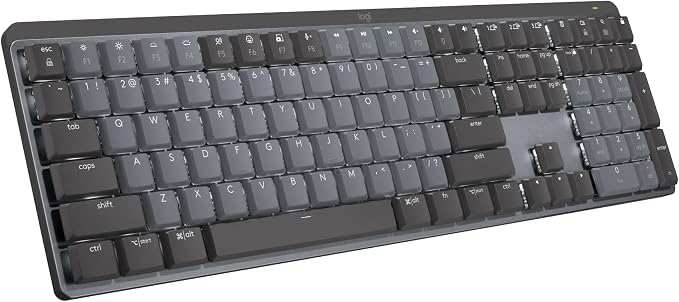
The Logitech MX Mechanical Tactile is a strong fit for Mac users who want a full-size productivity keyboard and still enjoy the feel of mechanical switches. We would especially consider it for accountants, analysts, administrators, and anyone who regularly works with numbers. official listing
Its low-profile Tactile Quiet switches give you a noticeable tactile bump without the pronounced clicking associated with clicky mechanical switches. That makes the keyboard better suited to a shared office or home workspace where excessive noise can become distracting. Logitech also provides more detail in its support guide.
The built-in smart illumination is another useful touch. Logitech says the keyboard uses an ambient light sensor to adjust the backlight, while the keys can illuminate as your hands approach. That means you can keep the backlight useful without having it running unnecessarily bright all the time.
For a busy workstation, Easy-Switch is particularly practical. The keyboard can connect to up to three devices through Bluetooth Low Energy or the Logi Bolt receiver, giving us an easy way to move between a Mac and other compatible devices. Multi-OS details also explain the broader compatibility and connectivity setup.
Mac support is clearly documented, including a Mac-specific layout and compatibility with macOS 10.15 or later. Logitech rates battery life at up to 15 days with backlighting enabled, or up to 10 months with the backlight turned off, according to its compatibility guide.
One important limitation is that the USB-C connection is intended for charging rather than wired keyboard data. We would therefore choose it when wireless use is the priority, rather than when a true wired fallback is essential. Logitech’s charging guidance explains this connection behavior.
A few cautions:
- Skip it if you specifically need a compact keyboard without a number pad.
- Look elsewhere if you need the USB-C cable to provide wired keyboard operation.
2. AULA F75 Pro Wireless Mechanical Keyboard

The AULA F75 Pro is a better match for Mac users who want a compact mechanical keyboard with plenty of enthusiast-friendly features. Its 75% layout removes the dedicated number pad while keeping the function row, arrow keys, and useful navigation controls.
Connectivity is one of its biggest strengths. The F75 Pro supports Bluetooth 5.0, 2.4GHz wireless, and USB-C wired operation, so you have several ways to connect it depending on the situation. Current specifications also list a 4000mAh rechargeable battery for extended wireless use, as shown in the current specifications.
There is plenty here for people who enjoy customizing mechanical keyboards. The board uses pre-lubricated LEOBOG Reaper switches, supports 3-pin and 5-pin hot-swappable switches, and includes PBT keycaps, RGB lighting, a gasket-mounted design, and a multifunction knob. Product details provide further information about these components.
That flexibility makes it useful beyond a basic office setup. You can keep the keyboard relatively compact while still having room to experiment with switches and customize parts of the experience. The 75% format also gives you more desk space around your mouse.
For Mac users, however, there is an important distinction between hardware compatibility and software support. Current listings document a Win/Mac mode, but the customization software is described as Windows-only. That means the keyboard itself can work with a Mac, while some advanced customization may remain unavailable on macOS. Compatibility notes outline that limitation.
We would use Bluetooth or the 2.4GHz receiver for wireless work and switch to USB-C when a direct connection makes more sense. Its main compromises come down to the compact layout and limited Mac-side software support rather than a lack of connection choices. The current specifications cover the available connection modes.
Notes of caution:
- Skip it if full software-based customization on macOS is essential to you.
- It may not be the right fit if your workflow relies heavily on a dedicated number pad.
3. Satechi SM3 Mechanical Keyboard, White LED Backlit
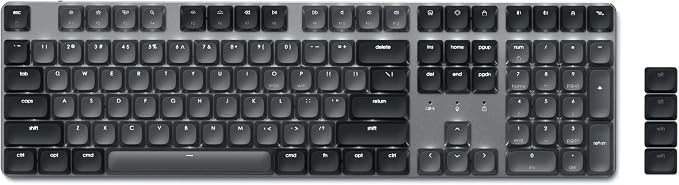
The Satechi SM3 makes sense for Mac users who want mechanical switches in a full-size, low-profile design. We would especially look at it for office work, spreadsheet-heavy tasks, and setups where a dedicated number pad is useful. Satechi’s official listing provides the core product details.
It uses low-profile brown tactile switches and a 108-key layout, so you keep the number pad without giving up the feel of mechanical keys. Satechi also includes adjustable backlighting with 14 patterns, giving you some flexibility when working in different lighting conditions.
Its connectivity is especially convenient for a multi-device desk. You can connect two Bluetooth devices, use the 2.4GHz USB-A receiver, or switch to USB-C wired mode. The keyboard also starts in Mac mode and includes Windows keycaps for people who move between operating systems. Satechi explains these options in its setup guide.
The rechargeable 2500mAh battery keeps the keyboard wireless between charges, while the USB-C port gives you a direct wired option when needed. Satechi’s documentation also covers Mac mode, pairing, charging, and sleep behavior in its manufacturer directions.
We also like that the manufacturer’s compatibility information is straightforward. It covers current Mac families and devices, making it easier to confirm whether the keyboard fits an existing Apple-centered workspace. The compatibility guide lays out the supported devices.
The biggest trade-off is simply the full-size footprint. The low-profile design keeps things visually slim, but it still occupies considerably more desk space than a 75% keyboard, particularly when you also need room for a larger mouse.
A few things to note:
- Skip it if you need a compact layout that leaves maximum room around your mouse.
- It may not suit you if hot-swappable switches and deeper keyboard customization are priorities.
4. Corsair K65 Plus Wireless RGB 75% Mechanical Gaming Keyboard
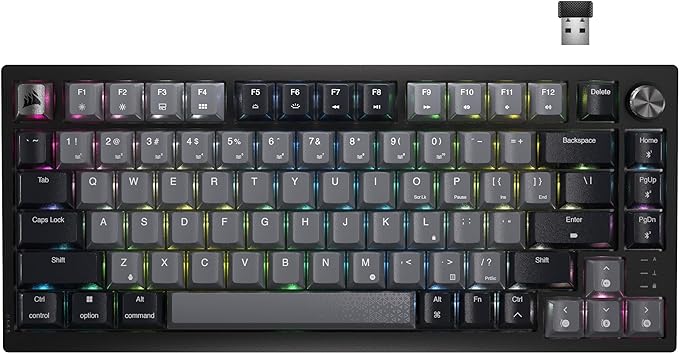
The Corsair K65 Plus Wireless is aimed at Mac users who want a compact mechanical keyboard with a more customizable, gaming-oriented feature set. Its 75% layout keeps the useful navigation controls while leaving more open space around the keyboard.
You get three connection options here: USB-C wired, 2.4GHz wireless, and Bluetooth. Corsair also provides a dedicated Win/Mac switch, making the transition between operating systems much simpler when the keyboard is shared between different devices. Its Mac support guide explains the supported setup.
The keyboard uses pre-lubricated CORSAIR MLX Red linear switches with a 45g actuation force, a 1.9mm actuation point, and 4.0mm total travel. It also has hot-swappable switches, PBT dye-sublimated keycaps, RGB lighting, and two layers of integrated sound dampening. Corsair’s current specifications document the hardware.
For Mac users who enjoy customizing their setup, iCUE adds another layer of control. The macOS version supports configuration features, although Corsair notes that accessibility permissions are required for some functions. Bluetooth also does not provide the full iCUE feature set, so your choice of connection matters. The setup guide explains those requirements.
Battery life is rated at up to 266 hours over 2.4GHz with RGB turned off. We would use Bluetooth when convenience matters most, then switch to the receiver or wired connection when greater functionality is more important. Corsair provides that figure in its battery specification.
Its main drawback is that it can feel more involved than a straightforward Mac productivity keyboard. Between iCUE, connection modes, and customization options, there is more to manage if you simply want to plug in and type.
A few cautions:
- Skip it if you want a minimalist Mac keyboard with almost no setup.
- Bluetooth users should know that some iCUE functionality is unavailable over that connection.
5. Satechi SM3 Mechanical Keyboard, White LED
The Satechi SM3 is another appealing choice for Mac users who want a full-size mechanical keyboard without moving to a taller traditional design. We would consider it for productivity-focused desks where the number pad earns its space. The official listing covers its main design and feature set.
Its low-profile brown switches provide tactile feedback without relying on a clicky switch design. The 108-key layout keeps the full number pad, while adjustable feet let you change the typing angle to better match your preferred desk position.
Satechi also gives you plenty of ways to connect it. The SM3 supports two Bluetooth connections, a 2.4GHz USB-A receiver, and USB-C wired operation. You can also switch between macOS and Windows modes using the documented keyboard shortcuts, as outlined in the manufacturer directions.
That makes it practical for mixed-device workspaces. Rather than being locked into one connection method, you can choose Bluetooth for convenience, the receiver for wireless desktop use, or USB-C when a wired connection is preferable.
The manufacturer’s support material is also useful for setup. It explains Mac mode, pairing, charging behavior, and sleep timings, while the compatibility guide covers current Mac hardware.
The trade-off is the same one that comes with any full-size keyboard: you need to give it enough desk space. And although it offers several useful features, it is not designed around enthusiast-focused switch customization in the way some smaller mechanical boards are.
A few things to note:
- Skip it if a compact 75% keyboard would suit your desk better.
- It may not be ideal if you want hot-swappable switches and extensive mechanical customization.
Final Thoughts
When choosing a wireless mechanical keyboard for Mac, we would start with the practical basics: reliable macOS support, a layout that suits your work, dependable connectivity, and a typing feel you genuinely enjoy. Software support deserves attention too, especially when customization is part of the appeal.
The best fit depends on how you work, how much desk space you have, and which features you will actually use. Think about your need for a number pad, device switching, wired connectivity, and advanced controls, then choose the keyboard that fits your everyday workflow most naturally.
Be First to Comment