Finding a smartphone tripod with a Bluetooth remote should be easy, but once we compare height, stability, framing, phone compatibility, and extras, the choices start to blur together. For a small business owner or home-office creator, that can make a simple purchase feel unnecessarily complicated.
The bigger problem is that these tripods are not really interchangeable. A tall stand can be excellent for standing videos but awkward to pack, while a flexible mini tripod can handle a railing or desk edge but cannot give you full standing height.
We dug through the category, compared the five models, checked their current product information, and picked options for different shooting needs. Our goal is to make the tradeoffs clear, so you can spend less time sorting through similar-looking listings and more time choosing confidently.
How We Selected the Best Smartphone Tripods
We started by looking at how each tripod fits the way you shoot. For business videos, tutorials, social posts, video calls, and product content, differences in height, stability, mounting, and setup can make a big difference.
We checked current product information and practical limitations. A tripod can look impressive on a listing while still being a poor fit for your workspace, phone, accessories, or routine.
- Fit for purpose: We looked at whether each design makes sense for standing videos, desk setups, travel, or flexible mounting.
- Remote usefulness: We considered how the included Bluetooth shutter helps you capture content without returning to the phone.
- Height and positioning: We checked adjustable height and head movement because easier framing means fewer repositioning sessions.
- Mounting flexibility: We considered phone clamps, 1/4-inch mounts, adapters, and accessory support for growing setups.
- Stability and build: We paid attention to construction and support design because your phone needs a dependable platform.
- Portability: We considered folded size and weight for anyone moving between workspaces or traveling.
These factors give us a clearer picture than a feature count. Each recommendation earns its place for a reason, so it is easier to jump to the setup that fits your routine.
Best Smartphone Tripods with Bluetooth Remotes
We’ve kept the lineup varied on purpose, so whether you need a tall stand, a travel-friendly option, or a flexible mini tripod, there’s a clear place to start.
1. UBeesize 72-Inch Phone Tripod & Selfie Stick
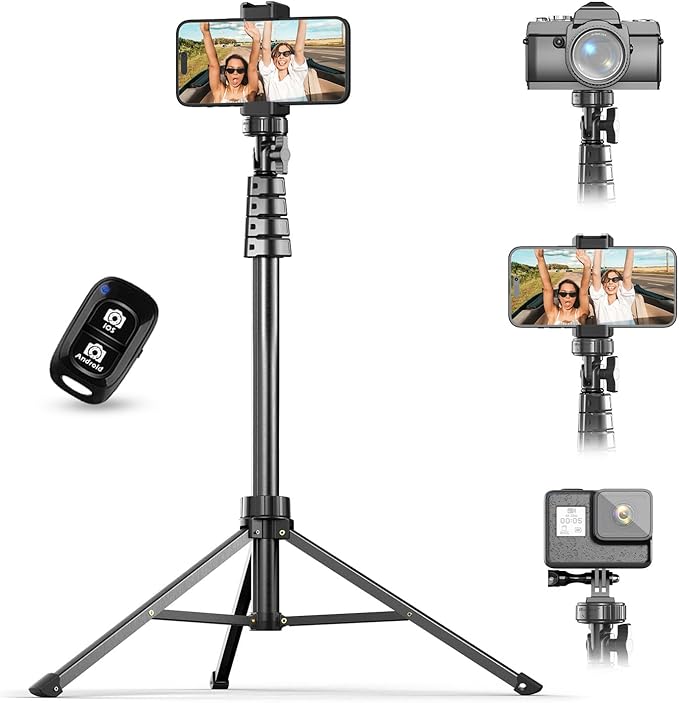
We’d match the UBeesize 72-inch tripod with solo entrepreneurs, educators, and home-office creators who want one setup for selfies, standing videos, and hands-free recording. Its tall reach gives us plenty of room to frame a person without crowding the phone.
The current product listing specifies an aluminum-alloy and stainless-steel build, plus a phone clamp designed for phones up to 5.7 inches wide. There’s also a cold shoe for a light or microphone and a universal 1/4-inch mount.
The combination lets us expand beyond a bare phone setup. The holder supports portrait or landscape shooting, and the head tilts up and down. The included wireless remote is rated for up to 30 feet, giving us useful distance for solo shots without crowding it.
Portability is the main compromise. The tripod folds to about 20 inches, so we’d think of it as a bag-friendly full-size stand rather than something for a small pocket. The warranty information also lists 12 months, which gives us clearer expectations after purchase.
For best results, we’d follow the basic setup in the official product listing: set the legs on a stable surface, extend the sections evenly, and frame the shot. We’d pair the remote first and make a quick test.
A few things to note:
- The roughly 20-inch folded length favors useful height over ultra-compact packing.
- We’d double-check the stated 5.7-inch phone-width limit when using a bulky case.
- It makes more sense for planned shooting setups than minimalist everyday carry.
2. Liphisy 64-Inch Tripod for Cell Phone & Camera
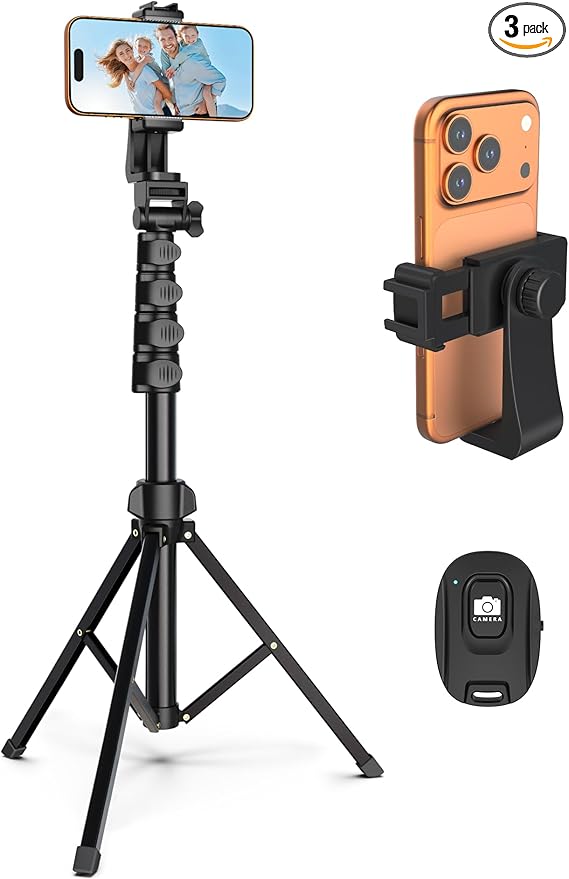
We’d choose the Liphisy 64-inch tripod for creators who want a familiar floor tripod that can move easily between desk-height work and standing shots. It fits home offices, presentations, travel content, and simple product videos where straightforward positioning matters more than unusual mounting.
The current listing describes aluminum-alloy and stainless-steel construction, with adjustment from 17 to 64 inches. Its head provides 210-degree rotation, while the phone holder rotates 360 degrees, giving us plenty of room to switch between portrait and landscape framing.
The included wireless remote lets us trigger the phone without reaching back to it. The current product details also show a standard 1/4-inch connection for compatible cameras and smartphones, which is handy when a creator’s setup grows.
The listed folded length is about 17.7 inches, with a stated weight of roughly 0.73 kilograms. Those figures appear in size and weight details. That is easier to carry than a larger floor tripod, giving us a practical middle ground for routine workdays.
For setup, we’d extend the legs and center sections evenly, lock each section firmly, and position the phone holder before framing. A quick stability check gives us more confidence before recording, especially when we are filming alone without touching the phone again during each take.
Notes of caution:
- Its 64-inch maximum height is lower than some full-height alternatives.
- Its conventional tripod shape is less suited to wrapping around rails, poles, or branches.
- We’d confirm the mount requirements before using heavier camera-and-accessory combinations.
3. Liphisy 72-Inch Metal Selfie Stick Tripod with Remote
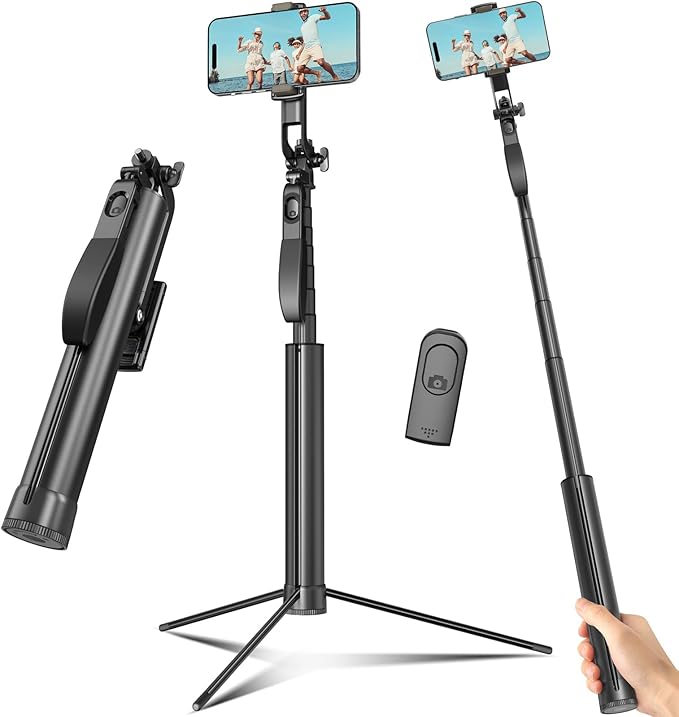
We’d pair the Liphisy 72-inch metal selfie-stick tripod with travelers and solo creators who want one tool that can work as both a selfie stick and a freestanding tripod. The design makes sense when we want useful reach without carrying a long traditional tripod.
The matching current listing identifies the SST01 and lists a maximum height of 72 inches with a minimum height of 11.8 inches. It also describes a 360-degree rotating holder and a 300-degree pan head for flexible framing.
The included wireless remote supports hands-free capture, while the camera connection gives us more flexibility than a phone-only stick. The metal construction and listed 1.4-pound weight also point toward a sturdier format than an ultra-light pocket selfie stick for creators on the move.
What stands out most is the range of positions. We can carry it closed, extend it for group shots, or set it down for stationary recording. The roughly 11.8-inch minimum height helps when compact storage matters, especially in smaller travel bags.
There is one important research caveat. We found conflicting listing details for this ASIN on other sites, so we’d verify the exact variant before ordering. Then we’d extend the sections evenly, lock the head, pair the remote, and stay within the intended mounting range.
A few things to note:
- We’d verify the exact 72-inch SST01 variant because third-party listings are inconsistent.
- The extended selfie-stick form is less discreet than a small desktop tripod.
- We’d favor it when we need height and portability together.
4. NEEWER TP34 Flexible Tripod with Remote
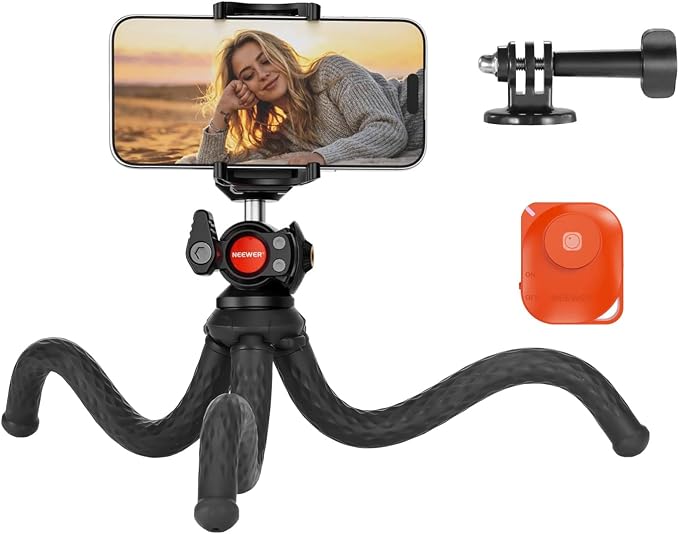
We’d pick the NEEWER TP34 for creators who need their phone to go somewhere a normal tripod cannot. It is especially useful for travel and hands-free content when we want to attach a setup to a desk edge, railing, pole, branch, or handlebar.
According to the official product page, its flexible legs use aluminum cores with a non-slip rubber exterior, and NEEWER rates the tripod for a 4.4-pound, or 2-kilogram, load. The metal ball head offers 360-degree swivel and 90-degree tilt.
The accessory selection is another strong point. We get a hidden phone holder, an action-camera adapter, and cold shoes for compatible accessories. The Bluetooth shutter reaches up to 33 feet, or 10 meters, unobstructed, so we can trigger the phone without touching it.
We also like how easy it is to pack. NEEWER lists the TP34 at about 11.8 by 3.1 by 2 inches and 10.3 ounces, or 292 grams. That gives us a compact option when a full-size floor tripod would be unnecessary baggage.
For best results, we’d wrap the legs securely around the support point, check that the grip is firm, and keep the load balanced. Before stepping away, we’d confirm the phone is properly held and the flexible legs are not slipping.
A few things to note:
- The TP34 is a mini tripod, so it cannot provide standing-height framing on its own.
- Irregular or narrow mounting surfaces deserve extra care before you leave the phone unattended.
- We’d keep the total load within NEEWER’s stated limit.
5. JOBY GorillaPod 1K Tripod Kit
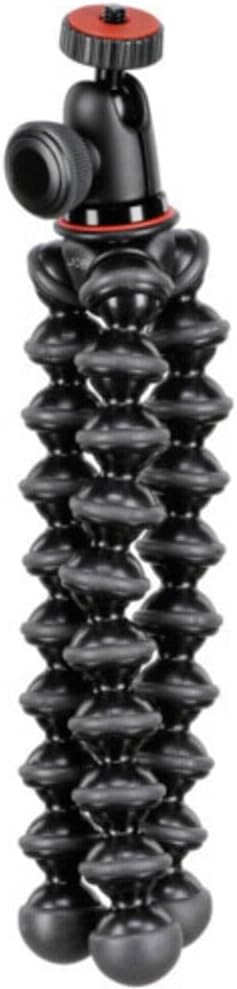
We’d consider the JOBY GorillaPod 1K Kit for creators who want flexible support for compact cameras or who plan to add a compatible smartphone mount. The kit combines the GorillaPod 1K stand with the BallHead 1K, making it a good fit for a modular setup.
The official product page lists support for devices up to 1 kilogram. Its flexible legs can grip, wrap around, or stand on surfaces, while the BallHead provides 360-degree panning and 90-degree tilt for easier angle changes during quick reframing and quick setups.
The standard 1/4-inch mount gives us room to expand with compatible accessories. JOBY says the BallHead can be removed for use on a standard tripod, while compatible GripTight mounts can add smartphone support. That helps when our gear changes over time.
There is one important distinction for this particular kit. The featured kit contents do not include a Bluetooth remote or phone holder, so this ASIN is not a complete remote-operated smartphone setup by itself.
JOBY also sells a newer 1K Gen 2 with a magnetic phone mount, but we should not confuse it with this kit. We’d confirm the generation, add compatible accessories, stay within the 1-kilogram limit, and secure the legs before framing each shot.
A few cautions:
- The featured kit does not include a Bluetooth remote.
- A separate compatible phone mount is needed for direct smartphone use.
- We’d keep heavier camera rigs outside its lightweight positioning sweet spot, particularly when stability matters more than portability in a busy setup.
Final Thoughts
Choosing a smartphone tripod gets easier when we focus on how we actually shoot, not the number of features on the box. We’d pay attention to stability, height, remote range, mounting options, and portability, because those details shape everyday use.
From there, match the tripod to your workspace, shooting style, and gear. A good choice should make framing and hands-free recording feel routine rather than fiddly. When the support matches your workflow, creating content becomes one less thing to wrestle with.
Be First to Comment