
A company’s mission and vision statements do more than look good on an About page. For large, publicly traded companies, these statements signal strategic intent to investors, employees, customers, and competitors alike. They answer two questions every serious brand must resolve: what are we doing right now, and where are we going?
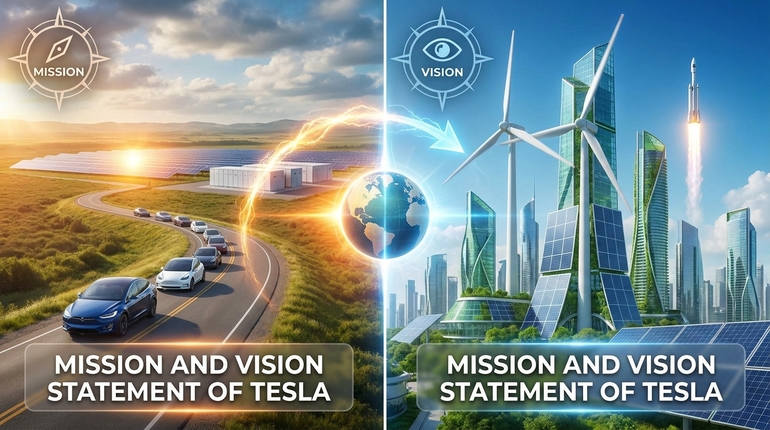
Tesla is one of the clearest examples of a company whose mission and vision statement of Tesla have shaped every major decision since its founding in 2003. Tesla’s official mission statement is: “To accelerate the world’s transition to sustainable energy.” The company does not publish a separate, standalone vision statement on its current website. Instead, it has historically operated under the directional statement: “To create the most compelling car company of the 21st century by driving the world’s transition to electric vehicles.”
Those two statements carry a lot of weight. Together, they explain why Tesla sells solar panels and home battery systems alongside cars, why it prices vehicles the way it does, and why its engineers think differently from those at legacy automakers. The sections below break down what each statement means, how they differ, and what any brand can learn from them.
What Is Tesla’s Mission Statement?
“To accelerate the world’s transition to sustainable energy.”
This is short, unusually clear, and notably free of corporate jargon. Most company mission statements are full of vague language about “delivering value” or “serving customers.” Tesla’s does neither. It names a specific global outcome (transition to sustainable energy) and defines Tesla’s role in relation to that outcome (accelerator, not just participant).
The word “world’s” is deliberate. Tesla is not positioning itself as a regional player or a niche product company. It is claiming a global scope of impact. The statement also says nothing about cars specifically, which is worth noting. By 2026, Tesla operates energy storage products, solar roof tiles, and a Supercharger network, all of which sit comfortably under this mission without requiring any rewrite. That kind of flexibility is a sign of a well-built mission statement. It sets the purpose without locking the company into a single product line.
101 Mission Statements is for you if:
- You’re a leader or entrepreneur needing a clear, inspiring statement of intent for your business or nonprofit.
- You want your team and clients aligned with a shared vision of excellence and long-term goals.
- You need a step-by-step guide to craft a customized mission statement that acts as a blueprint for future success.
What Is Tesla’s Vision Statement?
“To create the most compelling car company of the 21st century by driving the world’s transition to electric vehicles.”
Tesla does not currently publish this as a formal, updated vision statement on its main website. This language comes from an official Tesla presentation in 2011 and has been cited consistently in SEC filings and investor materials over the years. It remains the most widely recognized directional statement the company has used, and no formal replacement has been issued as of 2026.
The vision is forward-looking in a way the mission is not. Where the mission describes what Tesla is doing now, the vision describes what Tesla wants to be: the defining car company of an entire century. That is an audacious claim. It sets a competitive benchmark that is not just about unit sales but about shaping how the entire industry operates. The phrase “driving the world’s transition to electric vehicles” also echoes the mission closely, which is a structural choice worth noting. The two statements reinforce each other rather than pointing in separate directions.
Key Differences Between Tesla’s Mission and Vision
| Factor | Mission Statement | Vision Statement |
|---|---|---|
| Focus | Current activities and purpose | Long-term aspirational destination |
| Timeframe | Present-oriented | Future-oriented (21st century) |
| Primary Audience | Employees, partners, and the public | Investors, industry, and future customers |
| Core Question Answered | What do we do and why? | What do we want to become? |
| Purpose | Defines Tesla’s role in the energy transition | Positions Tesla as the century’s defining car company |
The mission tells people what Tesla does every day. The vision tells them what all of that daily effort is building toward. Read separately, each statement is strong. Read together, they form a coherent picture: a company executing a present purpose in service of a much larger future ambition.
Core Values Behind Tesla’s Mission and Vision
Tesla’s stated core values, as reflected in its ESG reports, hiring materials, and public communications, include the following:
- Doing the best: Tesla sets an expectation of excellence across engineering, manufacturing, and customer experience, treating mediocrity as incompatible with its mission.
- Taking risks: The company actively encourages employees to pursue bold ideas, which connects directly to the scale of change embedded in its mission and vision.
- Respect: Tesla applies this value both internally (toward employees and their working conditions) and externally (toward suppliers, customers, and affected communities).
- Constant learning: In a company that operates at the edge of battery science, software development, and factory automation, an institutional appetite for learning is not optional. It is structural.
- Environmental consciousness: This value is the clearest link between Tesla’s day-to-day behavior and its stated mission. It shows up in material sourcing decisions, factory design, and product development priorities.
These values do not operate in isolation. The combination of risk-taking and constant learning is what allows Tesla to attempt things that established automakers have historically avoided. Remove either value, and the mission becomes far harder to execute.
How Tesla Lives Its Mission and Vision
Tesla’s business structure is one of the most visible expressions of its mission. Rather than outsourcing key components the way most automakers do, Tesla manufactures its own battery cells, develops its own vehicle software, and operates its own retail and service network. This vertical integration is not just a cost strategy. It is a direct result of a mission that requires controlling the pace of change rather than waiting on suppliers or partners to keep up.
The Supercharger network is another example. Most automakers sold cars and left charging infrastructure to third parties. Tesla built its own global network of fast chargers, a decision that required enormous capital but reduced the single biggest barrier to EV adoption: range anxiety. By 2026, Tesla’s Supercharger network has surpassed 75,000 stalls globally, making it the largest fast-charging network in the world. That is a mission-driven infrastructure investment, not a profit-maximizing one.
Tesla’s energy products tell a similar story. The Powerwall home battery and the Megapack utility-scale storage system extend Tesla’s mission beyond transportation entirely. In Q4 2024, Tesla’s energy generation and storage segment posted revenue growth of 113% year over year, demonstrating that the “sustainable energy” framing of the mission was always meant to be taken literally, not just as a reference to electric cars.
Tesla’s approach to software also reflects the vision. Over-the-air (OTA) updates allow Tesla to improve vehicle performance, safety features, and functionality after the car has been purchased and delivered. This model, borrowed from the software industry, treats the car as a platform rather than a finished product. It is the kind of thinking that belongs to a company that genuinely believes it is building the most compelling car company of a century.
How Tesla’s Mission and Vision Have Evolved
Tesla was founded in 2003 by Martin Eberhard and Marc Tarpenning, with Elon Musk joining as chairman and lead investor shortly after. The original purpose was straightforward: prove that electric cars could outperform gasoline alternatives. At that early stage, the company’s direction was defined less by a formal statement and more by the product itself, the Tesla Roadster.
The clearest early articulation of Tesla’s purpose came in August 2006, when Musk published a blog post titled “The Secret Tesla Motors Master Plan (just between you and me).” In it, he wrote that the overarching purpose of Tesla was “to help expedite the move from a mine-and-burn hydrocarbon economy towards a solar electric economy.” That language is strikingly close to Tesla’s current mission statement, which means the core purpose has remained remarkably stable over nearly two decades. What changed was the scope.
The 2011 vision statement focused specifically on electric vehicles and the car industry. The current mission statement drops the automotive specificity entirely and speaks only of “sustainable energy.” That shift reflects how Tesla has grown. It is no longer purely a car company. It is an energy company that also happens to make the best-selling electric vehicles in the world. The evolution of the language tracks the evolution of the business, which is exactly what a living mission statement should do.
What Your Company Can Learn from Tesla’s Statements
Tesla’s mission and vision offer several concrete lessons for anyone working on brand strategy or company positioning.
Specificity beats inspiration. Tesla’s mission statement does not say “make the world a better place” or “lead the future of transportation.” It names a specific transition and a specific role. When writing your own mission statement, test it against this question: would a competitor be embarrassed to copy this word for word? If the answer is no, the statement is too generic.
Here are three additional takeaways worth building into your own process:
- Let your mission outlive your first product. Tesla’s mission says nothing about cars, which is why it still works now that the company sells solar roofs and grid storage. If your mission is tied too tightly to a single product, it will need rewriting the moment you expand.
- Make the vision genuinely ambitious. “Most compelling car company of the 21st century” is a 100-year claim. That kind of ambition gives employees and investors a long time horizon to work within. Vague aspirations like “be the leader in our industry” do not carry the same weight.
- Keep the mission and vision aligned. Tesla’s mission (accelerate the energy transition) and vision (define the car company of the century through EV adoption) point in the same direction. They do not create internal tension. If your mission and vision pull toward different outcomes, your teams will feel that conflict in everyday decisions.
Frequently Asked Questions
Q: What is Tesla’s current mission statement? Tesla’s official mission statement is “To accelerate the world’s transition to sustainable energy.” This statement appears in the company’s SEC filings, annual reports, and public communications. It has been Tesla’s formal mission since at least 2016, when the company broadened its focus beyond electric vehicles to include solar and energy storage products.
Q: What is Tesla’s vision for the future? Tesla’s most widely cited vision statement is “To create the most compelling car company of the 21st century by driving the world’s transition to electric vehicles.” This statement originated in a 2011 Tesla presentation. Tesla does not currently publish a revised, standalone vision statement on its website, so this remains the primary directional statement associated with the company.
Q: Does Tesla have a separate tagline from its mission statement? Tesla does not operate with a traditional advertising tagline in the way that many consumer brands do. The company spends virtually nothing on paid advertising. Its mission statement effectively functions as its public-facing directional phrase, and Elon Musk’s public communications often serve the awareness-building role that a tagline might play at other companies.
Q: How does Tesla’s mission statement reflect its brand identity? Tesla’s brand identity is built around performance, technology, and environmental purpose. The mission statement captures the last of these most directly. By framing Tesla’s work as accelerating a global transition rather than simply selling cars, the statement positions Tesla as a company with a cause rather than a product, which shapes everything from its marketing approach to its hiring pitch.
Q: Has Tesla’s mission or vision statement ever changed? The mission statement has evolved. Musk’s 2006 blog post described Tesla’s purpose as helping move from a “mine-and-burn hydrocarbon economy” to a solar electric one. By 2011, the vision statement had been formalized around electric vehicles specifically. By 2016, the mission had shifted to “sustainable energy” broadly, dropping the automotive specificity. The core intent has stayed consistent; the language has widened as the business has grown.
Q: What core values guide Tesla? Tesla’s core values include doing the best, taking risks, respect, constant learning, and environmental consciousness. These appear in ESG documentation and internal materials. The company also operates with internal principles that include moving fast, pursuing what others consider impossible, and thinking with an ownership mindset.
Q: How does Tesla put its mission into practice? Tesla puts its mission into practice through several concrete business decisions: building its own Supercharger network to accelerate EV adoption, manufacturing energy storage products for homes and utilities, developing over-the-air software updates that improve vehicles after purchase, and vertically integrating its manufacturing to control the speed of its own development. Each of these is a mission-aligned choice that a purely profit-focused company would likely not have made.
Final Thoughts
Tesla’s mission and vision statements stand out for two reasons: they are unusually clear, and they have remained directionally consistent across more than two decades of company growth. The mission tells you exactly what Tesla is doing and why. The vision, though no longer formally updated on the company’s website, tells you what all of that work is supposed to produce. Together, they reveal a company that knew what it was for before it knew exactly what it would sell.
Tesla’s statements are worth studying not because the company is without controversy, but because the statements themselves are genuinely well-constructed. If you are working on your own company’s mission or vision, take a close look at how Tesla builds specificity without narrowness and ambition without vagueness. What do you think of Tesla’s approach to its mission? Share your thoughts in the comments below.
101 Mission Statements is for you if:
- You’re a leader or entrepreneur needing a clear, inspiring statement of intent for your business or nonprofit.
- You want your team and clients aligned with a shared vision of excellence and long-term goals.
- You need a step-by-step guide to craft a customized mission statement that acts as a blueprint for future success.
Be First to Comment